How To Tell If Jade Bracelet Is Real
Table of Contents
- 10-Second Executive Summary / The Verdict Box
- Why Authenticity Matters Before You Buy
- 6 At-Home Tests to Tell If a Jade Bracelet Is Real
- 1. Temperature and Weight Test
- 2. Tap and Sound Test
- 3. Backlight and Surface Inspection
- 4. Scratch Test (Use with Caution)
- 5. Color and Texture Consistency Check
- 6. Weight-in-Hand Comparison
- Color, Texture, and Natural Imperfections
- The Most Reliable Check: Certificate and Lab Verification
- Decision Table: At-Home Checks vs. Lab Verification
- Common Fake Materials and Red Flags to Avoid
- How Lumina Quartz Helps You Shop Real Jade with Confidence
- Frequently Asked Questions
- How can I tell if my jade bracelet is real or fake at home?
- Does real jade feel cool to the touch and stay cool longer than fake?
- What does real jade sound like when tapped?
- Is a certificate or lab report necessary to confirm jade authenticity?
You can tell a real jade bracelet from a fake by combining simple physical checks — surface temperature, weight, tap sound, backlight inspection, and color variation — and then confirming with a gemological lab certificate, which is the only definitive test. No single at-home method is conclusive on its own, but together they reveal clear red flags in glass, plastic, dyed quartz, and polymer-treated stone.
10-Second Executive Summary / The Verdict Box
- Direct Verdict: Real jade (jadeite or nephrite) reads cool, feels dense for its size, rings clearly when tapped, and shows natural color variation. Glass, plastic, and treated stone usually fail at least two of these checks. A lab certificate is the final word.
- Mohs Hardness: Jadeite ≈ 6.5–7; Nephrite ≈ 6–6.5. Both are softer than quartz (7), so jade can be scratched by harder materials and is not indestructible.
- Specific Gravity (density): Jadeite ≈ 3.33; Nephrite ≈ 2.95. This density is why real jade feels heavier than glass or plastic of the same size.
- Refractive Index: Jadeite ≈ 1.66; Nephrite ≈ 1.61–1.63 — measurable only by a lab, not at home.
- Best For: Home screening before purchase using the five-check routine below, plus a certificate check for any bracelet above entry-level price.
Why Authenticity Matters Before You Buy
Jade is one of the most imitated gem materials in the world, and the price gap between natural jadeite, treated jadeite, and lookalikes such as glass or dyed quartz is enormous. What you pay for in real jade is not just appearance but durability and integrity: natural, untreated stone holds its color and structure for generations, while dyed or polymer-impregnated material may fade, discolor, or degrade over time. Buying without verification means you may pay natural-jade prices for a treated or synthetic piece — and you may not find out until the color shifts or a crack appears.
Authenticity also matters for how you care for the bracelet. Natural jade tolerates normal wear but is softer than quartz and can be chipped or scratched; treated and imitation materials often have different cleaning limits. Knowing what you own lets you protect it correctly. At Lumina Quartz, our Lumina Grade AAA Integrity Standard means natural rough stone, no chemical resin filling, and no irradiation or dye treatment — the baseline we believe any honest jade listing should meet.
6 At-Home Tests to Tell If a Jade Bracelet Is Real
These tests are screening tools, not proof. Use several together, and treat any single failed check as a reason to slow down and verify further. Handle the bracelet gently and never force a test on a piece you have not yet bought.
1. Temperature and Weight Test
Real jade is a dense, crystalline stone. Held in your hand, it typically feels noticeably cool at first touch and warms only slowly, and it feels heavier than a glass or plastic bracelet of the same size because of its higher specific gravity (jadeite ≈ 3.33, nephrite ≈ 2.95 versus roughly 2.4–2.6 for glass). Imitation glass or resin often feels light and warms quickly. Caution: this is a comparative test — hold a known glass bead beside the bracelet to feel the difference, and remember that a cold room or a thick bracelet can mislead you.
2. Tap and Sound Test
Gently tap the bracelet with a small, soft object such as a wooden chopstick or the flat of a fingernail, and listen. Natural, untreated jade usually produces a clear, resonant, bell-like tone that lingers briefly. Glass can also ring, so the sound alone does not prove jade — but a dull, flat thud is a common sign of plastic, resin, or a heavily fractured or treated piece. Never strike jade with metal or another hard stone; jade is only 6–7 on the Mohs scale and can chip.
3. Backlight and Surface Inspection
Hold the bracelet against a bright light or use a phone flashlight behind it. Natural jade usually shows a slightly fibrous or granular internal texture, with color that varies subtly rather than sitting in perfectly even layers. Look for: trapped round air bubbles (typical of glass), a perfectly uniform cloudy haze (common in dyed or polymer-filled stone), or dye gathering in fine surface cracks (a classic sign of dyed material). A loupe or phone macro lens helps here.
4. Scratch Test (Use with Caution)
Because jadeite is only about 6.5–7 and nephrite about 6–6.5 on the Mohs scale, a steel file or a piece of quartz can scratch real jade. This test is genuinely risky: it can permanently damage a bracelet, and it cannot distinguish natural jade from dyed jade or from materials of similar hardness. If you must test, do it on an inconspicuous inner edge, and accept that a scratch proves only that the material is softer than your tool — not that it is natural jade.
5. Color and Texture Consistency Check
Natural jade almost never has perfectly even color. Look for gentle variation, subtle mottling, and a fine interlocking grain visible at the surface. Perfectly uniform color combined with perfectly uniform translucency is more typical of glass or treated stone than of natural jade.
6. Weight-in-Hand Comparison
Weigh the bracelet against a known reference of similar size — a glass bangle, a plastic bangle, or a kitchen scale reading. A real jadeite bracelet of a given volume should feel and weigh noticeably more than glass, and clearly more than plastic. Record the weight: it becomes your baseline if you compare two bracelets of the same dimensions.
Color, Texture, and Natural Imperfections
Real jade is rarely flawless, and its imperfections are often its best evidence. Natural stones commonly show fine internal lines, small mineral inclusions, slight cloudy patches, and uneven saturation across the bracelet. These features are consistent with natural formation and are often accepted — even prized — in fine jade. What should raise concern is the opposite: a bracelet with perfectly uniform color, no visible grain, and identical translucency everywhere, especially if the color sits in surface cracks rather than within the stone. Natural jade may also show a slightly "greasy" or waxy luster rather than the hard, glassy shine of imitation materials.
The Most Reliable Check: Certificate and Lab Verification
At-home tests can filter obvious fakes, but they cannot confirm that a stone is natural, untreated jadeite or nephrite. Only a gemological laboratory can measure refractive index, specific gravity, and internal structure to confirm species and detect treatment. For any bracelet at a meaningful price, ask for a certificate from a recognized gemological lab and verify that the report number matches the piece — check the weight, dimensions, and photograph on the report against the bracelet in hand. A seller who cannot or will not provide verifiable lab documentation is a red flag, regardless of how good the stone looks. Our Lumina Grade AAA Integrity Standard is built around this principle: every piece should be traceable to natural, untreated material, with documentation you can check yourself.
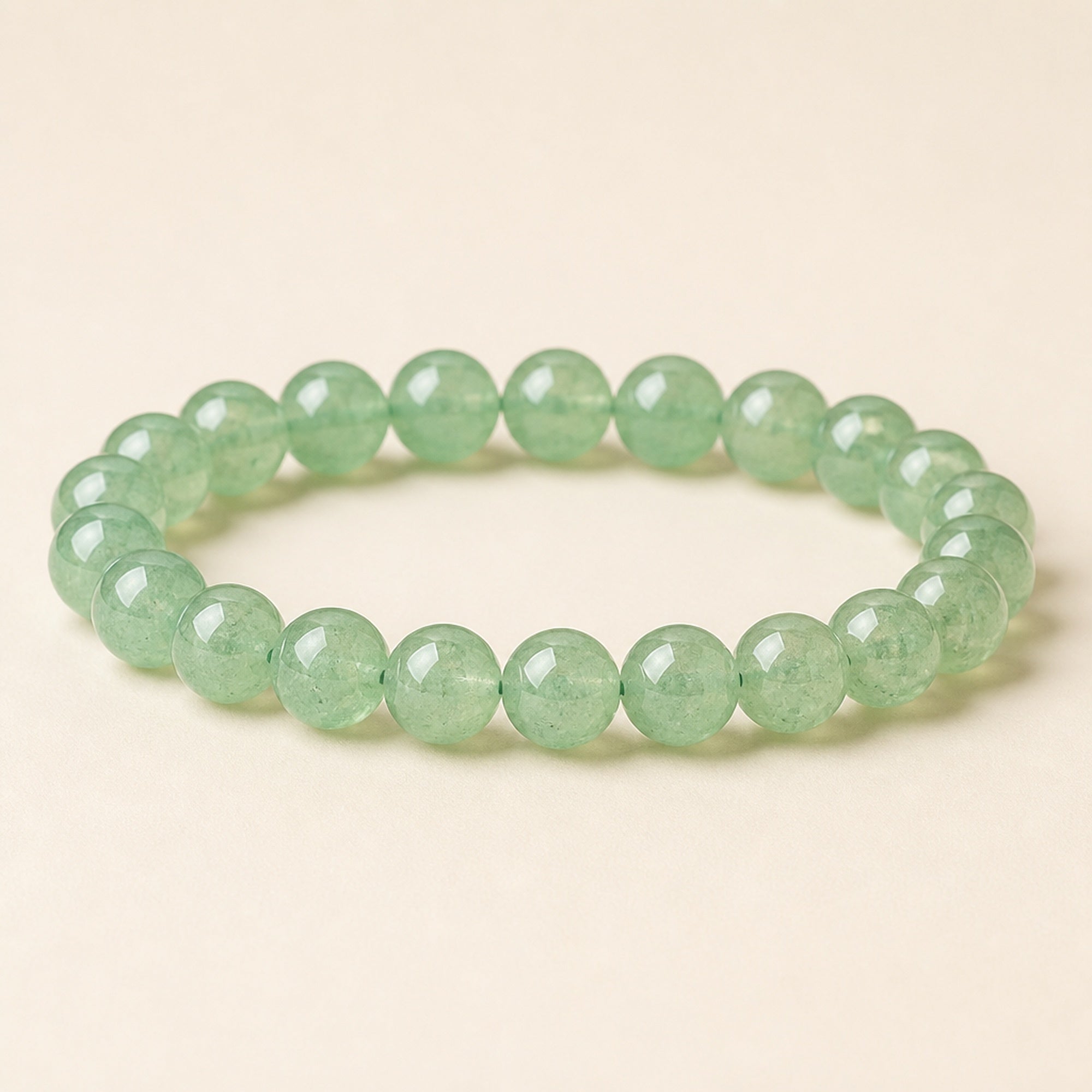
A related color-family option
Green Strawberry Quartz Bracelet – Gentle Renewal
This broader color-family option is not presented as Jade. We only identify jewelry as Jade when that exact material is verified.
Explore this related optionDecision Table: At-Home Checks vs. Lab Verification
| Check | What a Real Jade Bracelet Usually Shows | Common Fake Signal | Can It Prove Authenticity? |
|---|---|---|---|
| Temperature & weight | Cool at first touch, warms slowly, feels dense | Light, warms quickly (glass/resin) | No — screening only |
| Tap sound | Clear, resonant tone | Dull thud (plastic, heavily treated) | No — glass also rings |
| Backlight inspection | Fibrous/granular texture, subtle variation | Bubbles, uniform haze, dye in cracks | No — strong indicator |
| Scratch test | Can be scratched by quartz/steel (Mohs 6–7) | — | No — damages piece, low value |
| Color variation | Natural mottling, uneven saturation | Perfectly uniform color and translucency | No — supporting evidence |
| Lab certificate | RI, SG, and structure match natural jadeite/nephrite | No report, mismatched weight or photo | Yes — the only definitive check |
Boundary of this method: Home checks are best used to reject obvious fakes and to decide whether a piece is worth paying for lab verification. They cannot detect high-quality polymer treatment or distinguish natural from dyed jade of the same species.
Common Fake Materials and Red Flags to Avoid
- Glass ("imitation jade"): Often too light, warms fast, may show round bubbles under backlight, and can ring convincingly when tapped.
- Plastic and resin: Light in hand, warm quickly, dull when tapped, and may show mold seams.
- Dyed quartz or dyed stone: Color often concentrates in cracks; may be harder than jade and uniformly saturated.
- Treated jadeite (B/C jade): Natural jadeite that has been bleached and polymer-filled or dyed — looks real to most home tests, which is why lab verification matters.
- Red-flag pricing and pressure: Prices far below market for vivid green "jade," urgent sales language, no return policy, or refusal to share a certificate number.
These cultural and market associations are widely reported in gem trade practice, but they are not proof of authenticity by themselves — always pair them with the checks above.
How Lumina Quartz Helps You Shop Real Jade with Confidence
We built the Lumina Grade AAA Integrity Standard so that the hard questions are answered before you ask them: natural rough stone, no chemical resin filling, no irradiation or dye treatment, and documentation you can verify against the piece itself. When you shop with us, use the six checks above as your own screening routine, then match the certificate to the bracelet — weight, dimensions, and photograph. If a piece does not meet both tests, it does not meet our standard. Real jade is a quiet, grounding companion; you should be able to trust it as much as you enjoy it.
Frequently Asked Questions
How can I tell if my jade bracelet is real or fake at home?
Combine several checks: it should feel cool and dense, ring clearly when gently tapped, show natural color variation under backlight, and weigh more than glass of the same size. Treat these as screening only — a lab certificate is the only definitive confirmation.
Does real jade feel cool to the touch and stay cool longer than fake?
Natural jade typically feels cool at first touch and warms slowly because of its high density and thermal properties. Glass and resin often feel lighter and warm faster, but this is a comparative test and not proof on its own.
What does real jade sound like when tapped?
Untreated natural jade usually gives a clear, resonant, bell-like tone that lingers briefly. A dull thud often suggests plastic or heavily treated material, though glass can also ring, so sound alone is not conclusive.
Is a certificate or lab report necessary to confirm jade authenticity?
Yes, for any meaningful purchase. A gemological lab report that matches the bracelet's weight, dimensions, and photograph is the most reliable confirmation that the stone is natural, untreated jadeite or nephrite.
Jade's cultural symbolism and personal-reminder uses are distinct from its verified mineral properties. This article does not make medical claims. Mohs hardness, specific gravity, and refractive index values are standard mineralogical references and should be confirmed on a lab report for any specific piece. © 2026 Lumina Quartz.