Green Jade Crystal: Meaning, Healing Properties, and Daily Benefits

Table of Contents
- 10-Second Executive Summary / The Verdict Box
- What Green Jade Is: Mineral Nature, History, and Cultural Meaning
- Green Jade's Core Meanings: Harmony, Compassion, and Steady Prosperity
- Green Jade's Healing Properties: Body, Emotion, and Spirit
- Heart Chakra and Emotional Balance
- Traditional Health Claims and Their Safety Boundary
- Daily Benefits of Green Jade: Good Fortune, Manifestation, and Career Growth
- How to Use Green Jade in Daily Life: Wearing, Meditation, and Space
- Green Jade vs. Other Green Healing Stones—and How to Choose Real Jade
- Decision Table: Is Green Jade the Right Stone for Your Goal?
- Care and a Grounded Perspective: What Science Says and Common Questions
- What are the main meanings and benefits of green jade?
- Does green jade help the heart chakra and emotional health?
- Is green jade suitable for daily wear, and how should I care for it?
- Sources
Green jade is an umbrella term for jadeite and nephrite—two tough, interlocking-crystal stones that GIA classifies together as "jade"—and its reputation rests on three things you can actually verify: remarkable toughness (which makes it wearable for decades), a deep cultural lineage as a symbol of wisdom and heaven, and a widely held symbolic association with harmony, compassion, and steady prosperity. If you want the short answer to "what are green jade crystal benefits," it is this: as a mineral it offers durability and lasting beauty, and as a cultural and personal talisman it is traditionally associated with calm, goodwill, and grounded good fortune—not with medical treatment.
10-Second Executive Summary / The Verdict Box
- Direct Verdict: Green jade is a durable, low-hassle gemstone best valued for beauty, cultural meaning, and personal intention—buy it as a talisman and an heirloom-grade material, not as a medical remedy.
- What it is: A generic name covering jadeite (NaAlSi₂O₆), nephrite (Ca₂(Mg,Fe)₅Si₈O₂₂(OH)₂), and under certain conditions green omphacite.
- Mohs Hardness: 6.0–6.5 for nephrite; 6.5–7 for jadeite (GIA).
- Specific Gravity: about 2.95 (nephrite) and 3.34 (jadeite).
- Key practical edge: Its interlocking crystal structure makes jade "exceptionally tough," per GIA—one reason it survives daily wear better than many softer or more brittle green stones.
- Best for: Everyday pendants, bangles, and rings; meditation anchors; desk or entryway placement; gifts tied to harmony and good fortune.
- Quality standard to ask for: Natural, untreated stone—the Lumina Grade AAA Integrity Standard (natural rough, zero chemical resin-filling, no irradiation or dye).
- Boundary: Cultural symbolism and personal reminders only. No claim here is a substitute for medical or mental-health care.
What Green Jade Is: Mineral Nature, History, and Cultural Meaning
"Jade" is not one mineral. GIA defines it as a generic term for nephrite, jadeite, and, under certain conditions, green omphacite—three distinct materials with different chemistry and slightly different hardness (jadeite 6.5–7 on the Mohs scale; nephrite 6.0–6.5). Both jadeite and nephrite are metamorphic rocks made of tiny interlocking mineral crystals, and that structure is why jade is so tough.
Historically, jade is one of humanity's oldest worked stones. GIA notes that Stone Age craftspeople shaped this "toughest of gems" into weapons, tools, ornaments, and ritual objects, and that in China a pierced jade disk served as a symbol of heaven. That dual identity—practical tool and sacred object—is the honest foundation for everything people say about green jade today: its cultural weight is real and documented, while its energetic "benefits" are symbolic and personal.
Green Jade's Core Meanings: Harmony, Compassion, and Steady Prosperity
Across cultures, green jade is most often associated with harmony, sincerity, and compassionate strength. In Chinese tradition it is linked to virtue, wisdom, and heaven itself—meanings carried by carved disks and ritual objects rather than by any laboratory finding. In modern crystal practice, green jade is often associated with gentle stability: the feeling of a calm center that lets you respond rather than react.
Prosperity is the second major theme. Green jade is traditionally treated as a stone of "quiet wealth"—not sudden windfalls, but steady, earned growth. Read this as a symbol system you can use for reflection, not a promise of financial outcomes. When people describe green jade as bringing good luck, they are usually describing a mindset: patience, consistency, and goodwill toward others.
Green Jade's Healing Properties: Body, Emotion, and Spirit
Heart Chakra and Emotional Balance
In chakra-based traditions, green stones are associated with the heart center, and green jade is often associated with compassion, forgiveness, and relational ease. Used as a mindfulness anchor—held during breathing, worn as a reminder—it may support a calmer emotional tone for some people. Be clear about the boundary: this is a symbolic and ritual practice, not a treatment. Green jade does not regulate the nervous system, stabilize mood, or address compulsive thinking, and no credible mineral evidence supports those claims.
Traditional Health Claims and Their Safety Boundary
Older traditions, especially in East Asia, attributed protective and restorative qualities to jade. Those are cultural beliefs, not verified medical effects, and GIA's material fact sheet describes jade's properties in mineral and treatment terms—not therapeutic ones. If you are drawn to jade for wellbeing, treat it as a companion to good habits: sleep, movement, honest conversation, and professional care when needed.
Daily Benefits of Green Jade: Good Fortune, Manifestation, and Career Growth
The practical benefits of green jade are easiest to see in how people use it:
- As a daily anchor for intention. A pendant or bangle you touch before a meeting or decision can serve as a cue to pause, breathe, and act with integrity—an old idea dressed in a beautiful material.
- As a symbol of steady progress. Green jade's cultural link to earned prosperity fits a career mindset of consistency over hustle: keep the stone visible on your desk as a reminder to do the patient, unglamorous work.
- As a relationship talisman. Because it is often associated with compassion, jade is a common gift for reconciliations, new beginnings, and long partnerships.
- As a durable everyday piece. Jade's toughness means a well-chosen piece can be worn, not shelved—so the meaning stays with you instead of living in a drawer.
How to Use Green Jade in Daily Life: Wearing, Meditation, and Space
Wearing. Pendants and bangles are the classic formats; jadeite's 6.5–7 hardness handles daily wear well, though it can still chip against harder stones such as diamond. Remove bangles for heavy lifting or contact sports, and avoid sudden temperature swings that stress any stone over time.
Meditation. Hold a smooth cabochon or tumbled piece against your palm, set an intention tied to harmony or patience, and use the stone as a physical cue to return your attention to the breath. Ten minutes is plenty; consistency matters more than duration.
Space. Place a jade piece at an entryway or on a work desk as a visual reminder of the tone you want in that room—calm at home, integrity at work. Keep it out of direct, prolonged sunlight if you want to preserve its color over years.
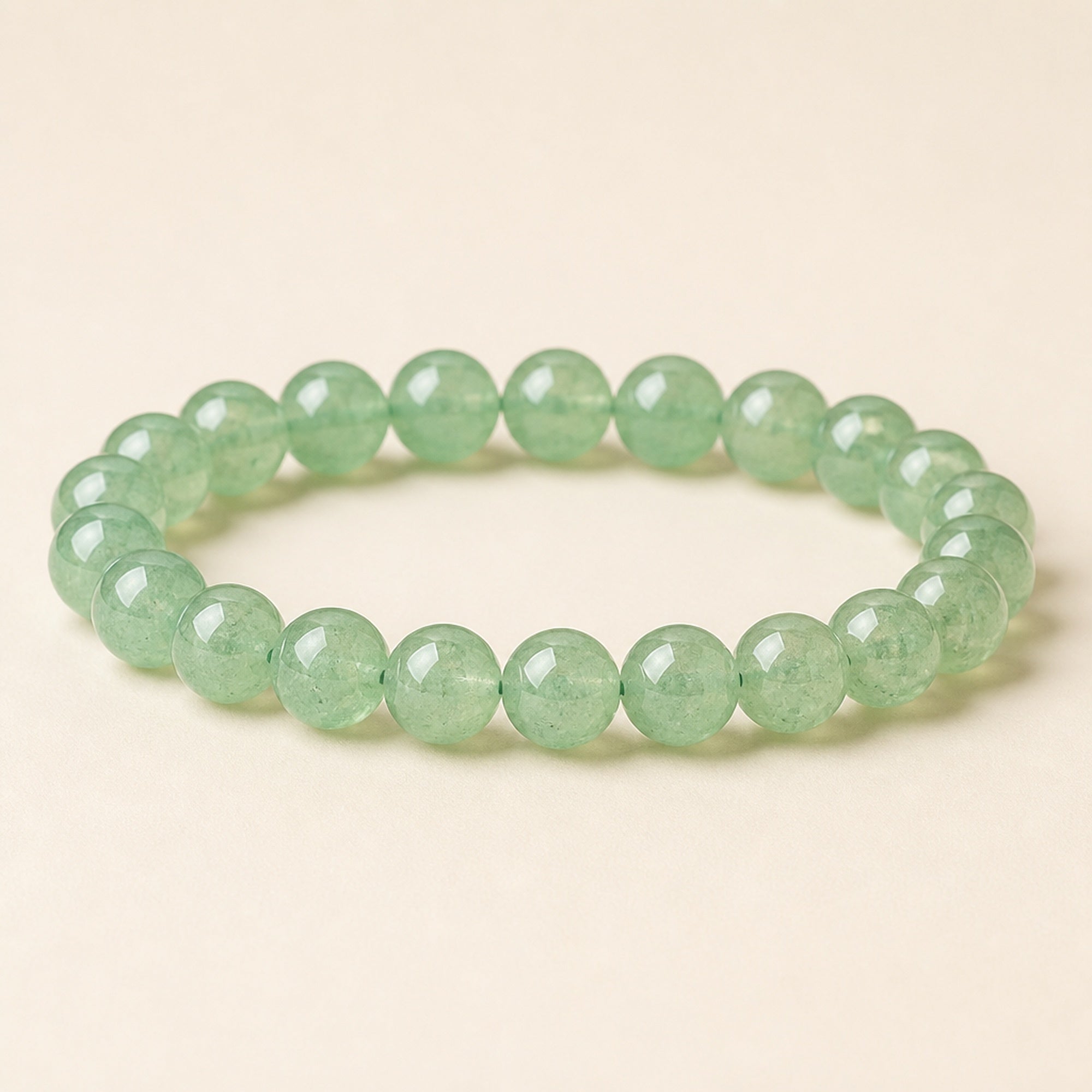
A related color-family option
Green Strawberry Quartz Bracelet – Gentle Renewal
This broader color-family option is not presented as Jade. We only identify jewelry as Jade when that exact material is verified.
Explore this related optionGreen Jade vs. Other Green Healing Stones—and How to Choose Real Jade
Green is the most crowded color in the gem world, so comparison matters. GIA's green gemstone guide notes that most emeralds contain inclusions and are routinely fracture-filled with oil, resin, or wax—treatments that are impermanent and require special care. Jade, by contrast, is a tough interlocking-crystal rock with no need for filling to be beautiful. Prehnite and green aventurine are softer options; none of them should be sold to you as "jade."
Use this checklist when choosing, guided by the Lumina Grade AAA Integrity Standard—our benchmark for natural rough material, zero chemical resin-filling, and no irradiation or dye:
- Confirm the mineral type. Ask whether the piece is jadeite or nephrite; both are "jade," but they differ in hardness (6.5–7 vs. 6.0–6.5) and specific gravity (≈3.34 vs. ≈2.95).
- Ask about treatments directly. In writing, request confirmation of no resin filling, no dye, and no irradiation.
- Look at the surface honestly. Natural jade can show fine internal texture; perfectly uniform, glass-clear color at a low price warrants questions.
- Weigh it in the hand. Jade is dense for its size—a light, hollow-feeling piece is a warning sign.
- Buy from sellers who welcome testing. A gemological report from an independent lab is the cleanest reassurance on species and treatment.
Decision Table: Is Green Jade the Right Stone for Your Goal?
| Your Goal | Green Jade Fits If… | Consider Another Green Stone If… |
|---|---|---|
| Everyday wear that lasts | Yes—jade's interlocking structure makes it exceptionally tough; jadeite at 6.5–7 Mohs suits rings and bangles | You want a softer, lighter-feeling stone and will accept more careful handling |
| Meaning tied to harmony and virtue | Yes—documented cultural symbolism from ritual objects to pierced disks | You prefer a stone with a purely modern, decorative identity |
| Symbol of steady prosperity | Yes—traditionally a stone of earned, quiet growth | You are looking for financial advice; no stone provides that |
| Emotional or physical healing | Use it as a mindfulness anchor and personal reminder only | You need symptom relief—speak with a qualified professional |
| Low-maintenance ownership | Yes—no filling needed; wipe with a soft cloth, store separately from diamonds | You are comparing with fracture-filled emeralds, which need extra care |
Care and a Grounded Perspective: What Science Says and Common Questions
Green jade needs little: wipe it with a soft, damp cloth, store it apart from harder gemstones, and avoid harsh chemicals and prolonged sun. Scientifically, its documented properties are mineralogical—composition, refractive index, specific gravity, hardness—and GIA also notes that treatments exist to alter color, clarity, or durability, which is exactly why asking about treatment matters. What jade offers beyond that is cultural and personal: a beautiful, durable object that can hold your intentions for harmony and steady growth. That is a real benefit—just an honest one.
What are the main meanings and benefits of green jade?
Green jade is traditionally associated with harmony, compassion, and steady prosperity, and its practical benefits are durability and timeless beauty—jadeite rates 6.5–7 on the Mohs scale and is exceptionally tough.
Does green jade help the heart chakra and emotional health?
In chakra traditions it is often associated with the heart center and may support a calmer, more compassionate mindset when used as a mindfulness anchor; it is not a treatment for emotional or mental-health conditions.
Is green jade suitable for daily wear, and how should I care for it?
Yes—its toughness makes it well suited to everyday pendants and bangles. Wipe it with a soft cloth, store it away from diamonds and harsh chemicals, and confirm with the seller that it is natural and untreated, such as under the Lumina Grade AAA Integrity Standard.
Sources
© 2026 Lumina Quartz. This article shares cultural and mineral information only and is not medical, financial, or psychological advice.