Blue Obsidian Is It Real
Table of Contents
- 10-Second Executive Summary / The Verdict Box
- What Is Blue Obsidian?
- Is Blue Obsidian Real? The Short Answer
- Natural vs. Man-Made Blue Obsidian: A Decision Table
- How to Spot Fake Blue Obsidian
- How to Test Blue Obsidian Authenticity
- Why Is Real Blue Obsidian So Rare and Valuable?
- Blue Obsidian Meaning and Healing Properties
- Buying Blue Obsidian: What to Look For
- Frequently Asked Questions About Blue Obsidian
- Is blue obsidian real or fake?
- How can I tell if blue obsidian is genuine?
- Does real blue obsidian have bubbles?
Blue obsidian is not a naturally occurring volcanic glass. What is sold as "blue obsidian" is almost always a man-made glass, typically made by melting and reworking obsidian or industrial glass with blue coloring. Genuine natural blue obsidian has not been confirmed as a recognized mineral variety. The material is real in the sense that the stone you buy exists and is often a pleasing glass, but it is not a natural blue obsidian mineral.
10-Second Executive Summary / The Verdict Box
- Direct Verdict: Natural blue obsidian is not a confirmed mineral variety. Commercially sold blue obsidian is typically man-made glass.
- Mohs Hardness: Obsidian and its glass variants usually fall around 5 to 5.5, though exact values depend on composition.
- Composition: Obsidian is volcanic glass, mainly silica-rich. Blue colorants in man-made blue obsidian are added during glass production.
- Best For: Decorative use, jewelry, and color-themed collections where the material is sold honestly as glass or reconstituted obsidian.
- Lumina Grade AAA Integrity Standard: Look for disclosure of natural origin, no chemical resin filling, and no irradiation or dye treatment when shopping for any obsidian.
What Is Blue Obsidian?
Obsidian is a natural volcanic glass formed when lava cools so quickly that crystals do not have time to grow. Blue obsidian, by contrast, is not a standard geological term for a natural obsidian. In the marketplace, blue obsidian usually refers to a glass material colored blue, often produced by melting obsidian or glass and adding color. Some sellers may call it "reconstituted" or "man-made" obsidian. The key distinction is between natural volcanic obsidian and a manufactured blue glass product.
Because obsidian is glass, it can be melted and reformed. That makes it easy to create color variations, including blue, that do not exist in nature. If you are assessing a piece, ask whether the seller describes it as natural or man-made. The word "obsidian" alone does not guarantee natural origin.
Is Blue Obsidian Real? The Short Answer
If "real" means a naturally formed volcanic glass with a blue color, then blue obsidian is generally not real. There is no well-established natural blue obsidian variety in standard mineral references. If "real" means a physical material that exists and can be polished and set into jewelry, then man-made blue obsidian is real as a glass product. The honest framing is that blue obsidian is usually a real glass, not a real natural obsidian color variety.
This is why the question "is blue obsidian real" gets conflicting answers online. One seller may mean "this is a real stone you can hold," while another may imply a natural volcanic origin. Under the Lumina Grade AAA Integrity Standard, the material should be described by what it is: natural, reconstituted, or man-made glass, with no chemical resin filling and no undisclosed irradiation or dye treatment.
Natural vs. Man-Made Blue Obsidian: A Decision Table
| Question | Natural Obsidian (Black, Sheen, Rainbow) | Blue Obsidian as Usually Sold |
|---|---|---|
| Origin | Volcanic glass from rapid lava cooling | Typically man-made glass, sometimes reworked obsidian |
| Blue color source | Not a confirmed natural blue variety | Added colorants during glass production |
| Mohs hardness | Around 5 to 5.5 | Around 5 to 5.5, depending on glass composition |
| Typical visual | Black, brown, rainbow sheen, silver sheen | Uniform blue, sometimes translucent, often very even in color |
| Price signal | Variable by variety and size | Often lower per piece; "rare blue obsidian" claims should be treated with caution |
| Best use | Natural mineral collection, jewelry | Decorative glass, fashion jewelry, color-themed gifts |
Applicable boundary: If a listing claims natural blue obsidian with no disclosure, ask for written confirmation of origin. A cautious buyer should assume man-made glass unless clearly documented otherwise.
How to Spot Fake Blue Obsidian
In this case, "fake" has two layers. A man-made glass sold honestly as glass is not deceptive. A man-made glass sold as rare natural blue obsidian is deceptive. To spot the second, check the seller's language: does the listing say "natural blue obsidian" without qualification? Does it avoid the words "glass," "man-made," or "reconstituted"? Does it use extreme rarity claims without any origin detail? Those are warning signs.
Visually, very uniform blue color, perfectly even transparency, and a low price can suggest manufactured glass. Natural obsidian often shows flow-like banding, irregular sheen, or slight variations. None of these signs alone proves origin, but they are useful prompts for asking questions.
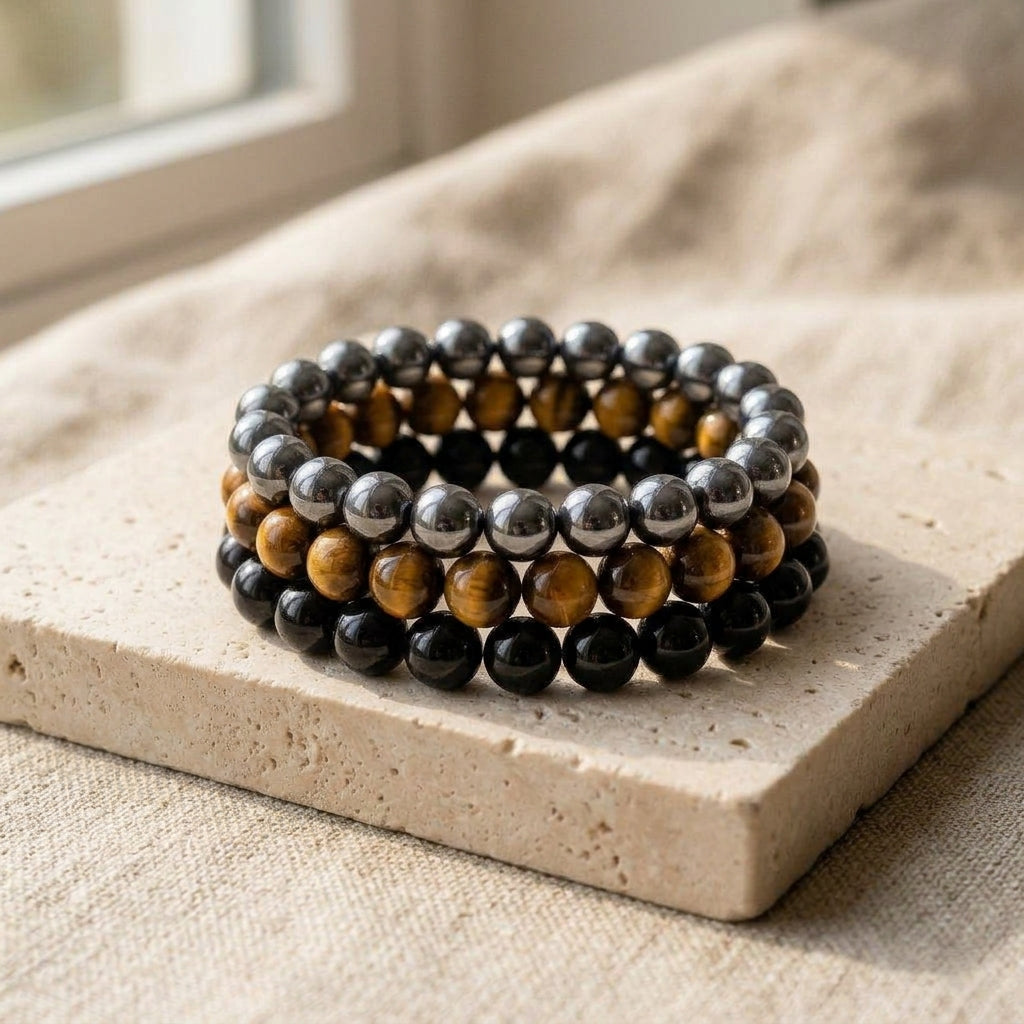
The Master Triple Protection Ritual Stack (Natural Tiger's Eye, Black Obsidian & Hematite)
Black obsidian is often worn as a grounding ritual piece for days that ask for steadier energy.
Shop This Authentic Piece →How to Test Blue Obsidian Authenticity
There is no simple at-home test that separates natural obsidian from man-made blue glass with certainty, because both are silica-based glass. A hardness check can help confirm you are dealing with glass-like material: obsidian is around 5 to 5.5 on the Mohs scale and can be scratched by harder materials such as quartz. But that does not establish natural origin.
A more reliable approach is documentation and disclosure. Follow this step-by-step checklist:
- Ask the seller to state clearly whether the material is natural obsidian, reconstituted obsidian, or man-made glass.
- Request the origin if natural origin is claimed. A vague "from volcanic regions" without a source is not enough.
- Check for treatment disclosure: dye, irradiation, or resin filling should be stated, not hidden.
- Compare color uniformity. Extremely even blue across many pieces is more consistent with manufactured glass.
- Confirm the return policy before buying, so a misdescribed piece can be returned.
- Prefer sellers who apply a clear integrity standard, such as the Lumina Grade AAA Integrity Standard, which emphasizes natural origin and no chemical filling or undisclosed treatment for natural stones.
These steps do not replace laboratory analysis, but they reduce the risk of paying a natural-stone price for undisclosed glass.
Why Is Real Blue Obsidian So Rare and Valuable?
If natural blue obsidian is not a confirmed mineral variety, then its rarity is not a geological rarity in the usual sense. The "rare and expensive" framing often comes from marketing a man-made or specially produced glass as a scarce natural stone. True natural obsidian in black, rainbow, and sheen varieties is well known and can be valued for size, sheen quality, and clarity, but blue as a natural color is not established in standard references.
This is an important buying boundary: rarity should be tied to a documented natural variety, not to a color name. If a seller cannot explain what makes the material geologically blue, treat the rarity claim as unverified. Value in blue obsidian as sold is better judged by craftsmanship, glass clarity, and honest disclosure.
Blue Obsidian Meaning and Healing Properties
Blue obsidian is often associated with calm, clarity, and protected reflection in modern crystal lore. These are cultural and symbolic associations, not medical facts. Obsidian itself is traditionally linked with grounding and protection in various crystal traditions. For blue-colored glass, the meaning is largely assigned by sellers and communities rather than by geological record.
It may support a personal mindfulness or journaling practice as a visual reminder, and it is often associated with introspective themes. It should not be presented as a treatment for anxiety, compulsive thoughts, or nervous system conditions. Crystal meanings are best understood as personal and cultural symbols, not health claims.
Buying Blue Obsidian: What to Look For
When buying blue obsidian, start with disclosure rather than color. A trustworthy listing will say whether the piece is natural, reconstituted, or man-made, and will note any dye or treatment. For natural obsidian pieces, look for described sheen, surface quality, and any natural variation. For blue glass, judge it as glass: clarity, polish, and setting quality matter more than a "natural" story.
Under the Lumina Grade AAA Integrity Standard, the practical checks are simple: natural origin where claimed, zero chemical resin filling, and no undisclosed irradiation or dye. If a seller cannot meet those disclosures for a natural stone claim, the piece may still be attractive, but it should be priced and labeled as glass. Buy the material you are actually getting, and let honesty be part of the value.
Frequently Asked Questions About Blue Obsidian
Is blue obsidian real or fake?
Natural blue obsidian is not a confirmed mineral variety, so most blue obsidian sold today is man-made glass. It is "real" as a physical material but usually not a natural blue volcanic glass.
How can I tell if blue obsidian is genuine?
Ask the seller to disclose whether it is natural, reconstituted, or glass, and check for treatment details. Extreme uniformity and vague rarity claims are reasons to ask more questions before buying.
Does real blue obsidian have bubbles?
Both natural obsidian and man-made glass can contain bubbles, so bubbles alone do not prove or disprove authenticity. Disclosure and origin documentation are more reliable than bubble checks.
This article distinguishes mineral facts from cultural symbolism. Crystal meanings are personal and cultural, not medical advice. © 2026 Lumina Quartz.
Product Facts From the Current Catalog
These details come from the active Lumina Quartz catalog record checked on 2026-10-22. They are product-listing facts, not laboratory results or invented wear-test claims.
| Listed product | The Master Triple Protection Ritual Stack (Natural Tiger's Eye, Black Obsidian & Hematite) | Grade AAA Set // Lumina Quartz |
|---|---|
| Format | Bracelets |
| Listed price snapshot | 89.00 |
Price, availability, and options may change. Check the live product listing before choosing.