The Complete Everyday Guide to Rose Quartz Jewelry: Meaning and Uses
Table of Contents
- 10-Second Executive Summary / The Verdict Box
- What Rose Quartz Jewelry Means: Love, Compassion, and Everyday Intention
- A Brief History of Rose Quartz, from Roman Seals to Modern Pink Gemstones
- How to Choose Real Rose Quartz Jewelry: Color, Clarity, Cut, and Quality
- Step-by-Step Authentication Checklist
- Why Some Rose Quartz Shows a Star Effect
- Everyday Ways to Wear Rose Quartz: Necklaces, Rings, Bracelets, and Earrings
- How to Style Pink Rose Quartz with Your Daily Outfits
- How to Care for Rose Quartz Jewelry So It Keeps Its Color
- Rose Quartz Jewelry as a Gift: Meaningful Picks and Buying Tips
- FAQ: Common Questions About Rose Quartz Jewelry
- What does rose quartz jewelry mean and what is it used for?
- How can you tell if rose quartz jewelry is real or fake?
- How do you care for and clean rose quartz jewelry?
- Sources
Rose quartz jewelry is natural quartz (Mohs hardness 7.0) whose pink color comes from microscopic fibrous borosilicate nanoinclusions inside the stone — so you can test authenticity by checking that it scratches window glass (Mohs 5.5) and that no dye bleeds off with acetone. Knowing the stone's hardness, its characteristic soft translucency, and how it is graded lets you separate genuine earth-mined rose quartz from dyed crackle quartz or glass before you buy, wear, or gift it.
10-Second Executive Summary / The Verdict Box
- Direct Verdict: Real rose quartz jewelry is natural quartz; authenticity is confirmed by Mohs hardness, not by saturation of pink. Soft, milky translucency is a mark of quality, not a flaw.
- Mohs Hardness: 7.0 — it will scratch ordinary window glass (5.5) without being marked.
- Color Source: Microscopic fibrous borosilicate nanoinclusions (closely related to dumortierite), not surface dye.
- Quality Benchmark: Lumina Grade AAA Madagascar Earth-Mined Rose Quartz Standard — natural origin, no chemical resin filling, no irradiation or dye treatment (Lumina Grade AAA Integrity Standard).
- Best Use Cases: Left-wrist bracelets for personal intention work, pendants for daily wear, rings for low-impact use, earrings for statement styling.
- Biggest Risk: Over 70% of "vivid pink" crystals on mass-marketplace platforms are dyed crackle quartz, cheap calcite, or dyed glass that bleed pigment under an acetone test.
What Rose Quartz Jewelry Means: Love, Compassion, and Everyday Intention
The most common search question — "what does rose quartz jewelry mean and what is it used for?" — has a two-part answer. Culturally, rose quartz is often associated with love, gentleness, and compassion; historically, ancient Roman, Egyptian, and Greek civilizations used quartz crystals as talismans, with Romans employing rose quartz as a seal to signify ownership, as documented by the GIA. In modern crystal traditions, it is known as the quintessential Heart Chakra (Anahata) stone and is most commonly worn on the left wrist to support self-compassion and inner emotional restoration as a personal reminder practice.
It is important to keep these traditions in their lane: cultural symbolism and personal intention are meaningful, but they are not medical claims. Rose quartz jewelry may support a daily ritual of pause and reflection; it is not a treatment for anxiety, stress, or any health condition. What you can rely on objectively is the mineral itself — natural quartz, hard, stable, and beautiful in its own quiet way.
A Brief History of Rose Quartz, from Roman Seals to Modern Pink Gemstones
Rose quartz has been loved across cultures for thousands of years. Per the Gemological Institute of America, the earliest recorded civilizations believed quartz held magical power, and both Romans and Egyptians used it as a protective talisman. The stone's modern identity, however, is distinctly geological. As Mindat notes, two distinct materials are commonly sold as "rose quartz," and one is a translucent massive quartz made of intergrown crystals — which is what most jewelry-grade material actually is.
That distinction matters far more today than any legend. The quiet, milky pink you see in a fine bracelet is the result of millions of tiny fibrous inclusions, not a surface treatment. When you understand how the stone forms, you stop looking for neon pink and start looking for character.
How to Choose Real Rose Quartz Jewelry: Color, Clarity, Cut, and Quality
The second most common question is "how can you tell if rose quartz jewelry is real or fake?" Here is the short version: real rose quartz is defined by its geology, not its intensity. Its delicate pink hue derives from microscopic fibrous borosilicate nanoinclusions closely related to dumortierite — not from surface dyes. If a piece looks like glowing candy, be suspicious.
The single most reliable physical test is hardness. Natural rose quartz has a true quartz Mohs hardness of 7.0, which means it can easily scratch ordinary window glass (Mohs 5.5) without sustaining surface damage. Dyed crackle quartz, calcite, and glass are softer or treated, and they frequently fail that test. A second check is the acetone wipe: over 70% of overly saturated "vivid pink" crystals sold on mass marketplace platforms are dyed materials that bleed pigment when tested. A cotton swab with a little acetone on an inconspicuous spot should show nothing on genuine earth-mined stone.
For color and clarity, expect soft translucency rather than perfect transparency. Lumina Grade AAA Integrity Standard means natural origin, zero chemical resin filling, and no irradiation or dye treatment — the standard I apply when evaluating Madagascar material, which is prized for its gentle, luminous body color.
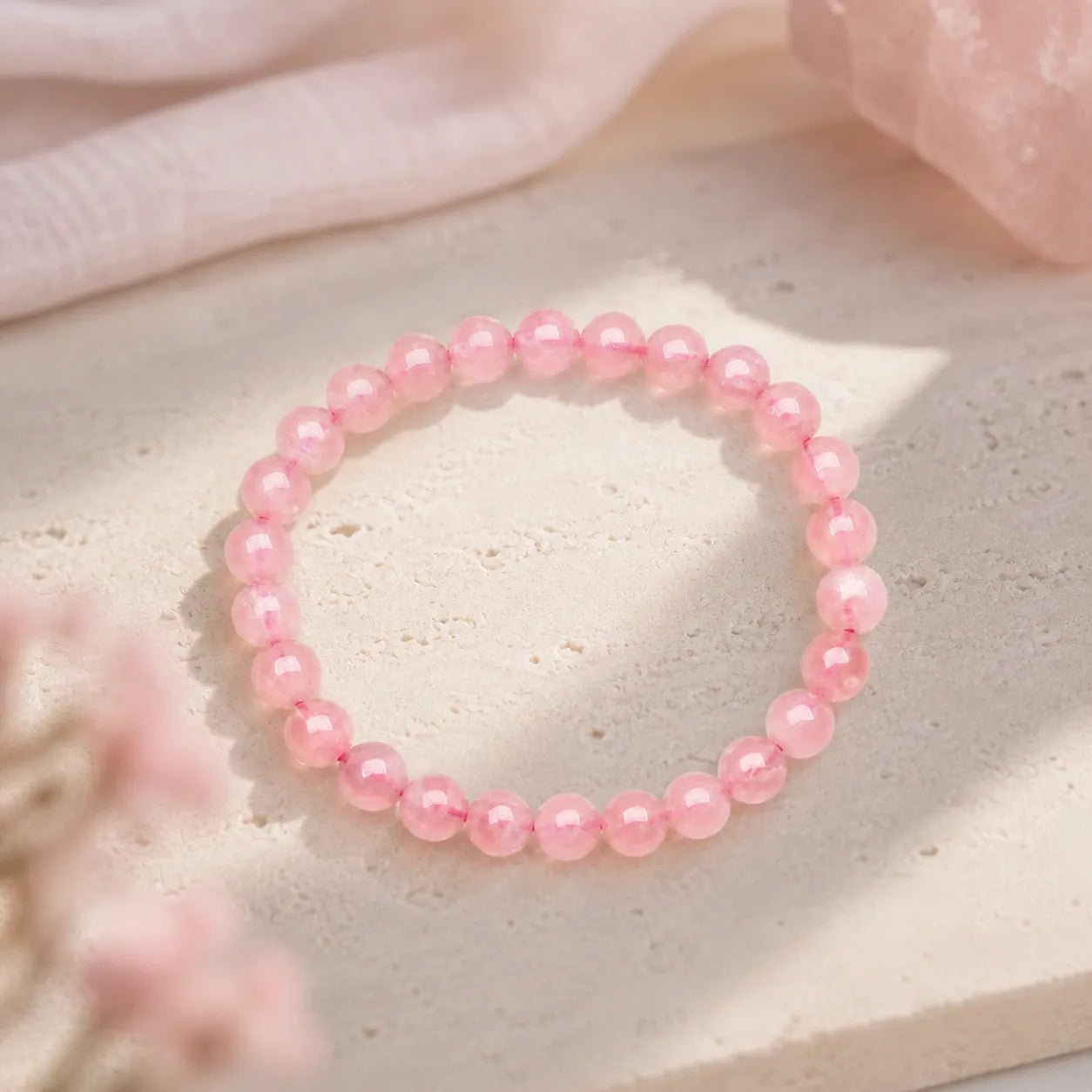
Rose Quartz Love Bracelet
Rose quartz can become a soft daily reminder to return to tenderness, self-trust, and emotional ease.
Shop This Authentic Piece →Step-by-Step Authentication Checklist
Use this ordered checklist when you inspect a piece in person or after delivery:
- Look at the color behavior. Genuine rose quartz shows gentle, slightly uneven pink — never a flat, uniform "painted" tone. Deep saturation in a cheap setting is a red flag for crackle quartz or dyed glass.
- Check translucency. Hold it against a light. High-grade Madagascar specimens show soft, milky translucency; completely opaque, chalky pieces are more likely calcite or low-grade material.
- Perform the glass scratch test. Gently try to scratch a piece of ordinary window glass with an inconspicuous edge of the stone. At Mohs 7.0, real quartz should leave a mark on the glass without being damaged. (Choose a hidden area and apply light pressure.)
- Do the acetone wipe. A small amount of acetone on a cotton swab on the back of the bead or under the setting should leave no pigment on the swab. Any pink transfer suggests dye.
- Inspect the setting and string. Look for resin-filled cracks or cloudy glue lines — signs of chemical filling rather than untreated natural stone.
- Confirm the grade and origin claim. Ask whether the piece meets a documented earth-mined standard such as Lumina Grade AAA Madagascar Earth-Mined Rose Quartz Standard.
Boundary note: Lab-grown quartz is chemically quartz and will pass the hardness test, so if origin matters to you, ask for the mining source. Also remember these tests are for natural-stone verification only — they say nothing about spiritual or health benefits, which are matters of personal tradition.
Why Some Rose Quartz Shows a Star Effect
High-grade Madagascar specimens can exhibit asterism — a soft star effect visible under focused single-point light — caused by oriented fibrous micro-silk inside the stone. This is a quality signal, not a defect. A star that shifts cleanly with the light suggests well-oriented inclusions and, often, a stone that has been cut to respect its internal structure. If you see a perfectly rendered, photographic star in a very inexpensive mass-market listing, treat it as a possible imitation; real asterism is subtle and changes with angle.
Everyday Ways to Wear Rose Quartz: Necklaces, Rings, Bracelets, and Earrings
Each format has a practical personality, and choosing well is about matching wear to the stone's gentle physical profile.
- Bracelets: The most popular format. In healing traditions, rose quartz is traditionally worn on the left wrist to nurture internal emotional restoration and self-compassion. A 7.0-hardness stone handles daily desk and home life well, but it should be removed for gym sessions and heavy lifting.
- Necklaces and pendants: Sit close to the heart and suit daily wear under a shirt collar. A pendant rarely knocks against hard surfaces, making it one of the safest formats for a high-grade translucent stone.
- Rings: Beautiful but exposed. Rose quartz at Mohs 7.0 is softer than diamond or sapphire, so a ring may show fine scratches over years. Choose a bezel setting over prongs for everyday use.
- Earrings: Great for showcasing clarity and soft color. Avoid long dangles if you wear headphones or a helmet regularly.
For comfort, pair each format with a quiet intention — the jewelry is often associated with a daily reminder to be kinder to yourself, and that reminder works best when the piece is comfortable enough to forget you're wearing it.
How to Style Pink Rose Quartz with Your Daily Outfits
Rose quartz's muted, milky pink is a forgiving neutral. It pairs naturally with cream, oatmeal, soft grey, and denim; it warms up black in a way silver doesn't. For a grounding look, choose one rose quartz piece and one metal — yellow gold brings out the warmth, while matte silver keeps the palette cool and quiet. Because genuine stone is often slightly translucent, layering two rose quartz bracelets of different translucency creates depth without loud contrast. Let the stone be the softest note in the outfit, not the loudest.
How to Care for Rose Quartz Jewelry So It Keeps Its Color
Care is mostly about avoiding the two things that damage natural quartz: abrasion and heat. Because the stone is Mohs 7.0, it will scratch softer materials — but it can itself be scratched by diamond, corundum, and some ceramics, so store rose quartz separately from other gemstone jewelry in a soft pouch.
Clean with lukewarm water and a drop of mild soap, using a soft brush, then pat dry. Avoid ultrasonic cleaners and steam, which can stress filled or included stones, and skip harsh chemicals and long soaks. Regarding sunlight: the color of natural rose quartz comes from internal inclusions, not dye, so ordinary daily wear in daylight is not a documented fading risk; prolonged intense sun exposure is simply not necessary, and keeping jewelry in a drawer between wears is a sensible habit. If you bought a dyed piece, however, sunlight and acetone test wipes are exactly where the pigment fails — another reason to confirm natural origin before purchase.
Rose Quartz Jewelry as a Gift: Meaningful Picks and Buying Tips
Rose quartz is a natural gift stone for graduations, new homes, and quiet milestones, because its associations are gentle rather than grand — love, compassion, and self-kindness. When choosing a gift, favor formats that get worn: a left-wrist bracelet, a simple pendant, or small stud earrings.
Buy from sellers who document origin and grade, and ask specifically whether the piece meets a natural-standard benchmark such as Lumina Grade AAA Madagascar Earth-Mined Rose Quartz Standard. A gift of gem quality lasts; a gift of dyed crackle quartz disappoints when the color rubs off on a wrist. Include a small care card — soft pouch, mild soap, no ultrasonic — and you've gifted something that stays lovely for years.
FAQ: Common Questions About Rose Quartz Jewelry
What does rose quartz jewelry mean and what is it used for?
It is traditionally associated with love, compassion, and self-kindness, and is worn as a Heart Chakra (Anahata) reminder — most commonly on the left wrist — for personal intention and emotional reflection, not as a medical treatment.
How can you tell if rose quartz jewelry is real or fake?
Real rose quartz has Mohs hardness 7.0 and should scratch window glass (5.5) without damage, and an acetone wipe should leave no pink pigment; heavily saturated "vivid pink" pieces are frequently dyed crackle quartz or glass that bleeds color.
How do you care for and clean rose quartz jewelry?
Clean with lukewarm water, mild soap, and a soft brush, then pat dry; store it in a soft pouch away from harder gems, and avoid ultrasonic cleaners, steam, and harsh chemicals.
Sources
© 2026 Lumina Quartz. This article shares mineral facts and cultural traditions for informational purposes only; crystal jewelry is not intended to diagnose, treat, or prevent any condition.
Product Facts From the Current Catalog
These details come from the active Lumina Quartz catalog record checked on 2026-10-28. They are product-listing facts, not laboratory results or invented wear-test claims.
| Listed product | Rose Quartz Love Bracelet |
|---|---|
| Format | Bracelet |
| Listed price snapshot | 28.80 |
Price, availability, and options may change. Check the live product listing before choosing.