The Complete Everyday Guide to Lavender Rose Quartz: Meaning and Uses
Table of Contents
- 10-Second Executive Summary / The Verdict Box
- What Is Lavender Rose Quartz? A Trade Name, Not a Mineral Species
- Lavender Rose Quartz vs. Regular Rose Quartz vs. Amethyst and Lavender Quartz
- Colour, Transparency and How Light Changes It
- Where It Comes From: Bahia Brazil, Madagascar and Other Sources
- Is It Natural? Treatments, Dyes and How to Spot the Difference
- Spot-Check Checklist: Five Steps to Verify Lavender Rose Quartz Before You Buy
- Meaning and Healing Properties: Heart, Crown and Emotional Calm
- Heart Chakra Love, Self-Compassion and Grief Support
- Everyday Uses: Jewelry, Meditation, Home Styling and Gifting
- Care, Cleansing and Buying Checklist
- FAQ: Common Questions About Lavender Rose Quartz
- What is lavender rose quartz and what makes it different from regular rose quartz?
- Is lavender rose quartz natural or dyed/treated, and where does it come from?
- What are the meaning and healing properties of lavender rose quartz?
- What chakra is lavender rose quartz associated with?
- How do I clean, charge, and care for lavender rose quartz jewelry and specimens?
- Sources
Lavender rose quartz is a pale pink-to-lilac variety of quartz that is best understood as a trade name for rose quartz with unusually soft violet overtones, not a separate mineral species. Its lavender cast comes from the same microscopic fibrous borosilicate inclusions that give rose quartz its pink colour, combined with subtle structural factors in the crystal; true quartz hardness (Mohs 7.0) and the absence of surface dye are the two fastest field tests you can perform.
10-Second Executive Summary / The Verdict Box
- Direct Verdict: Lavender rose quartz is a colour-descriptive trade name for natural rose quartz with a pale lilac tint — not a mineral species and not the same as "lavender quartz" or amethyst.
- Mohs Hardness: 7.0 (true quartz), hard enough to scratch ordinary window glass (Mohs 5.5) without surface damage.
- Colour Source: Microscopic fibrous borosilicate nanoinclusions closely related to dumortierite — not chemical surface dyes.
- Quality Benchmark: Lumina Grade AAA Madagascar Earth-Mined Rose Quartz Standard (natural rough, zero chemical resin-filling, no irradiation or dye treatment).
- Best For: Everyday jewellery worn on the left wrist, gentle heart-centred meditation, gifting, and soft home styling.
- Buyer Warning: Over 70% of overly saturated "vivid pink" crystals sold on mass marketplace platforms are dyed crackle quartz, cheap calcite, or dyed glass that bleed pigment when tested with acetone.
What Is Lavender Rose Quartz? A Trade Name, Not a Mineral Species
Gemologically, the name "lavender rose quartz" describes a visual range rather than a distinct material. Mineral databases recognise two varieties commonly called rose quartz: one appears as translucent masses of intergrown anhedral crystals, and the other occurs in different crystalline habits (see the Mindat rose quartz entry). Lavender rose quartz sits within the first, mass-form variety, distinguished only by a cooler, violet-leaning pink.
That distinction matters for shoppers. Because it is a trade name, a seller can apply "lavender rose quartz" to almost any pale lilac-pink quartz — or to something that is not quartz at all. The only reliable way to verify what you are holding is to test the physical constants: quartz hardness of 7.0, cool touch, and conchoidal fracture on rough pieces. Authentic rose quartz derives its delicate pink hue from microscopic fibrous borosilicate nanoinclusions closely related to dumortierite, rather than chemical surface dyes — a geological fact that no trade name can override.
Lavender Rose Quartz vs. Regular Rose Quartz vs. Amethyst and Lavender Quartz
The market conflates three related-looking stones. Here is how they actually differ:
- Regular rose quartz: warm, bubblegum-to-blush pink. The colour is inclusion-driven. Mohs 7.0.
- Lavender rose quartz: the same inclusion-driven pink, but cooled toward lilac by subtle structural and trace variations. Still Mohs 7.0, still rose quartz.
- Amethyst: violet quartz coloured by iron centres and irradiation — a genuinely different colour mechanism. Mohs 7.0, but the violet is usually deeper and more saturated.
- "Lavender quartz" (trade): a loose marketplace label that may describe amethyst, dyed material, or mixed quartz. Treat it as unverified until tested.
The practical rule: if a piece is pale, cloudy, and pink-violet with soft translucency, it is plausibly lavender rose quartz. If it is glassy, evenly saturated violet, suspect amethyst or dye. If it is milky lime-green or neon pink with visible crackle lines, it is almost certainly treated material.
Colour, Transparency and How Light Changes It
High-grade Madagascar specimens exhibit characteristic soft translucency with asterism potential — a star effect under focused single-point light caused by oriented fibrous micro-silk. In daylight, lavender rose quartz reads as a gentle dusty pink; under warm indoor light it can look almost beige; under cool LED light the lilac note strengthens. This light-dependent colour shift is normal and is one reason photos mislead. Ask sellers for natural-light images alongside studio shots, and expect variation between pieces rather than uniform colour.
Where It Comes From: Bahia Brazil, Madagascar and Other Sources
Rose quartz occurs in pegmatites worldwide, and the pale lavender-leaning material is most often associated with two origins in the trade: Bahia, Brazil, and Madagascar. Both produce large, translucent masses suitable for carving, spheres, and cabochons. Madagascar material in particular is often cited for the soft translucency and asterism potential described above.
Origin claims, however, are difficult to verify from a finished polished stone. Unlike some gemstones with diagnostic inclusions, rose quartz rarely carries provenance markers visible to the naked eye. A seller's "Bahia" or "Madagascar" certificate is only as good as the seller's sourcing discipline. For this reason, the Lumina Grade AAA Integrity Standard is built around what can be verified: natural rough origin, zero chemical resin-filling, and no irradiation or dye treatment — rather than origin claims alone.
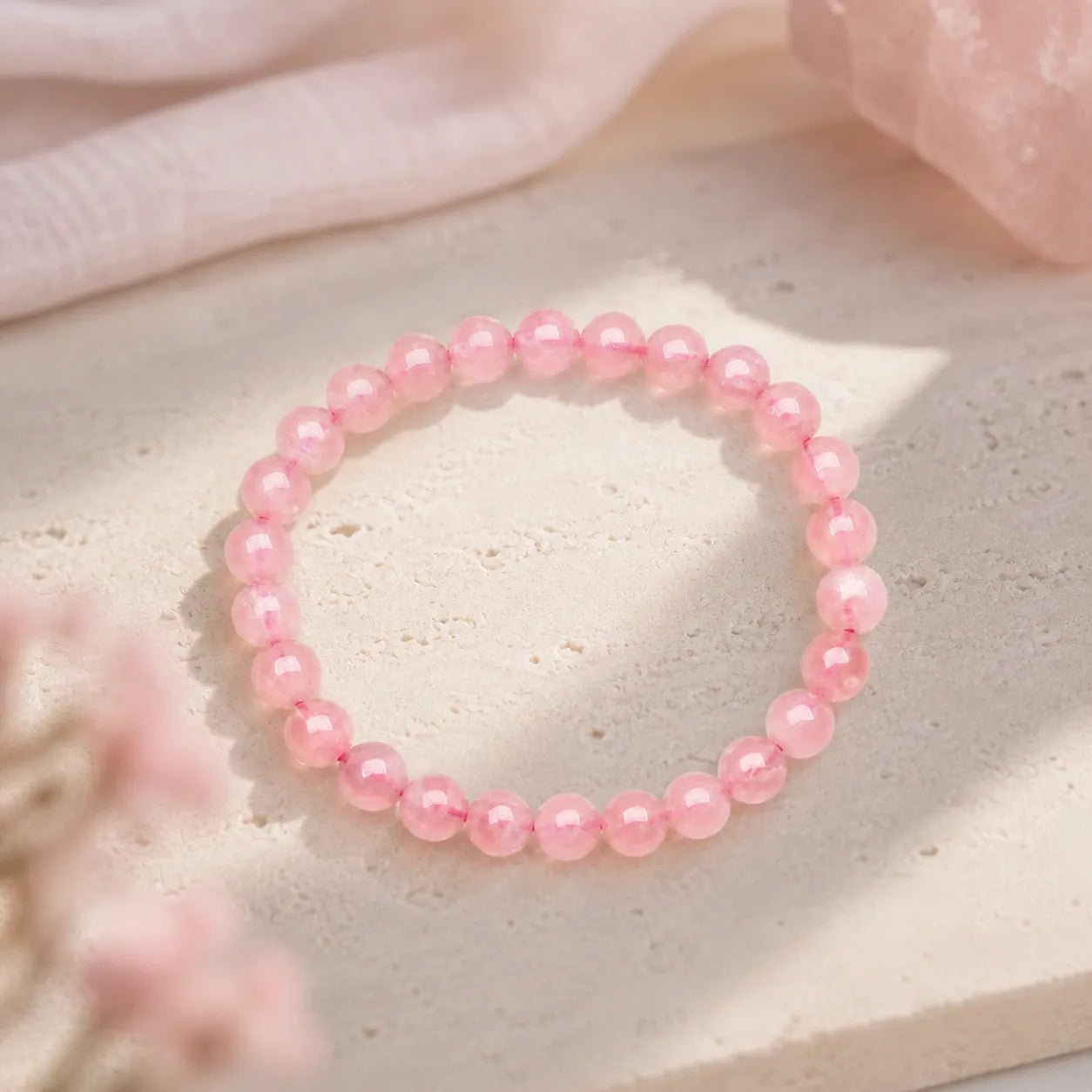
Rose Quartz Love Bracelet
Rose quartz can become a soft daily reminder to return to tenderness, self-trust, and emotional ease.
Shop This Authentic Piece →Is It Natural? Treatments, Dyes and How to Spot the Difference
Most lavender rose quartz on the market is natural and untreated, because the material is abundant and inexpensive to produce. The risk is concentrated in the saturated end of the market. Over 70% of overly saturated "vivid pink" crystals sold on mass marketplace platforms are dyed crackle quartz, cheap calcite, or dyed glass which bleed pigment when tested with acetone. Lavender tones are less frequently faked than hot pink, but pale violet stones are sometimes dyed to imitate amethyst-adjacent material.
Treatment issues to watch for:
- Dye: colour pools in fractures; acetone on a cotton swab will lift pigment from dyed crackle quartz or dyed glass.
- Resin-filling: stabilises crumbly or low-grade rough; adds weight and a plastic-like sheen. The Lumina Grade AAA Integrity Standard requires zero chemical resin-filling.
- Irradiation: can shift quartz colour; not required to create natural rose quartz colour, and a red flag in "enhanced" listings.
- Calcite substitution: softer (Mohs 3.0), warmer to the touch, and easily scratched by steel — it will fail the glass-scratch test.
Spot-Check Checklist: Five Steps to Verify Lavender Rose Quartz Before You Buy
- Scratch test (with care): A natural quartz point at Mohs 7.0 should scratch ordinary window glass (Mohs 5.5) without sustaining surface damage. Calcite, glass, and resin-filled material behave differently. Test on an inconspicuous edge, never on a finished face.
- Acetone swab: Rub a cotton swab with nail-polish remover on an inconspicuous spot. Any lifted pink or violet pigment indicates dye — the most common treatment on mass-market saturated stones.
- Light behaviour: Examine under a single-point focused light. High-grade Madagascar specimens may show asterism potential from oriented fibrous micro-silk; uniform milky opacity with no internal structure suggests treated or composite material.
- Colour logic: Natural lavender rose quartz is pale and slightly cloudy. If the saturation is vivid and glassy, ask why — and expect a documented answer or walk away.
- Ask for the standard: Request confirmation that the piece is natural rough, untreated, and resin-free. Sellers working to the Lumina Grade AAA Integrity Standard can answer without hesitation.
Meaning and Healing Properties: Heart, Crown and Emotional Calm
In crystal traditions, rose quartz is the quintessential Heart Chakra (Anahata) stone, traditionally worn on the left wrist to nurture internal emotional restoration and self-compassion. Lavender rose quartz inherits that association and adds a softer, quieter quality that many people find easy to sit with during meditation. These are cultural and symbolic attributions, not medical claims: wearing or holding the stone may support a personal mindfulness practice, and it is often associated with gentleness and self-reflection.
The historical record shows how long this symbolism runs. Ancient Roman, Egyptian, and Greek civilisations used quartz crystals as talismans; the Romans used rose quartz as a seal to signify ownership, and Egyptians believed the stone could prevent aging, according to the GIA's rose quartz history and lore. Treat these as cultural history, not efficacy evidence. Modern symbolic readings typically pair the pink heart association with a pale violet "crown-adjacent" calm — a poetic bridge rather than a mineral fact.
Heart Chakra Love, Self-Compassion and Grief Support
Practitioners often place rose quartz over the heart during quiet breathing or journaling. Lavender rose quartz may support a gentler tone for grief and self-compassion work because its colour is less stimulating than saturated pink. It is often associated with reminders to speak kindly to oneself. No stone replaces professional support; if grief or anxiety feels heavy, the stone can sit alongside care, not instead of it.
Everyday Uses: Jewelry, Meditation, Home Styling and Gifting
- Jewellery: A left-wrist beaded bracelet is the most common everyday format. Check that elastic is knotted and glued, and that beads are cool to the touch.
- Meditation: Hold a palm stone or tumbled piece during breath practice; the pale colour works well in low light.
- Home styling: A small sphere or rough cluster on a bedside tray or desk adds a soft focal point. Keep it out of direct sun to protect colour over time.
- Gifting: Lavender rose quartz is often given as a gentle "thinking of you" stone. Pair it with a short note about its symbolic heart association rather than promising emotional outcomes.
Care, Cleansing and Buying Checklist
Quartz is durable but not indestructible. Clean with lukewarm water and a soft cloth; avoid ultrasonic cleaners and harsh chemicals, particularly on resin-filled or dyed pieces. Store separately from softer stones so the Mohs 7.0 surface does not scratch them.
For symbolic cleansing, many people use moonlight, sound, or a brief rinse — these are traditional practices, not verified effects. Sunlight is best avoided for long periods because UV exposure can fade the delicate colour.
Buying checklist:
- Confirm natural, untreated material and no resin-filling (Lumina Grade AAA Integrity Standard).
- Ask for natural-light photos; expect pale, slightly cloudy colour.
- Test hardness and acetone reactivity where possible.
- Prefer sellers who describe treatment status openly rather than using "AAA" as decoration.
FAQ: Common Questions About Lavender Rose Quartz
What is lavender rose quartz and what makes it different from regular rose quartz?
It is a trade name for rose quartz with a pale lilac-pink tone rather than warm pink. The colour difference is subtle and structural, not a different mineral — both are quartz at Mohs 7.0 with inclusion-driven colour.
Is lavender rose quartz natural or dyed/treated, and where does it come from?
Most is natural and untreated, commonly sourced from Bahia, Brazil, and Madagascar. Dyed or resin-filled material exists, especially in saturated colours; test with acetone and check hardness before buying.
What are the meaning and healing properties of lavender rose quartz?
In crystal traditions it is associated with the Heart Chakra, self-compassion, and gentle emotional calm. These are symbolic and cultural associations, not medical effects.
What chakra is lavender rose quartz associated with?
It is primarily associated with the Heart Chakra (Anahata), with a secondary poetic link to the Crown Chakra because of its soft violet note.
How do I clean, charge, and care for lavender rose quartz jewelry and specimens?
Use lukewarm water and a soft cloth, avoid harsh chemicals and ultrasonic cleaners, and store it away from softer stones. For symbolic charging, moonlight or sound is traditional; avoid prolonged direct sunlight to protect the colour.
Sources
© 2026 Lumina Quartz. Crystal meanings and traditional uses are cultural and symbolic; they are not medical advice. Mineral properties and treatment tests should be verified on your own piece where possible.
Product Facts From the Current Catalog
These details come from the active Lumina Quartz catalog record checked on 2026-11-14. They are product-listing facts, not laboratory results or invented wear-test claims.
| Listed product | Rose Quartz Love Bracelet |
|---|---|
| Format | Bracelet |
| Listed price snapshot | 28.80 |
Price, availability, and options may change. Check the live product listing before choosing.