Fluorite Crystal Guide: How This Stone Supports Focus, Stress Relief, and Emotional Clarity
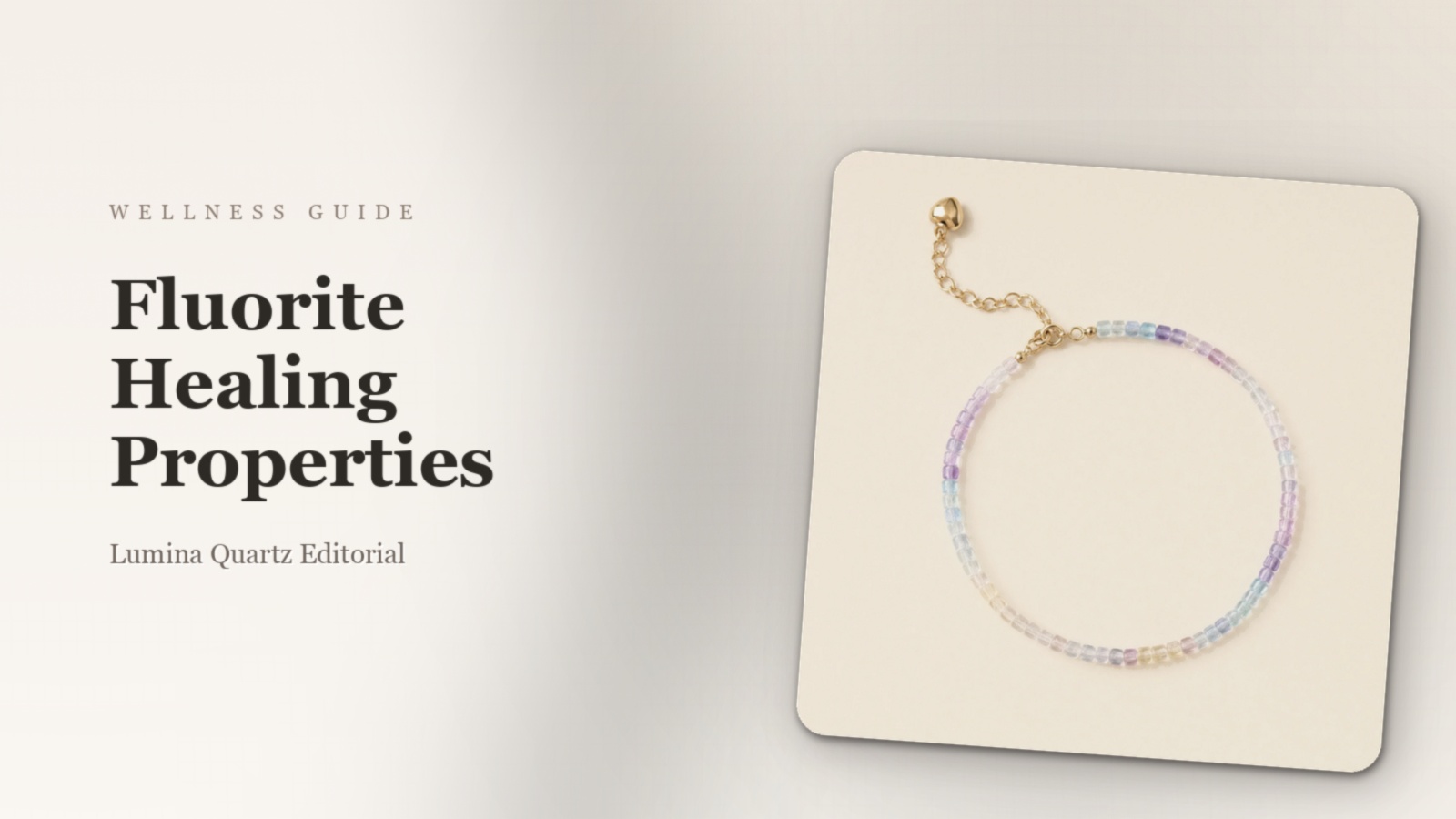
Table of Contents
- What is Fluorite?
- Fluorite Healing Properties Overview
- Key Takeaways
- Working With Fluorite: A Grounded Boundary Guide
- Mental Clarity and Focus
- Emotional Healing and Stress Relief
- Physical Wellbeing: Traditional Associations
- How to Use Fluorite for Healing
- Cleansing and Charging Your Fluorite
- Fluorite Colors and Their Unique Meanings
- Green Fluorite
- Purple Fluorite
- Blue Fluorite
- Yellow and Rainbow Fluorite
- Flower Agate Healing Properties and How It Pairs With Fluorite
- Conclusion: Incorporating Fluorite into Your Wellness Routine
- Fluorite Healing Properties FAQ
There are stones that whisper, and stones that sing. Fluorite, with its layered bands of violet, green, and blue, hums a quiet melody of order and calm. For centuries, this crystalline treasure has been admired not only for its beauty but for the sense of clarity it seems to bring to those who hold it. In the world of crystal healing, few minerals feel as simultaneously grounding and uplifting as fluorite.
Whether you are new to crystal work or a seasoned collector, understanding fluorite healing properties begins with a simple truth: this crystal does not promise to change your life all at once. Instead, it gently invites you to slow down, to sort through the mental noise, and to find a quieter center. That is, perhaps, its greatest gift.
What is Fluorite?
Fluorite is a calcium fluoride mineral that crystallizes in the cubic system, forming most often as cubes and octahedra. According to the Smithsonian National Museum of Natural History, fluorite is sometimes faceted into gemstones, but mostly for collectors — at a hardness of 4 on the Mohs scale, it is too soft and fragile for most everyday jewelry.
It is celebrated for its astonishing range of colors — green, purple, blue, yellow, pink, and clear — often within a single specimen. When you hold a piece of rainbow fluorite, you are holding a layered timeline of the earth's own creative process, each band a different chapter of mineral-rich solutions and geological pressure.
The name "fluorite" comes from the Latin fluere, meaning "to flow." This is fitting, as fluorite has long been associated with flow — the flow of ideas, of emotional release, of energy moving more freely through the body and mind. Historically, fluorite was used as a flux in metallurgy to help metals fuse and melt more easily; today it remains an important industrial mineral, and the U.S. Geological Survey documents fluorite (fluorspar) deposits in central Colorado as a source of fluorine. In the same way, many crystal practitioners believe fluorite helps the heart and mind soften, allowing trapped thoughts and tensions to dissolve and move.
Fluorite Healing Properties Overview
When people search for fluorite healing properties, they are usually looking for help with one thing: clarity. Perhaps clarity of mind, clarity of emotion, or clarity of purpose. Fluorite's layered structure mirrors the way our own lives can become layered with responsibilities, worries, and half-finished thoughts. Working with fluorite is an invitation to gently peel back those layers and rediscover what matters most.
The energies of fluorite are often described as orderly and calming. It is considered by many to be a "mental clarity stone," one that may support clear thinking, organized decision-making, and a calm, focused state of being. In crystal healing traditions, fluorite is often associated with the idea of cognitive order — helping to turn chaos into coherence.
It is worth saying clearly: these are traditions and personal experiences, not clinical findings. What makes fluorite meaningful is often the pause it creates — a small, beautiful object that reminds you to breathe, reset, and return to the task in front of you.
Key Takeaways
- Fluorite is a calcium fluoride crystal found in a beautiful spectrum of colors, often associated with mental clarity and emotional balance.
- Its traditional properties may support focus, decision-making, and a calmer internal environment, though crystal healing should never replace professional medical or mental health care.
- There are many ways to use fluorite, including meditation, carrying it with you, placing it in your workspace, and incorporating it into journaling rituals.
- Fluorite requires regular cleansing — using smoke, sound, moonlight, or dry salt — to clear accumulated energies and maintain its clarity.
- Each color of fluorite carries its own meaning, from green's connection to growth and renewal to purple's link with intuition and blue's calming influence.
Working With Fluorite: A Grounded Boundary Guide
Before you slip fluorite into a pocket or set it on your desk, it helps to know exactly where a crystal ritual ends and where other kinds of support begin. This short guide keeps the practice both meaningful and sensible.
Where Fluorite Fits Well
- As a sensory anchor: holding a cool, banded stone gives your attention somewhere gentle to land when your thoughts are scattered.
- As a ritual cue: picking it up before a work block, a breath practice, or an evening wind-down turns the stone into a reminder rather than a remedy.
- As a workspace object: a small tumbled piece or cluster on a desk can signal "this is where I focus" without asking anything of you.
Where Fluorite Doesn't Fit
- Medical or mental health treatment: if you are dealing with persistent anxiety, low mood, pain, or a health concern, please speak with a qualified professional. A stone is a companion, not a substitute.
- Gemstone elixirs or drinking water: fluorite is calcium fluoride, which crystallizes in the cubic system and has a Mohs hardness of 4, making it too soft and fragile for most jewelry (Smithsonian National Museum of Natural History). Because mineral specimens should always be handled with care, keep fluorite out of drinking water, elixirs, and anything you ingest.
- Home cutting, grinding, or polishing: lapidary work on fluorite produces fine dust. Leave it to professionals with ventilation and respiratory protection, or use wet methods only.
- Rings and rough-and-tumble jewelry: at Mohs 4, fluorite scratches and chips easily. Pendants, bezel settings, and bracelets worn with care are friendlier choices than a daily-wear ring.
A Two-Minute Handling Checklist
- Keep it dry — no soaking, no salt water, no dishwasher, no ultrasonic cleaner.
- Store it separately from harder stones such as quartz or obsidian so it doesn't get scratched.
- Wipe gently with a soft dry cloth instead of scrubbing the surface.
- Avoid prolonged direct sunlight, which can dull some colors over time.
- Wash your hands after handling rough, chipped, or dusty material.
Mental Clarity and Focus
The most widely discussed benefit of fluorite is its support for mental clarity. Many people work with fluorite when they feel scattered, overwhelmed, or unable to see a situation clearly. The stone is often associated with the third eye chakra — the energy center linked to intuition and perception — and may support a balanced perspective that cuts through confusion.
Students, writers, and creative professionals often keep fluorite on their desks or hold it during study sessions. Is there scientific proof that fluorite improves focus? No, and we won't claim it does. But many people find that the ritual of pausing, taking a breath, and holding a calming stone creates a shift in their mental state. The act of focusing on the crystal's quiet geometry — its cubic lattices, its satisfying bands of color — can itself be a form of mindfulness. In that way, fluorite may support the same kind of mental clarity that meditation and deep breathing do.
Emotional Healing and Stress Relief
Long before fluorite found its way onto modern desks and nightstands, it was treasured in various cultures as a stone of peace and protection. Many people describe the feeling of working with fluorite as one of being gently held, as if the crystal is saying, you do not have to solve everything right now.
Fluorite is often associated with the heart chakra, especially the green varieties, and is thought to help release emotional patterns that no longer serve us. If you are navigating anxiety, grief, or the ordinary stress of daily life, fluorite may support a sense of emotional steadiness. It doesn't erase the feeling, but it may help you move through it with more grace.
It's important to say this plainly: crystals cannot replace therapy, medication, or professional emotional support. But as a complement to the work you are already doing — as a small, beautiful anchor in your pocket or on your bedside table — fluorite can be a gentle companion on difficult days.
Physical Wellbeing: Traditional Associations
Because fluorite is a calcium-bearing mineral, older crystal lore links it to bones, teeth, and the idea of "flow" within the body. These are traditional associations rather than medical findings, and they are best held lightly. Fluorite is not a treatment for any condition, and no stone should delay you from seeing a doctor about a symptom that concerns you.
What fluorite can offer physically is more ordinary and more honest: a reason to slow your breathing, a tactile moment of stillness in a busy day, and a visual reminder to drink water, stretch, or step outside. If a piece of fluorite becomes the cue for those small healthy habits, that is a genuinely useful role.
One practical note: fluorite is a soft stone that can chip. Keep small tumbled pieces away from young children and pets who might chew or swallow them, and check bracelets or pendants regularly for loose settings or cracked beads.
How to Use Fluorite for Healing
There is no single correct way to work with fluorite. The approach that lasts is the one that fits your actual routine. A few gentle options:
- Meditation and breathwork: rest fluorite in your palm or beside you, and let your attention settle on the bands of color as you breathe slowly.
- Study and work sessions: place a piece at the edge of your desk, and pick it up each time you notice your focus drifting.
- Journaling: hold fluorite for a moment before you write, then name one thing you want to think more clearly about.
- Evening wind-down: keep a small piece on your nightstand as a signal that the day's mental load can be set down.
- Carrying it with you: a smooth tumbled stone in a pocket or pouch turns an ordinary moment — waiting in line, starting a meeting — into a brief reset.
If you prefer your intention to travel with you rather than sit on a shelf, the Fluorite Bracelet – Organized Focus keeps a strand of soft green and purple fluorite against your wrist — an easy, everyday anchor for the moments you want to return to.
Cleansing and Charging Your Fluorite
In crystal traditions, regular cleansing is how a stone is "reset" between intentions. Because fluorite is soft and sensitive, choose methods that are gentle on the material as well as the energy:
- Smoke: pass the stone through the smoke of palo santo, cedar, or incense for a few slow breaths.
- Sound: rest fluorite near a singing bowl, chime, or bell — no contact required, which makes this the safest option for polished pieces.
- Moonlight: leave it on a windowsill overnight during a full or new moon.
- Dry salt or a selenite plate: place the stone on a bed of dry salt or beside selenite for a few hours, then dust it clean.
- Brown rice or a fabric pouch: a simple, traditional way to rest the stone between uses.
Skip water, salt water soaks, and ultrasonic cleaners — fluorite is a 4 on the Mohs scale and can scratch, cloud, or degrade with repeated moisture. Intention matters too: as you cleanse, hold a simple thought about what you'd like to feel clearer about, and let that be enough.
Fluorite Colors and Their Unique Meanings
Fluorite's palette is one of its great charms, and in crystal traditions each hue carries a slightly different emphasis. None of these meanings are fixed rules — notice which color you keep reaching for, and let that inform your choice.
Green Fluorite
Green fluorite is often connected with the heart chakra, renewal, and growth. It is a favorite for anyone moving through change — a new role, a fresh start, a season of letting go — and is traditionally associated with softening old emotional patterns so new ones have room to form.
Purple Fluorite
Purple fluorite is the intuitive one, linked with the third eye and crown chakras. It is often chosen for meditation, dream work, and times when you need to trust your own perception. Interestingly, the U.S. Geological Survey has studied purple fluorite found in association with radioactive materials, comparing its physical properties with a synthetic colorless sample — a quiet reminder of how much geology shapes a stone's color.
Blue Fluorite
Blue fluorite is the calm communicator. Associated with the throat chakra, it is often used by people who want to speak clearly, listen carefully, or stay measured in a difficult conversation. Keep a piece nearby before a presentation, a negotiation, or a heart-to-heart.
Yellow and Rainbow Fluorite
Yellow fluorite is traditionally linked with confidence, optimism, and steady mental energy — a good companion for long projects. Rainbow fluorite, with its bands of several colors in one stone, is often described as the most balanced of all, holding clarity, softness, and grounding in a single piece.
Flower Agate Healing Properties and How It Pairs With Fluorite
If you enjoy working with more than one stone, flower agate healing properties make a natural companion to fluorite. Flower agate is a variety of agate with soft, plume-like formations that look like blossoms suspended inside the stone. In crystal traditions it is associated with growth, patience, and emotional blossoming — the feeling of slowly coming into your own rather than forcing a sudden change.
Paired with fluorite, the two cover complementary ground: fluorite for clear thinking and mental order, flower agate for gentle, heart-centered encouragement. Try holding flower agate when you need reassurance and fluorite when you need structure — or keep them together on a desk or altar as a reminder that clarity and kindness can travel side by side. As with all crystal work, these are traditional associations rather than medical or psychological treatments.
Conclusion: Incorporating Fluorite into Your Wellness Routine
Fluorite does not ask for a dramatic transformation. It asks for a few minutes of your attention — a breath before a meeting, a pause before you answer an email, a moment of stillness at the end of the day. Over time, those small pauses add up.
Start simply: choose one piece in a color that appeals to you, decide on one repeatable moment to use it, and cleanse it when the ritual starts to feel automatic. If fluorite becomes the object that reminds you to slow down and think clearly, it is doing its quiet work well — and that is more than enough.
Fluorite Healing Properties FAQ
What is fluorite used for in crystal healing?
Fluorite is most often associated with mental clarity, focus, and emotional balance. People use it during meditation, keep it on a desk while studying or working, carry a tumbled piece in a pocket, or hold it during journaling as a cue to slow down and think clearly. These are traditional associations and personal experiences rather than clinical findings.
Does fluorite really improve focus?
There is no scientific evidence that fluorite improves concentration. What many people notice is that the ritual around the stone — pausing, breathing, holding something calm and visually ordered — helps them settle into a task. That effect comes from the pause and the intention, which is why pairing fluorite with a specific habit works better than simply owning it.
Is fluorite safe to wear every day?
With care, yes. Fluorite rates only 4 on the Mohs hardness scale, so it scratches and chips more easily than quartz or amethyst. Pendants, bezel-set pieces, and bracelets worn thoughtfully hold up better than rings, and it's wise to remove fluorite jewelry before gardening, exercising, or doing dishes.
Can I put fluorite in water or make an elixir with it?
It's best not to. Fluorite is calcium fluoride and is not a stone to ingest or soak in drinking water, and NIOSH notes on calcium fluoride describe it as a dust hazard. Use dry cleansing methods such as smoke, sound, moonlight, or dry salt instead of water or salt-water soaks, which can also dull the stone's surface.
How often should I cleanse my fluorite?
There is no fixed rule. Many people cleanse a stone once a month, after an emotionally heavy day, or whenever the piece starts to feel like "background" rather than a cue. Gentle methods — sound, moonlight, or smoke — are easiest on a soft stone and can be repeated as often as you like.
Which color of fluorite is best for focus?
Green and yellow fluorite are the most commonly chosen for focus and steady mental energy, while purple fluorite is favored for meditation and intuition and blue fluorite for clear communication. The most useful piece is usually the one you actually enjoy looking at, since it's the one you'll remember to use.
Sources
- Smithsonian National Museum of Natural History — Fluorite
- U.S. Geological Survey — Some physical properties of naturally irradiated fluorite
- U.S. Geological Survey — Fluorine, Fluorite, and Fluorspar in Central Colorado
Related reading: Fluorite Meaning: Meaning, Properties, and Everyday Uses