Moonstone vs. Amethyst: Lunar Emotional Rhythms vs. Crown Stillness: Harmonizing Intuition with Restful Sleep
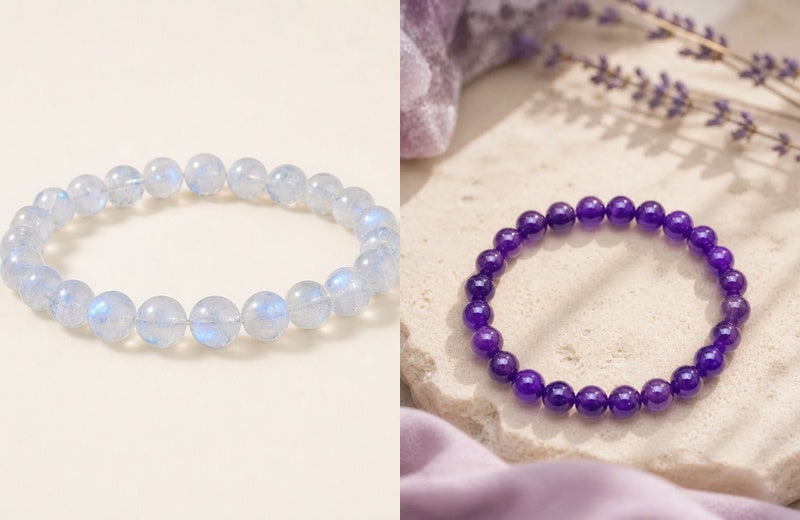
Born from the same mineral kingdom yet shaped by divergent geological histories, Moonstone and Amethyst embody two poles of restorative energy. Moonstone, with its lunar adularescence, mirrors emotional tides and invites cyclical intuition; Amethyst, a crystalline quartz, offers crown stillness and a quiet meditative reset. Together, they form a quiet luxury of balance—harmonizing the ebb and flow of feeling with the serene clarity of restful sleep.
Core Diagnostic Verdict: For cyclical intuition and emotional fluidity, choose Moonstone; for meditative stillness and a calming evening ritual, choose Amethyst—but the ultimate quiet luxury is stacking both for a harmonious loop of lunar rhythm and crown calm.
- Direct Distinction: Moonstone represents lunar emotional rhythms vs Amethyst represents crown stillness
- Mohs Hardness: Moonstone (Mohs 6–6.5) vs Amethyst (Mohs 7)
- Primary Energy Axis: Intuitive Flow vs Meditative Stillness
- Lumina Standard: Grade AAA Natural Gemstones // Verified Untreated
- Mineral Identity: Feldspar (orthoclase with albite) vs Quartz (SiO₂)
The Core Energetic Key: Moonstone is the fluid, intuitive embrace of lunar rhythms; Amethyst is the still, meditative sanctuary of crown calm.
Moonstone: The Lunar Pulse of Emotional Intuition
Moonstone is a variety of the feldspar-group mineral orthoclase. During formation, orthoclase and albite separate into alternating microscopic layers, and when light falls between these thin layers it scatters—producing the phenomenon known as adularescence, a soft, billowing sheen that appears to move across the gem like moonlight through thin clouds. The layers that create this glow are remarkably fine, close in scale to the wavelength of light itself. Formed in igneous rocks through slow cooling, Moonstone carries the geological memory of tectonic patience.
- Cyclical Intuition Amplification – Moonstone is traditionally associated with the body's natural rhythms and with lunar phases, encouraging emotional awareness and intuitive flow. In crystal-wellness practice it is used to invite receptivity to inner tides—ideal for those seeking to honor their emotional cycles rather than suppress them.
- Restful Sleep and Dream Recall – A gentle companion for the transition between wakefulness and slumber, Moonstone is often kept bedside or worn at night as a reminder to slow the mind and drift into sleep with grace, inviting intuitive insight on waking.
Amethyst: The Crown's Crystalline Stillness
Amethyst is the purple variety of the mineral quartz (SiO₂), colored by irradiation and trace iron impurities within a trigonal crystal lattice. It forms in geodes and hydrothermal veins, where slow crystallization yields the large, six-sided columns with tapering, pointed faces that collectors treasure; many crystals show distinct purple and colorless zoning. Historically as precious as ruby and emerald until large Brazilian deposits were discovered in the 19th century, Amethyst is now the most valued quartz variety. In crystal tradition its ordered structure is associated with the crown chakra—a stable, high-frequency field for mental clarity and meditative depth.
- Crown Chakra Stillness – Resonating with the crown and third-eye chakras, Amethyst is used to foster a sense of detachment from mental chatter. It supports meditation, deepens spiritual awareness, and cultivates a serene perspective that softens the edges of daily stressors.
- Sleep Sanctuary Creation – Placed bedside or worn as a bracelet, Amethyst is a traditional ally for quieting restless energy and inviting tranquility—particularly welcome for those whose minds race at bedtime, offering a crystalline cocoon of calm.
Side-by-Side Diagnostic Breakdown: Moonstone vs. Amethyst
Review this mineral and vibrational matrix to align your choice with the intended outcome:
| Diagnostic Attribute | Moonstone | Amethyst |
|---|---|---|
| Geological Mineral Group | Feldspar (orthoclase with albite) | Quartz (SiO₂) |
| Optical Signature | Adularescence—billowing blue, silver, or white sheen | Vitreous luster; purple-to-colorless crystal zoning |
| Crystal System | Monoclinic | Trigonal |
| Mohs Hardness | 6.0–6.5 | 7 |
| Primary Chakra Resonance (Tradition) | Sacral, Third Eye | Crown, Third Eye |
| Energetic Quality | Fluid, receptive, cyclical | Still, ordered, clarifying |
| Sleep-Support Style | Dream recall, gentle transition into slumber | Quieting mental chatter, bedside calm |
| Best Worn | Daytime, lunar rituals, creative work | Evening meditation, wind-down, sleep |
| Care Note | Softer stone—protect from knocks and hard abrasion | Avoid prolonged heat or direct sun, which can fade color |
How to Choose: A Practical Checklist
Both stones are traditionally used as supportive ritual tools—not as substitutes for medical care. Use this checklist to decide which belongs in your daily practice:
- Choose Moonstone if… you want a tactile reminder to check in with your emotions, you keep a journal or track lunar phases, or you enjoy a softer stone that feels personal and gently worn.
- Choose Amethyst if… your bedtime routine needs a visual anchor for winding down, you meditate and prefer an ordered, calming focal point, or you want a hardy stone suited to near-daily wear.
- Choose both if… you like a morning-to-evening ritual: Moonstone by day for intuitive flow, Amethyst by night for crown calm.
- Practical boundary: If sleep struggles, emotional turbulence, or anxiety persist or interfere with daily life, treat crystals as a complement to—not a replacement for—professional guidance.
When buying, ask for natural, untreated material and confirm the mineral identity: fine Moonstone shows a mobile sheen on a clean, semi-transparent body, while Amethyst should display even purple saturation without cracks or heavy inclusions. Since Moonstone is the softer of the two, reserve it for gentler wear and store it separately from harder pieces.
Harmonizing Both: A Day-to-Night Ritual
The pairing works because the two stones answer different moments. In the morning, slip on Moonstone and set a single intention for emotional awareness—notice where your energy rises and falls without judgment. In the evening, remove it and place Amethyst beside your bed or on your wrist. Let its stillness mark the boundary between the day's receptive flow and the night's quiet reset. Over time, the ritual itself—not the stones alone—becomes the anchor: a gentle rhythm of feeling by day and resting by night. A single, well-chosen piece is often enough; our Moonstone Bracelet (Grade AAA Natural Gemstone) is a lovely starting point for the daytime half of the loop.
Frequently Asked Questions

Moonstone Bracelet (Grade AAA Natural Gemstone)
A gentle ritual piece for bringing this intention into your daily routine.
Shop This Authentic Piece →Can I wear Moonstone and Amethyst at the same time?
Yes—many people wear both, often with Moonstone on one wrist and Amethyst on the other. If you prefer one piece at a time, wear Moonstone during the day and Amethyst in the evening to create a simple day-to-night rhythm.
Which stone is better for sleep?
Both are traditional sleep companions, but their styles differ. Amethyst is commonly chosen for its association with quieting mental chatter and creating a calm bedside atmosphere, while Moonstone is associated with dream recall and a gentle transition into slumber. Try each for a week and notice which ritual feels more natural.
Why is Moonstone softer than Amethyst?
Moonstone is a feldspar with a Mohs hardness of 6.0–6.5, while Amethyst is quartz at Mohs 7. That difference means Moonstone is more vulnerable to scratches and knocks, so it benefits from a protective setting, separate storage, and gentler daily wear.
How do I care for each stone?
Clean both with warm, soapy water. For Amethyst, avoid prolonged exposure to heat or direct sunlight, as this can fade its color. For Moonstone, skip harsh cleaners and ultrasonic machines; a soft cloth and mild soap are safest.
How can I tell a natural, untreated stone?
Look for natural character rather than perfection: Moonstone should show a moving sheen on a slightly translucent body, and Amethyst often displays subtle color zoning from purple to colorless. Ask sellers for disclosure of any treatments and, whenever possible, seek pieces with documented grading such as natural, untreated gemstones.
Continue Reading
- Moonstone Crystal Benefits: Emotional Balance, Intuition, and Sleep Support
- Moonstone Meaning: Guide to Emotional Balance, Intuition & New Beginnings
- Rainbow Moonstone Meaning: A Guide to Intuition, Emotional Balance, and Meditation
- Moonstone Meaning: How to Use This Crystal for Intuition, Sleep & New Beginnings
- Sweet Dreams with Amethyst: A Gentle Guide to Using Crystals for Restful Sleep
- Citrine vs. Amethyst: Ambition vs. Inner Stillness: Harmonizing Daily Financial Drive with Restful Sleep