
Tree agate is a trade name for a white-background moss agate — an opaque-to-translucent chalcedony (microcrystalline quartz) with green moss-like inclusions — and its widely circulated meaning centers on steady growth, patience, rootedness, and quiet connection with nature, rather than dramatic transformation. If you arrived wondering "what does tree agate mean," that single sentence is the honest core: a stone symbolically read as gentle persistence and grounded belonging, not a healing device.
The Verdict Box: 10-Second Executive Summary
- Direct Verdict: Tree agate is symbolic of growth, patience, and rooted connection. Its value is cultural and aesthetic; no verified source supports physical or emotional healing claims.
- What it is: A variety of moss agate — chalcedony, i.e., microcrystalline quartz — usually with an opaque white background and green dendritic or moss-like inclusions (see the Mindat mineral record).
- Mohs Hardness: 6.5–7 for quartz-family chalcedony (standard mineralogy reference value; not separately tested for this article).
- Quality marker: Natural, untreated material with crisp green patterns and no dye pooling or resin-filled cracks — the bar we call the Lumina Grade AAA Integrity Standard.
- Best for: Everyday wear (pendants, bracelets, pocket stones), desk and entryway placement, and as a personal reminder of slow, incremental progress.
- Not for: Replacing medical or mental-health care; treat all metaphysical meanings as symbolic.
What Is Tree Agate? A Plain-English Definition
Tree agate is a gemstone trade name, not a formal mineral species. Mineral databases classify it as a type of moss agate — typically the opaque white-background variety with moss-like inclusions — and moss agate itself is a form of chalcedony, which sits within the quartz family (Mindat). In plain terms: a milky-white stone threaded with green, fern-like or branching patterns that look like tiny landscapes or tree shadows.
Because the "tree" element comes from inclusion patterns rather than a distinct mineral formula, two pieces can look dramatically different. That is normal, not a defect. What should look consistent is the base: an even white-to-cream body, clean green patterning, and a surface that feels cool, smooth, and dense rather than waxy or tacky.
Tree Agate vs. Moss Agate vs. Dendritic Agate
These three names are routinely confused because the boundaries are commercial rather than scientific. The comparison below reflects how mineral databases and the gem trade actually sort them, so you can shop with accurate expectations.
Comparison Table: Telling the Three "Landscape" Agates Apart
| Feature | Tree Agate | Moss Agate | Dendritic Agate |
|---|---|---|---|
| Background body color | Usually opaque white to cream | Translucent to semi-translucent, often clear or greyish | Translucent to opaque, commonly white or pale |
| Inclusion style | Green moss-like or branching patches on white | Green, sometimes brown or red, moss or plume forms | Fine black or brown fern/tree-like dendrites (often manganese oxide) |
| Relationship to each other | A described type of moss agate (per Mindat) | The broader chalcedony category | Sibling chalcedony variety with distinct dendritic patterns |
| Symbolic emphasis in common use | Growth, patience, roots, abundance | Renewal, nature connection, creativity | Inner clarity, pattern-finding, grounding |
| Typical visual giveaway | Snowy white base with green "trees" | Greener, more translucent overall | Black/brown branching lines, not green |
How to apply this: If a listing calls a stone "tree agate" but the background is see-through and the inclusions are black, it is more accurately dendritic agate. If the green looks painted on with pooling around the edges, treat that as a dye red flag rather than a variety question. Genuine natural patterning follows the stone's internal grain; dye collects in cracks.
Spiritual Meaning and Symbolism of Tree Agate
The symbolism of tree agate is usually read from its appearance: a pale, quiet stone wearing the image of growth. Across crystal lore — which is cultural and personal, not scientifically established — it is often associated with steadiness, quiet perseverance, and feeling connected to something larger than yourself. None of this has been demonstrated in research; the value lies in what a meaningful symbol does for your attention and habits.
Growth, Patience, and Quiet Progress
Tree agate is often associated with the kind of growth you cannot watch happen — a root spreading underground, a trunk widening by millimeters a year. As a personal reminder, it may support a slower relationship with your own progress: celebrating the unglamorous reps, the small daily consistency, the work that looks like nothing until it suddenly looks like everything. If you are impatient with a long project, keeping this stone in view can serve as a simple cue to judge progress monthly instead of hourly.
Roots, Family, and Connection with Nature
The branching inclusions call to mind roots as much as branches — and that is where much of the stone's emotional symbolism settles: belonging, family lines, home ground, and the feeling of being planted rather than scattered. It is often associated with nature connection too. A practical expression: place a piece near a window or on a tray with found leaves and stones, so it anchors a small ritual of noticing the outdoors even on indoor days.
Traditional Associations: Chakras, Zodiac Signs, and the "Stone of Plenitude"
In crystal tradition, tree agate is commonly linked with the heart chakra (matters of connection, care, and belonging) and sometimes the root chakra (stability and grounding). These are interpretive frameworks, not measurable properties — there is no verifiable anatomical "chakra" for a stone to influence.
Zodiac associations vary by source and should be treated loosely. Tree agate is most frequently listed for Taurus (earth sign, nature and patience themes), with Virgo and Cancer also appearing in common pairings — Virgo for the earthy, orderly temperament, Cancer for the home-and-family symbolism. The nickname "Stone of Plenitude" is a traditional marketplace epithet tied to the green abundance mirror often associated with the stone's foliage-like patterns. It is a poetic label, not a claim of prosperity effects.
Authentic sourcing matters for any meaningful purchase. When a piece is offered as natural tree agate, look for the Lumina Grade AAA Integrity Standard: natural rough material, no chemical resin stabilization, and no irradiation or dye treatment. These criteria keep the stone as nature formed it, rather than as a re-colored facsimile of it.
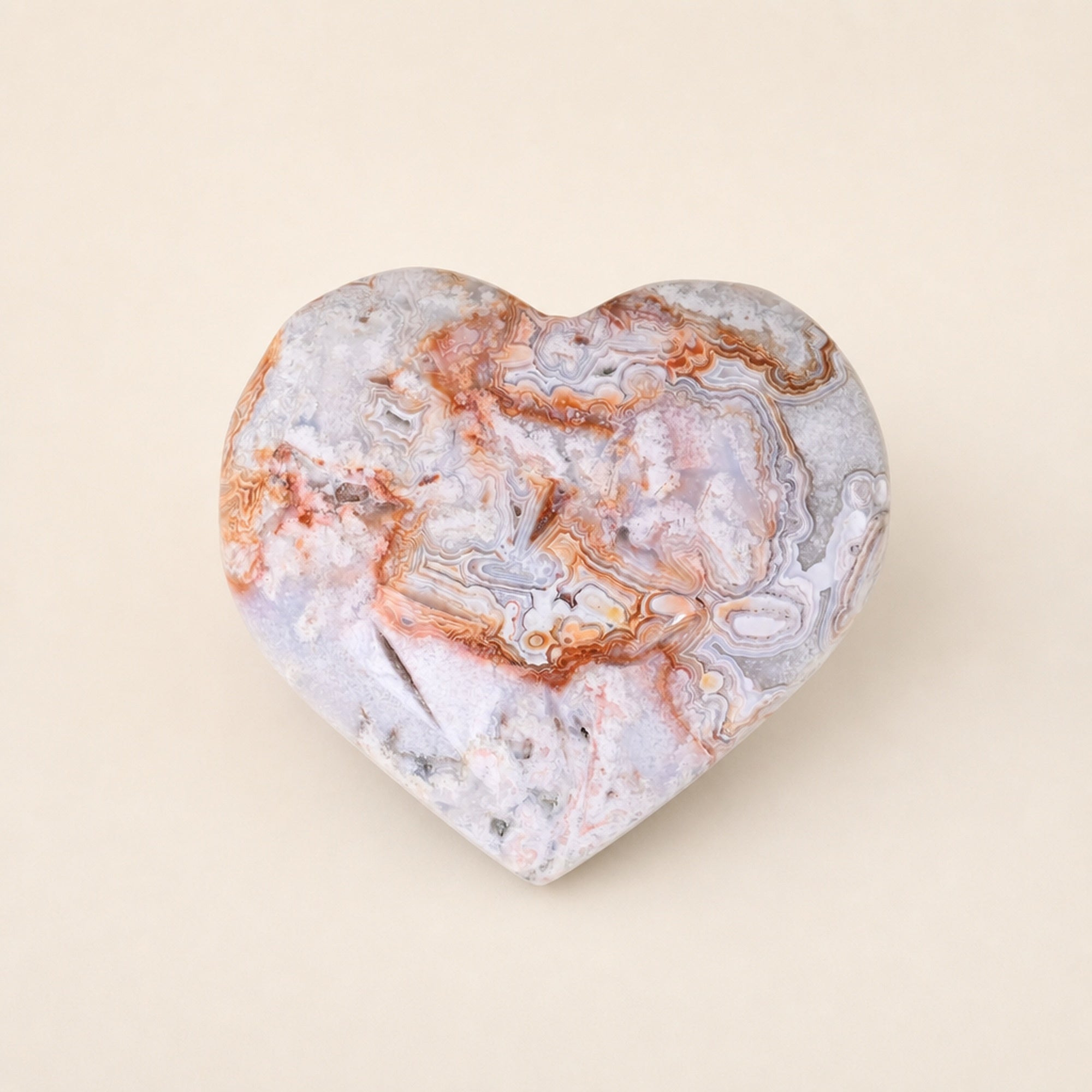
A related stone-family option
Crazy Lace Agate Heart Stone – Joyful Movement
This is a related variety in the same stone family, not a Agate product. We only identify jewelry as Agate when that exact material is verified.
Explore this related optionHow to Use Tree Agate Every Day
The most defensible "daily use" of tree agate is as an object of attention and a gentle environmental cue. Below are practical, low-risk ways people incorporate it — framed as habit anchors and personal reminders, not as therapeutic interventions.
Wearing, Carrying, and Placing It at Home
- Jewelry: A pendant or beaded bracelet keeps the stone in your visual field. Because chalcedony sits around 6.5–7 on the Mohs scale, it tolerates daily wear well, but it can still scratch glass-hard finishes and is best removed for heavy cleaning.
- Pocket or pouch stone: Carry a smooth tumbled piece and handle it during a short pause — one slow breath, one sentence about what "slow growth" looks like today. This works as a habit cue, not a treatment.
- Desk placement: Keep it beside your workspace as a monthly-progress reminder; pair it with a small note listing the one habit you are growing.
- Entryway or windowsill: Place it where you arrive and leave home, tying it to the "roots and belonging" symbolism.
- Plants and garden trays: Set a piece in a potted plant's soil surface as a decorative anchor — a small nod to the nature-connection reading.
Boundary to respect: Do not rely on a stone to manage anxiety, low mood, sleep, or physical symptoms. Seek qualified care for those needs; crystal symbolism and evidence-based support belong in separate categories.
How to Choose, Cleanse, and Care for Tree Agate
Selecting a good piece takes a minute if you know what to look for. Use this quick, decisive checklist rather than a vague "feel the energy" approach.
- Inspect the base. Natural tree agate usually has a white-to-cream background. A suspiciously uniform, flat white can point to bleaching; a see-through body points to a different agate variety.
- Follow the green. Natural moss-like inclusions follow internal structure and look irregular, feathered, or patchy. Pooling in crevices or unnaturally vivid neon-green suggest dye.
- Feel the surface. Cool, dense, and smooth is expected. A tacky or overly waxy feel on a "natural" label is a resin-fill warning sign.
- Hold it to light. Expect subtle translucency at thin edges. Opaque chalkiness is fine; milky plastics often look uniformly cloudy with no depth.
- Ask about treatment. Reputable sellers disclose dye, stabilization, or irradiation. The Lumina Grade AAA Integrity Standard is our shorthand for natural, untreated material with clear treatment transparency.
- Check the finish. Pendants should have smooth bezels and no sharp drill holes; beads should feel uniform without chipped edges.
Cleansing and care: Chalcedony tolerates brief lukewarm water and mild soap; rinse, dry with a soft cloth, and avoid ultrasonic or steam cleaners if the stone is dyed or resin-filled. Keep pieces away from prolonged direct sun and harsh household chemicals. For symbolic "cleansing," moonlight, a dry cloth wipe, or resting the stone on a clean shelf are gentle, non-damaging options — skip salt-water soaks, which can dry out or cloud some agates and are unnecessary.
Frequently Asked Questions
What does tree agate symbolize spiritually?
It is most often associated with growth, patience, rootedness, and connection with nature or family — symbolic readings drawn from its white body and green branching patterns. These are cultural meanings, not proven effects.
What is the difference between tree agate and moss agate?
Tree agate is generally described as a type of moss agate, usually the opaque white-background variety with green moss-like inclusions, while "moss agate" is the broader chalcedony category with more varied translucency and color (Mindat).
How do you use tree agate in daily life?
Wear it as jewelry, carry a tumbled piece as a habit reminder, or place it on a desk, entryway, or windowsill. Treat it as an attention cue for slow progress, not as a healing tool, and keep it out of ultrasonic cleaners.
Sources
Disclaimer: This article shares cultural symbolism and gemstone-care guidance for general information only. It is not medical, psychological, or professional advice, and it makes no claims about healing or therapeutic effects. © 2026 Lumina Quartz.