The Complete Everyday Guide to What Does Amethyst Do: Meaning and Uses
Table of Contents
- What Does Amethyst Do? A Quick Answer to the Everyday Question
- 10-Second Executive Summary / The Verdict Box
- The Meaning Behind the Name: Amethyst's "Not Drunk" History
- From Greek Myth to Modern Symbolism
- Why Amethyst Was Once as Valuable as Ruby and Emerald
- Calming the Mind: Amethyst's Emotional and Mental Effects
- Stress, Overthinking, and Mental Clarity
- Emotional Patterns and Sober-Mindedness
- Amethyst and the Chakras: What It Does for Spiritual Balance
- Practical Everyday Uses: Jewelry, Desk Stones, and Sleep Rituals
- How to Wear and Place Amethyst for Daily Benefit
- Amethyst vs. Citrine: Why the Pairing Works
- Step-by-Step Authenticity Checklist: Is This Amethyst Natural and Grade AAA?
- Amethyst as a February Birthstone
- Frequently Asked Questions
- What does amethyst do for you mentally and emotionally?
- Why is amethyst called the "not drunk" stone?
- How do you cleanse, charge, and care for an amethyst crystal or jewelry?
- A Gentle Closing Note
- Sources
What Does Amethyst Do? A Quick Answer to the Everyday Question
Amethyst is a violet variety of quartz that, in everyday use, is most often associated with calm focus, sober-mindedness, and a gentle sense of mental clarity — and these cultural associations trace directly back to its name, which comes from the Greek a-methystos, meaning "not drunk." In practical terms, people turn to amethyst for three overlapping purposes: as a wearable reminder to stay clear-headed, as a grounding object for desks and bedside tables, and as a birthstone and jewelry gem valued for its color and durability (Mohs hardness 7.0). Its calming reputation is a long-standing cultural and symbolic tradition rather than a medical effect, and high-grade natural amethyst — such as stones meeting the Lumina Grade AAA High-Vibrational Amethyst Standard — is distinguished by saturated royal purple with blue-magenta undertones, natural color zoning, and no chemical filling or irradiation dyeing.
10-Second Executive Summary / The Verdict Box
- Direct Verdict: Amethyst is a natural violet quartz traditionally associated with clarity, calm, and sober-mindedness; it is a symbolic and decorative stone, not a treatment for any condition.
- Mohs Hardness: 7.0 — durable enough for daily rings and pendants with reasonable care.
- Color Origin: Natural violet comes from Fe3+ iron ions in the quartz lattice, colored by natural geological gamma irradiation over millions of years.
- Quality Benchmark: Lumina Grade AAA High-Vibrational Amethyst Standard — saturated royal purple with blue-magenta undertones, visible sectoral growth banding, no chemical filling, no irradiation dyeing.
- Best For: Everyday jewelry, desk and bedside placement, February birthstone gifts, and meditation or journaling rituals where a calm visual cue is welcome.
The Meaning Behind the Name: Amethyst's "Not Drunk" History
The word amethyst derives from the Greek a-methystos — "not drunk" — and in ancient times the stone was believed to ward off drunkenness; drinking cups were sometimes carved from amethyst for exactly this reason (Mindat). Because of its wine-like color, early Greek legends associated amethyst with Dionysus, the god of wine and pleasure, while Roman mythology held that the god of wine colored the stone purple and that it offered protection against drunkenness (GIA; Smithsonian National Museum of Natural History).
From Greek Myth to Modern Symbolism
What began as a legend about wine and clear-headedness became, over centuries, a broader symbol of temperance, sincerity, and focused thought. Today the "not drunk" story is best understood as cultural heritage — a poetic origin for the stone's enduring association with sober-mindedness — rather than a physical property of quartz. That distinction matters: the legend explains why people reach for amethyst, while mineralogy explains what the stone actually is.
Why Amethyst Was Once as Valuable as Ruby and Emerald
Historically, fine amethyst was ranked among the precious colored stones, and large, richly colored specimens were reserved for royalty and the church. The Smithsonian's collection, for example, includes a famous historical amethyst jewel — the "Delhi Sapphire" — a remarkable piece of historical jewelry that shows how seriously amethyst was once treasured (Smithsonian). Large deposits discovered later changed the market, but the stone's aristocratic reputation never fully faded — which is one reason saturated, royal-purple amethyst still reads as "special" today.
Calming the Mind: Amethyst's Emotional and Mental Effects
Amethyst is most often associated with a quiet, steadying presence — a visual and tactile cue that many people use to pause, breathe, and refocus. These are symbolic and personal-reminder uses, not clinical effects; no crystal is a substitute for rest, professional support, or honest self-care.
Stress, Overthinking, and Mental Clarity
In crystal traditions, amethyst may support a sense of mental clarity and is often associated with winding down at the end of the day. A practical, honest way to use it: keep a stone on your desk or nightstand as a physical anchor for a short ritual — three slow breaths before opening your inbox, or a moment of quiet before sleep. The benefit, if any, comes from the pause the stone reminds you to take, not from the quartz itself.
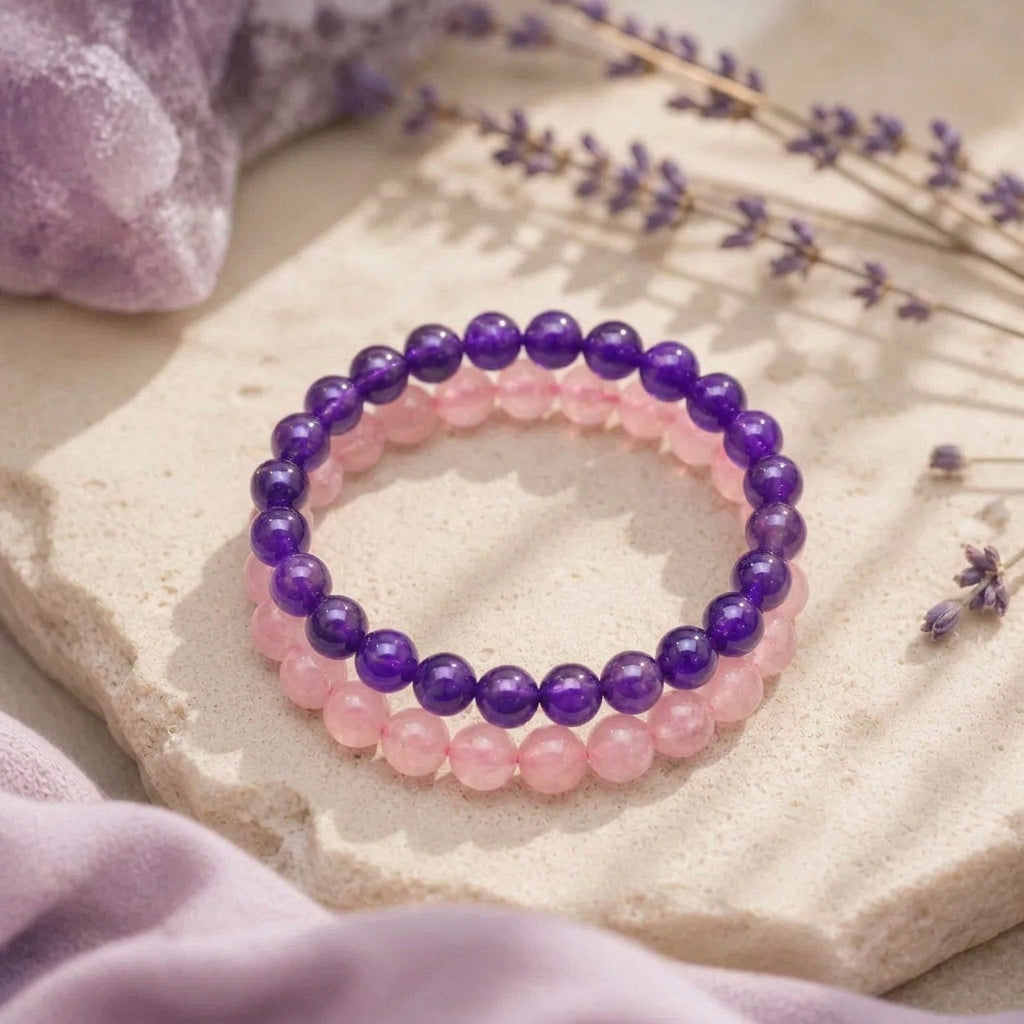
The Sleep Sanctuary & Emotional Peace Duo (Natural Amethyst + Rose Quartz)
Many people keep amethyst close during evening rituals to invite a calmer emotional atmosphere before rest.
Shop This Authentic Piece →Emotional Patterns and Sober-Mindedness
The "not drunk" heritage gives amethyst a natural modern reading: sober-mindedness in the broadest sense — clearer decisions, fewer reactive choices, more honest self-reflection. If you are working on a habit you want to understand better, an amethyst on your journal cover can serve as a gentle reminder of the intention you set. It is a symbol of your commitment, not a mechanism that changes behavior on its own.
Amethyst and the Chakras: What It Does for Spiritual Balance
In chakra traditions, amethyst is most commonly associated with the third eye and crown chakras — the centers linked with intuition, insight, and spiritual perspective. Practitioners often place amethyst above the brows or at the crown during meditation, or keep it nearby during quiet reflection. These are cultural and spiritual practices, presented here as tradition rather than verified physiology. If chakra work is meaningful to you, amethyst's traditional placement is simple: wear it high — as a pendant or earrings — or rest it near the head during meditation.
Practical Everyday Uses: Jewelry, Desk Stones, and Sleep Rituals
Because amethyst holds a Mohs hardness of 7.0, it is durable enough for daily wear, though it deserves reasonable care around hard knocks. Natural high-grade amethyst also shows its authenticity: subtle color zoning (sectoral growth banding) is a signature of natural formation and helps distinguish it from synthetic hydrothermal quartz or purple glass. Saturated royal purple with blue-magenta undertones — rather than milky lilac or bleached gray — is the mark of quality material, and this is exactly the standard behind Lumina Grade AAA Integrity Standard: natural rough origin, zero chemical resin filling, no irradiation dyeing.
How to Wear and Place Amethyst for Daily Benefit
- Wear it where you'll see it: a pendant or ring turns the stone into a repeated visual cue for calm and clarity.
- Desk placement: keep a small amethyst point or tumble near your workspace as an anchor for a brief reset between tasks.
- Bedside ritual: place a stone on the nightstand and pair it with a simple evening wind-down — dim lights, a few pages of a book, a short breath practice.
- Cleansing and charging: rinse with lukewarm water and pat dry; avoid harsh chemicals, prolonged direct sun (which can fade color), and ultrasonic cleaners on filled or antique pieces.
Amethyst vs. Citrine: Why the Pairing Works
Amethyst and citrine are both quartz, and in rare cases they grow together in a single crystal called ametrine. That natural geologic synergy validates what crystal traditions have long said: the two stones' energies are complementary rather than conflicting. In practice, amethyst's cool violet is often paired with citrine's warm gold for a balanced look — one stone associated with calm reflection, the other with bright momentum. When shopping, look for clear color separation between the purple and golden zones in ametrine pieces; blended, muddy color is a sign of lower-grade material.
Step-by-Step Authenticity Checklist: Is This Amethyst Natural and Grade AAA?
- Check the color saturation. Grade AAA amethyst shows saturated royal purple with blue-magenta undertones. Milky lilac, pale lavender, or bleached gray tones usually indicate lower grade or treated material.
- Look for natural color zoning. Tilt the stone in light. Subtle sectoral growth banding — uneven but gradual color zones — is a hallmark of natural quartz. Perfectly uniform color can suggest synthetic hydrothermal quartz or dyed material.
- Confirm the hardness context. Quartz sits at Mohs 7.0. If a "purple stone" scratches easily with a steel blade or feels unusually light and warm-fast, suspect glass.
- Ask about treatment. Request confirmation of no chemical resin filling and no irradiation dyeing — the core of the Lumina Grade AAA Integrity Standard.
- Inspect the setting and surface. Under magnification, natural stones may show tiny inclusions; perfectly flawless, bubble-like interiors often point to glass or synthetic material.
- Buy from sellers who state origin and grade. A written statement of natural origin and treatment status is the simplest safeguard.
Amethyst as a February Birthstone
Amethyst is the traditional February birthstone, which gives it a second life as a gift stone — often chosen for birthdays, anniversaries, and graduations. For February wearers, the stone's meaning layers nicely: a symbol of clear-headedness and calm, given to someone at the start of a new chapter. Because amethyst is durable at Mohs 7.0, it works well for everyday birthstone jewelry, from delicate pendants to statement rings, provided the piece is cared for sensibly.
Frequently Asked Questions
What does amethyst do for you mentally and emotionally?
Amethyst is traditionally associated with mental clarity, calm focus, and sober-mindedness — a symbolic reminder to pause and reflect rather than a medical effect. Many people use it as a visual cue for short breathing or journaling rituals.
Why is amethyst called the "not drunk" stone?
The name comes from the Greek a-methystos, meaning "not drunk"; ancient lore held that amethyst warded off drunkenness, and drinking cups were sometimes carved from it. The story is cultural heritage, not a physical property of quartz.
How do you cleanse, charge, and care for an amethyst crystal or jewelry?
Rinse gently with lukewarm water, pat dry, and keep it out of prolonged direct sun, which can fade color. Avoid harsh chemicals and ultrasonic cleaners on filled or antique settings, and store pieces separately to prevent scratching.
A Gentle Closing Note
Amethyst has carried the "not drunk" story for thousands of years — through Greek myth, Roman legend, and the jewelry cases of museums — and it still earns its place as a stone of clear-headed calm. Use it honestly: as a beautiful, durable quartz that reminds you to slow down, reflect, and choose deliberately. Its meaning is yours to shape.
Sources
- GIA — Amethyst History and Lore
- Mindat — Amethyst: Mineral information, data and localities
- GIA GemKids — Amethyst
- Smithsonian National Museum of Natural History — Tiffany Amethyst Necklace
© 2026 Lumina Quartz. This article shares cultural traditions and mineral facts for general interest only; it is not medical advice and makes no claims to treat or prevent any condition.
Product Facts From the Current Catalog
These details come from the active Lumina Quartz catalog record checked on 2026-10-30. They are product-listing facts, not laboratory results or invented wear-test claims.
| Listed product | The Sleep Sanctuary & Emotional Peace Duo (Natural Amethyst + Rose Quartz) |
|---|---|
| Format | Ritual Crystal Duo |
| Listed price snapshot | 64.60 |
Price, availability, and options may change. Check the live product listing before choosing.