The Complete Everyday Guide to Tree Agate: Meaning and Uses
Table of Contents
- 10-Second Executive Summary / The Verdict Box
- What Is Tree Agate? (Geology, Appearance & Origin)
- Tree Agate Meaning: Grounded Growth and Inner Peace
- The tree-branch symbolism of dendritic inclusions
- Root and heart chakra connections
- Everyday Healing Uses and Who It's For
- Tree Agate vs Moss Agate: How to Tell Them Apart
- A Practical Comparison Table: Tree Agate Checkpoints
- How to Wear and Style Tree Agate Jewelry
- Cleansing, Charging and Care for Tree Agate
- How to Choose Quality Tree Agate (Buying Guide)
- Why Tree Agate May Suit a Slower, Grounded Season
- FAQ: Your Tree Agate Questions Answered
- What does tree agate mean and what is it good for?
- How do you tell tree agate apart from moss agate?
- Which chakra is tree agate connected to?
- Sources
Tree agate is an opaque, white-to-cream variety of chalcedony (a form of quartz) whose soft green dendritic inclusions look like tiny ferns or mossy branches. People most often use it as a calming, grounding stone for daily wear, desk decoration, or slow-morning rituals, and it is generally understood to be associated with the root and heart chakras. Its most common lookalike is moss agate; the quickest way to tell them apart is background color and translucency — tree agate is opaque and milky white, while moss agate is usually translucent to semi-transparent with a darker, translucent base.
10-Second Executive Summary / The Verdict Box
- Direct Verdict: Tree agate is a gentle, budget-friendly, opaque quartz that suits everyday grounding and mindful-growth intentions better than it suits dramatic display or high-shine jewelry.
- Mohs Hardness: 6.5–7 for quartz-family chalcedony (relatively durable but softer than pure crystalline quartz at 7).
- Composition: Silicon dioxide (SiO₂), microcrystalline quartz with mineral and dendritic inclusions.
- Transparency: Opaque; milky white or cream base with green, gray, or black branch-like patterns.
- Best For: Daily-wear rings and pendants, desk and windowsill placements, meditation focus pieces, and thoughtful gifts for people who prefer understated, nature-inspired stones.
- Not Ideal For: Harsh-contact sports, prolonged water exposure, or anyone wanting a see-through gemstone look.
What Is Tree Agate? (Geology, Appearance & Origin)
Tree agate is a trade name rather than a formally distinct mineral species. Mineral databases classify it as a variety of quartz (specifically chalcedony), and it is commonly described as the opaque white-backed member of the moss agate family (Mindat). Its "branches" are not plant fossils; they are dendritic mineral inclusions — manganese and iron oxides are the usual suspects — that grew in branching patterns as the silica-rich material formed. This matters for buyers: a genuine tree agate is rock with natural pattern growth, not a printed or glued image, and the branching can repeat or fan out but should never look like a sticker, needle-stuck, or decal along a flat plane.
Appearance-wise, expect a milky, opaque, often slightly waxy surface. The green can lean sage, olive, or gray-green. Because the pattern is three-dimensional, a fresh angle or backlight often reveals depth the photograph missed. On origins, labels like "from Brazil," "from India," or "from Madagascar" are common in the trade, but per the available reference data we do not have a verified locality for this material, so treat origin labels as claims a seller should be able to support — not as proof of quality.
Tree Agate Meaning: Grounded Growth and Inner Peace
In crystal-lore and modern spiritual practice, tree agate is often associated with steady, patient growth — calm roots rather than fast breakouts. People reach for it when they want to feel settled, start small habits, or keep a gentle reminder of a personal intention. Those meanings are cultural and symbolic; they are not proven mineral effects, and a stone does not replace rest, therapy, or medical care. Used that way, though, it is a quiet, honest companion.
The tree-branch symbolism of dendritic inclusions
The branching pattern is the whole point. In symbolic reading, branches suggest two things at once: a rooted trunk (stability, continuity) and outward reach (new directions, small unfolding projects). That duality is why tree agate is often chosen for "slow growth" intentions — a study plan, a recovery habit, a creative project being taken one season at a time — rather than for quick-result goals.
Root and heart chakra connections
Writers and practitioners commonly pair tree agate with the root chakra (grounding, feelings of safety) and the heart chakra (connection, gentleness). Many people hold it during quiet reflection or keep it near their sleep space or desk. These associations are traditional and personal, not clinical; there is no evidence that a stone influences the body's energy centers or nervous system.
Everyday Healing Uses and Who It's For
The phrase "healing uses" is best understood as mindful or symbolic practice. With that honest framing, tree agate is most useful to people who like ritual with low overhead. Practical ways to use it:
- Morning anchor: Hold the stone for one slow breath before checking your phone; set one small intention for the day.
- Desk companion: Place a palm stone beside the keyboard as a visual cue to pause and reset during long work blocks.
- Journal support: Rest it on the page while journaling about growth, patience, or a decision that doesn't need to be rushed.
- Gift of intention: Give a small tumbled piece or bracelet to someone starting a new season — a move, a course, a new habit.
It is often appreciated by people who want something tangible and calming without a high-maintenance gemstone. It is a poor fit for anyone expecting a see-through stone or for wear during rough physical activity, where any 6.5–7 hardness material can chip.
Tree Agate vs Moss Agate: How to Tell Them Apart
This is the most common point of confusion, so here is the difference in plain terms. Moss agate is generally translucent to semi-transparent — light passes through, sometimes just at the edges — and its inclusions often look like fine suspended moss or lichen. Tree agate is opaque with a solid milky white or cream background, and its inclusions read as branched lines, ferns, or small trees. The same mineral family, but the visual experience is opposite: one lets light through, the other blocks it. Note that trade naming can blur — some sellers use "tree agate" loosely for any white-based mossy chalcedony — so always judge the specific stone you are buying, not only the label.
A Practical Comparison Table: Tree Agate Checkpoints
Use this table at the point of purchase or when sorting a mixed lot. It is built around the one verified reference point — tree agate as an opaque, white-backed chalcedony variety (Mindat) — plus the physical behavior of quartz-family stones.
| Checkpoint | Tree Agate (expected) | Moss Agate (expected) | Why It Matters |
|---|---|---|---|
| Body color | Opaque milk-white, cream, or pale gray base | Translucent to semi-transparent base, often darker | Light behavior is the clearest first filter. |
| Pattern form | Branching, fern-like, tree-shaped lines | Mossy, cloud-like, speckled lichen spots | Pattern shape confirms the visual match to the name. |
| Translucency test (flashlight at edge) | Little to no light passes through the body | A soft glow or edge light appears | Best quick test in dim room light. |
| Hardness | 6.5–7 (quartz-family chalcedony) | 6.5–7 | Same care needs: avoid harsh impact and scratches. |
| Pattern depth | Inclusions sit inside the stone at varied depths | Inclusions usually appear suspended inside | Real patterns reward a tilt in light; printed patterns stay flat. |
| Red flag | Uniform pattern on a perfectly flat surface; color thick at drilled edges | Same red flags apply | May indicate dye, resin filling, or a printed imitation. |
How to Wear and Style Tree Agate Jewelry
Tree agate is a soft, neutral stone to style — think of it as the sage-green equivalent of a plain linen shirt. Because the material is opaque, it pairs best with warm neutrals, denim, and olive tones; it can look muddy against highly saturated colors. Practical styling notes:
- Bracelets: A bead bracelet is the most common form; choose a snug but not tight fit so beads don't rub together and dull the polish.
- Pendants: A cabochon pendant lets the branch pattern face outward; a simple silver or brass setting keeps focus on the pattern.
- Rings: Fine for everyday wear, but remove before lifting weights, gardening, or swimming — chips are the main risk at 6.5–7 hardness.
- Layering: It works gently alongside clear quartz or matte metals; avoid mixing with sharp-cornered harder stones (like a raw diamond-cut piece) if the two are in constant contact.
Style aside, keep cleaning to a minimum of harsh chemicals — that is where care comes in.
Cleansing, Charging and Care for Tree Agate
Tree agate is a durable quartz-family stone but not indestructible. Gentle, low-water care is the honest rule.
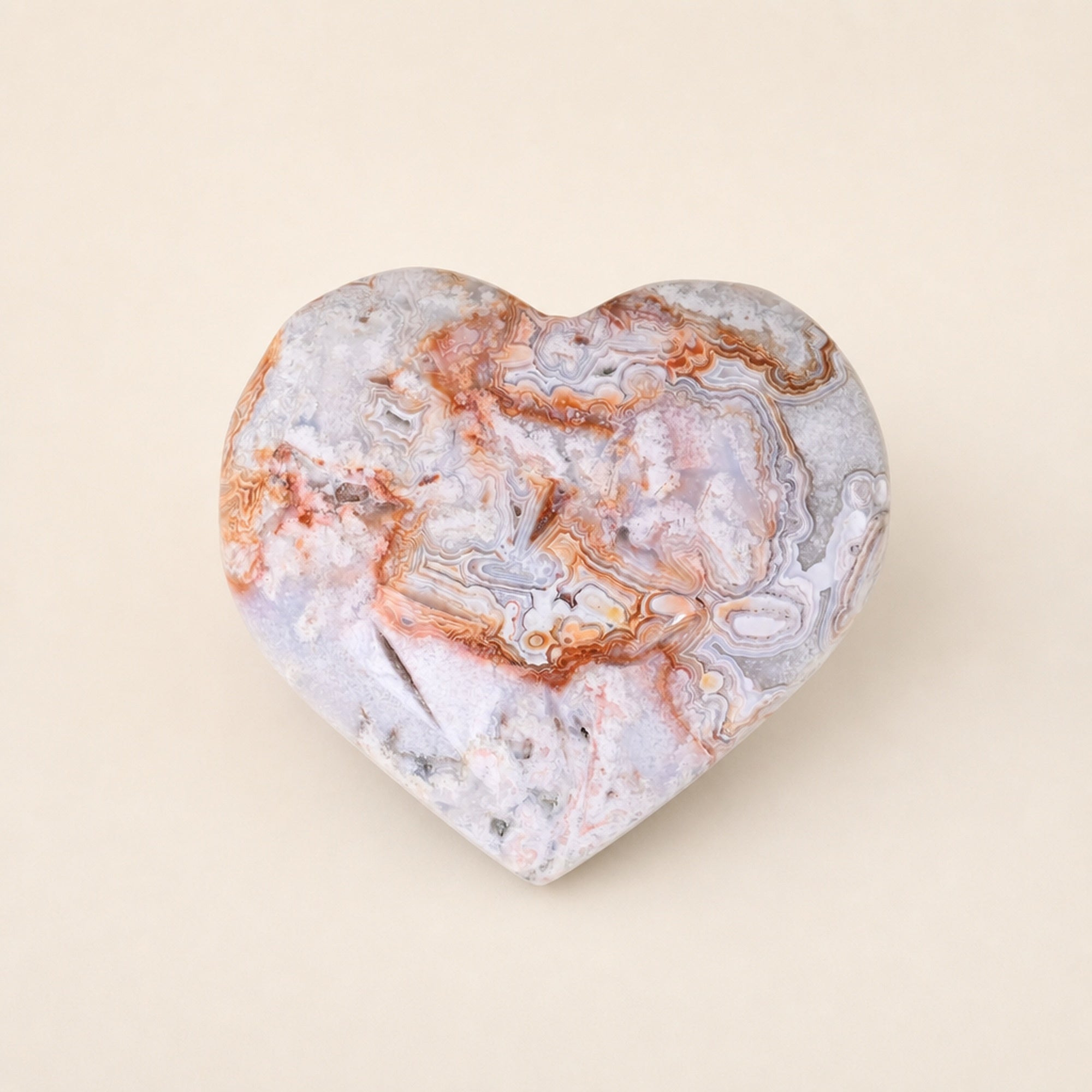
A related stone-family option
Crazy Lace Agate Heart Stone – Joyful Movement
This is a related variety in the same stone family, not a Agate product. We only identify jewelry as Agate when that exact material is verified.
Explore this related option- Wipe first: Use a soft, slightly damp cloth to remove skin oils; dry immediately with a lint-free cloth.
- Avoid long soaking: Prolonged water exposure isn't needed and can dull surface polish over time. A quick rinse is fine; don't leave pieces in a bath.
- Skip harsh chemicals: Household cleaners, alcohol-heavy products, and ultrasonic cleaners are not recommended for dyed or resin-filled material — and a stone marketed as untested should be treated gently.
- Store separately: Keep it in a soft pouch or its own compartment so harder stones don't scratch it.
- Cleansing rituals, if you use them: Many people prefer smoke, sound, or simply placing the stone briefly in morning light. These are symbolic practices, not a chemical process, and no verified source treats them as empirically proven.
- Recharging a "charge": Set a glass of water and the stone on a windowsill for a few minutes of morning calm; sunlight is fine, but avoid leaving it in hot cars or prolonged direct summer sun as a general care habit.
The most important care habit is simple: treat it like a delicate textile — gentle friction, minimal water, and no rough edges against it.
How to Choose Quality Tree Agate (Buying Guide)
At Lumina Quartz, we judge quality under a plain standard we call the Lumina Grade AAA Integrity Standard: natural rough or polished material, zero chemical glue or resin filling, and no irradiation or dye treatment. This is a practical, checkable standard, not a secret code — here is how to test for it yourself:
- Look at the drilled edges and back: Dye often pools where a hole is drilled. A natural stone's color should look consistent at the surface and, as far as visible, inside.
- Tilt it in light: Real branch patterns sit at multiple depths and change as you tilt. A uniform, flat print doesn't.
- Feel for coldness and weight: Quartz-family stones tend to feel cool and dense in the hand. Very lightweight or overly warm-to-touch pieces deserve a second look, though feel alone is not proof.
- Ask about treatment plainly: A trustworthy seller can say whether a piece is untreated or stabilized. "Unknown origin" is fine; "no answer on treatment" is not ideal.
- Check the pattern-to-size ratio: On a bracelet, patterns repeat every stone; on a large cabochon, a single fern-like pattern facing the viewer is usually the most collectible.
- Match the form to use: A tumbled stone for a desk, a flat-backed cabochon for a pendant, and a bead bracelet for wear. Buy for the job, not for the photograph.
These steps are the honest boundary: without a lab analysis, no one can certify a single stone from a photo, so buy from sellers who are transparent about the standard they apply.
Why Tree Agate May Suit a Slower, Grounded Season
If your current season is loud, tree agate is a small argument for quiet. Its meaning is associated with patient growth rather than fast results, and its look — milky, earthy, gently branched — reads more like a forest floor than a spotlight. That pairing of symbolism and appearance is why people keep it on desks, in pockets, and beside journals. It may support a feeling of calm and focus through ritual and reminder; it is not a treatment, and it is not a substitute for real support systems. Used honestly, it is simply a beautiful, sturdy object that helps you pause.
FAQ: Your Tree Agate Questions Answered
What does tree agate mean and what is it good for?
It is often associated with grounded growth and calm, and is commonly used as a mindfulness or intention-setting stone; it may support a sense of focus through ritual, but it is not a medical or scientifically proven remedy.
How do you tell tree agate apart from moss agate?
Tree agate is opaque with a milky white base and branch-like patterns, while moss agate is typically translucent with mossy, cloud-like inclusions — a flashlight helped at the edge quickly shows the difference.
Which chakra is tree agate connected to?
It is traditionally linked with the root chakra for grounding and the heart chakra for gentle connection; these associations are cultural and personal rather than clinical.
Sources
- Mindat — Tree Agate: Mineral information, data and localities (used for classification as an opaque, white-backed variety of moss agate/chalcedony and quartz-family identification).
Note: cultural, chakra, and symbolic meanings in this article are presented as traditional and personal interpretations, not verified mineral properties or health claims.
© 2026 Lumina Quartz.