The Complete Everyday Guide to Orange Agate: Meaning and Uses

Table of Contents
- What Is Orange Agate? Composition, Color, and Patterns Explained
- The Verdict Box: 10-Second Executive Summary
- Orange Agate vs. Carnelian: How to Tell Them Apart
- Orange Agate Meaning and History
- Healing Properties and Benefits of Orange Agate
- Emotional, Mental, and Physical Benefits
- Sacral Chakra Balancing and Spiritual Uses
- Natural vs. Treated Orange Agate: What Buyers Should Know
- A Buyer's Step-by-Step Checklist
- Everyday Uses: Jewelry, Home Decor, and Meditation Practice
- How to Cleanse, Charge, and Care for Orange Agate
- FAQ: Orange Agate Quick Answers
- What is orange agate and how is it different from carnelian?
- What are the healing properties and benefits of orange agate?
- Which chakra is orange agate associated with and how do you use it?
- Is orange agate natural or heat-treated and dyed?
- How do you cleanse, charge, and care for orange agate jewelry?
- Sources
What Is Orange Agate? Composition, Color, and Patterns Explained
Orange agate is a banded, translucent-to-opaque variety of chalcedony—a microcrystalline form of quartz—whose warm orange tones come from iron oxide inclusions and layered deposition. Its defining feature is not just color but pattern: agates often form in layers or bands of color, and the Brazilian material that remains a favorite of gem carvers for its depth of color is a classic example of this layered structure.
The Verdict Box: 10-Second Executive Summary
- Direct Verdict: Orange agate is a banded chalcedony (microcrystalline quartz) best used as an everyday grounding and decorative stone—not a substitute for medical care.
- Mohs Hardness: Roughly 6.5–7 (typical for quartz-family chalcedony), making it suitable for pendants, rings, and home objects with normal care.
- Composition: Silicon dioxide (SiO₂) with iron-oxide color and characteristic banding.
- Key Distinction: Agate shows visible bands or layers; carnelian is typically more uniform orange-red and is a separate chalcedony variety traded under its own name.
- Best For: Everyday wear, warm-toned home decor, and simple meditation or intention practices.
Orange Agate vs. Carnelian: How to Tell Them Apart
The clearest way to separate the two is pattern. Agates are known for forming in layers or bands of color, while carnelian is generally appreciated for a more even, saturated orange-red body color. If you can see distinct bands, swirls, or translucent layering, you are most likely looking at agate; if the stone is uniform and the color fairly consistent throughout, carnelian is the better guess.
A second difference is hue depth. Orange agate tends to read as a softer, peachy-to-rust orange with visible structure, and its depth of color is one reason Brazilian agate remains favored by carvers. Carnelian usually carries a deeper, more uniform red-orange. Because both are chalcedony, neither is "fake" when it lacks bands—but you can feel confident paying for the correct name.
In gem and mineral trade, the distinction matters for pricing and for the story you attach to a piece. If a seller labels a uniform stone "orange agate," ask whether the banding was simply minimal or whether the stone is actually carnelian sold under a broader umbrella term. At Lumina Quartz, our Lumina Grade AAA Integrity Standard requires that a stone's trade name match its visible characteristics—natural, untreated material with no chemical resin-filling and no irradiation or dye—so you know exactly what you are holding.
Orange Agate Meaning and History
Agate has long been associated with protection, steadiness, and connection to the earth, meanings that are cultural and symbolic rather than scientific claims. Orange tones in particular are often associated with warmth, vitality, and creativity in traditions that assign color meaning to stones.
On the practical and historical side, agate's story is one of global trade. Massive agate deposits were discovered in Rio Grande do Sul, Brazil in the 1800s and shipped for cutting to Idar-Oberstein, the German gem-cutting center. That history explains why Brazilian agate is still prized for its depth of color and layered patterns. It is a useful reminder that an orange agate stone is both a natural mineral specimen and a small piece of trade history.
Healing Properties and Benefits of Orange Agate
Emotional, Mental, and Physical Benefits
In crystal lore, orange agate may support feelings of grounding and steadiness during busy days; it is often associated with patience and with a gentle return to the present moment. Some people use it as a tactile reminder to slow their breathing and reset their attention. These are personal and symbolic uses, not medical effects—orange agate does not treat, cure, or prevent any condition.
Mentally, the stone's warm color and layered pattern can serve as a visual anchor during journaling or intention-setting. If you find yourself reaching for it when you feel scattered, treat that as a cue to pause rather than as proof of a chemical effect. The benefit comes from the ritual and the attention, not from the mineral itself.
Sacral Chakra Balancing and Spiritual Uses
Orange agate is often associated with the sacral chakra in chakra traditions, which place this energy center near the lower abdomen and link it with creativity and emotional flow. A common practice is to hold the stone during quiet meditation or place it nearby while writing, as a symbolic focus for creative work.
Spiritual uses vary widely by tradition and personal belief. What remains consistent is that these are symbolic practices: orange agate may be used as a reminder of your intentions, but it is not a substitute for professional care, and the stone itself has no documented effect on the body or nervous system.
Natural vs. Treated Orange Agate: What Buyers Should Know
Natural orange agate is colored by iron oxides and shows natural banding, small inclusions, and slight variations in tone from stone to stone. Treated agate may be heat-treated to deepen color, dyed to create orange hues, or resin-filled to hide cracks. Heat treatment is common and generally accepted in the trade; dyeing and chemical filling are the areas where buyers deserve clear disclosure.
Our Lumina Grade AAA Integrity Standard is built around the stricter end of that spectrum: natural rough origin, no chemical resin injection, and no irradiation or dye. When grading, we check for natural color zoning and banding that follows the stone's structure, since dye often pools in cracks and fills them with unnaturally even orange.
A Buyer's Step-by-Step Checklist
- Look at the bands first. Natural layering follows the stone's growth structure and may shift in translucency; painted or dyed color tends to sit more uniformly on the surface.
- Turn it in light. Natural banded agate changes subtly as light passes through thin bands. Dye often looks flat across the whole face.
- Check cracks. Color concentrated along fine fracture lines is a classic sign of dye penetration.
- Ask about treatments directly. A reputable seller should tell you whether heat treatment, dyeing, or resin-filling was used.
- Confirm hardness and use. At about 6.5–7 on the Mohs scale, orange agate suits rings and pendants but can scratch, so store it separately from softer stones.
Boundary note: No visual check can replace a laboratory report for high-value pieces. For everyday purchases, the checklist above helps you ask better questions rather than make a guarantee.
Everyday Uses: Jewelry, Home Decor, and Meditation Practice
Because orange agate sits at about 6.5–7 on the Mohs hardness scale, it is practical for everyday jewelry—pendants, rings, and bracelets—as long as you remove pieces during hard physical work and store them in a soft pouch. Its warm tone pairs naturally with gold and copper settings; stone carvers have long favored Brazilian agate for its depth of color.
For home decor, orange agate slices and tumbled stones make a soft, low-key accent on a desk, tray, or bookshelf. Place slices where sunlight can pass through them so the banding reads clearly; this is the same layering that makes agate distinctive in fall palettes of orange, brown, and yellow.
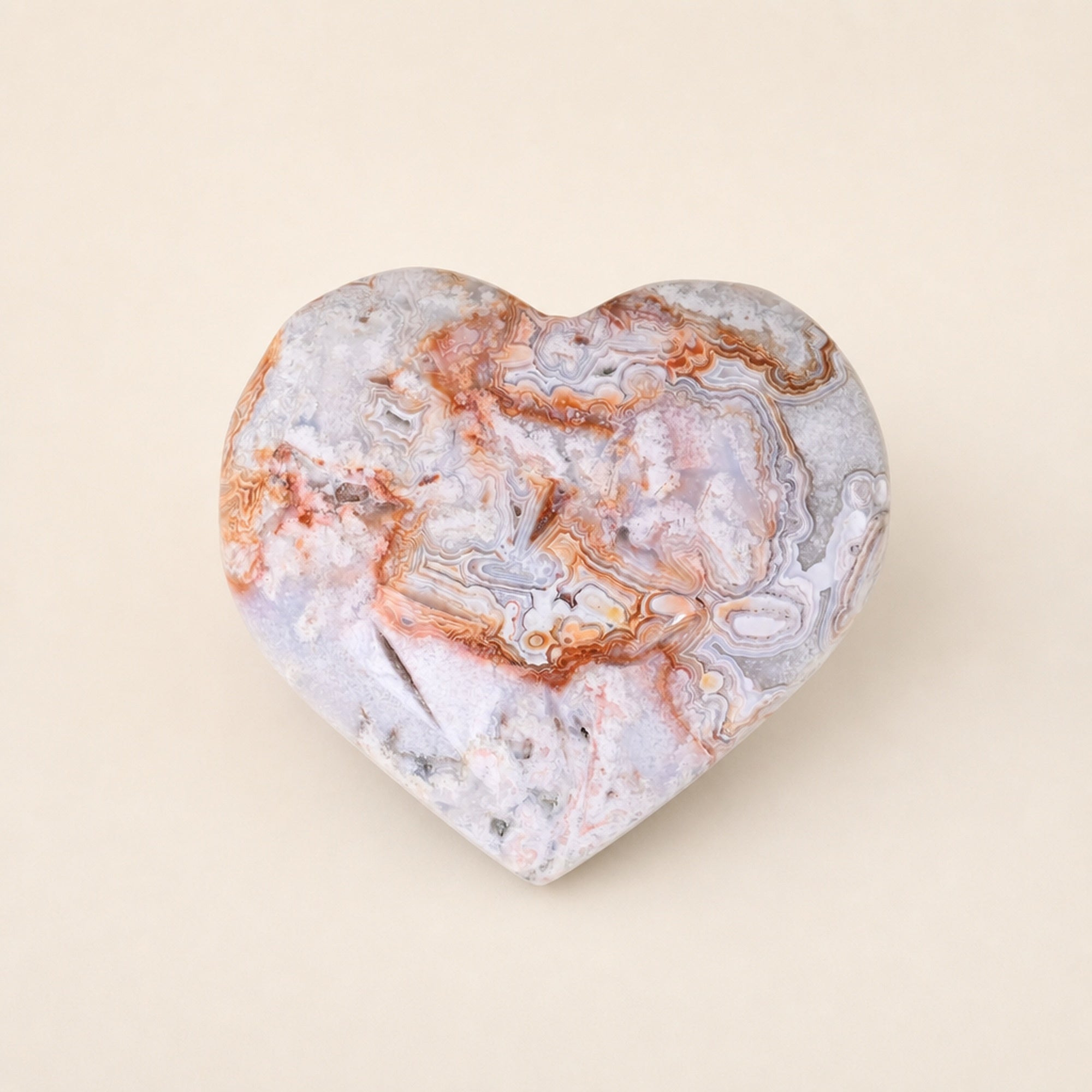
A related stone-family option
Crazy Lace Agate Heart Stone – Joyful Movement
This is a related variety in the same stone family, not a Agate product. We only identify jewelry as Agate when that exact material is verified.
Explore this related optionFor meditation or intention work, keep it simple: hold the piece, name one thing you want to stay grounded through today, and set it down. The value is in the ritual and the pause, not in a promised physical change.
How to Cleanse, Charge, and Care for Orange Agate
Care is straightforward. Clean orange agate with lukewarm water and a soft cloth, dry it gently, and avoid harsh chemicals, ultrasonic cleaners, and steam on any piece with a treatment or filled crack. Keep jewelry away from perfume and household cleaners, which can dull the surface over time.
For a simple cleansing ritual, rinse natural pieces in cool water, pat them dry, and let them rest on a windowsill or a soft cloth—symbolic and gentle. Avoid long soaking for treated pieces, and never store orange agate loose in a drawer with softer stones; hardness only protects the agate, not the stone beside it.
FAQ: Orange Agate Quick Answers
What is orange agate and how is it different from carnelian?
Orange agate is a banded form of chalcedony with visible layers or swirls, while carnelian usually shows a more uniform orange-red color. Both are chalcedony, so check the banding first—it is the clearest everyday distinction.
What are the healing properties and benefits of orange agate?
In crystal traditions, orange agate may support feelings of grounding, patience, and creative focus, and it is often used as a tactile reminder to pause. These are symbolic, personal practices—not medical treatments, and not claims that the stone changes your body.
Which chakra is orange agate associated with and how do you use it?
It is often associated with the sacral chakra in chakra traditions. A common use is holding it during quiet meditation or keeping it near your workspace as a focus for creative intentions.
Is orange agate natural or heat-treated and dyed?
Both exist. Heat treatment is common in the trade, while dyeing and resin-filling should be disclosed by the seller. Under our Lumina Grade AAA Integrity Standard, pieces are natural origin with no chemical resin-filling and no irradiation or dye.
How do you cleanse, charge, and care for orange agate jewelry?
Wipe with lukewarm water and a soft cloth, dry gently, and keep it away from chemicals and ultrasonic cleaners. For symbolic cleansing, rinse natural pieces and let them rest in soft light; store jewelry separately to prevent scratches.
Sources
- GIA — Fall for Autumn Gems (agate layering, fire agate/chalcedony composition, Brazilian agate deposits and carving trade)
Disclaimer: Cultural and spiritual meanings described here are symbolic and traditional, not medical claims. Orange agate is not a treatment for any health condition. Mohs hardness figures are general values for quartz-family chalcedony and can vary by specimen.
© 2026 Lumina Quartz