The Complete Everyday Guide to Green Garnet Stone: Meaning and Uses
Table of Contents
- What Is Green Garnet Stone? A Clear Definition
- 10-Second Executive Summary / The Verdict Box
- Green Garnet Meaning: Spiritual Protection and Everyday Symbolism
- Types of Green Garnet: Tsavorite, Demantoid, and Rare Uvarovite
- Green Garnet Properties: Color, Hardness, and What Makes It Special
- Decision Table: Which Green Garnet Fits Your Goal?
- Everyday Uses: Jewelry, Décor, and Energy Practices
- Green Garnet vs. Emerald: Value, Durability, and Buying Advice
- How to Choose and Care for Green Garnet Stone
- FAQ: Quick Answers to Common Green Garnet Questions
- What is green garnet stone and what does it mean?
- Is green garnet the same as tsavorite or demantoid?
- How do I choose and care for green garnet jewelry?
- Sources
What Is Green Garnet Stone? A Clear Definition
Green garnet stone is a variety of the garnet mineral family that displays green rather than the familiar deep red—and it is not one single gem, but a small group of distinct garnet species whose chemistry produces green color. Only three of the six main garnet types (Grossular, Andradite, and Uvarovite) can appear green, and each behaves differently in terms of rarity, brilliance, and hardness. The most valuable are tsavorite (a green grossular) and demantoid (a green andradite), both prized because their vivid hues can rival or exceed fine emeralds. GIA notes that color is the most important value factor in garnet, and that green varieties like tsavorite and demantoid are among the rarest and most sought after.
10-Second Executive Summary / The Verdict Box
- Direct Verdict: Green garnet is a genuine, distinct gem group—not a dyed or "green emerald substitute." Tsavorite and demantoid are the two collector-grade types; uvarovite is a rare collectors' mineral.
- Mohs Hardness: Tsavorite (grossular) ≈ 6.5–7.5; Demantoid (andradite) ≈ 6.5–7; Uvarovite ≈ 6.5–7. These are generally harder and more chip-resistant than emerald (≈ 7.5–8 but often heavily included and brittle).
- Key Physical Traits: High refractive index and strong light transmission give green garnet notable brilliance and "life" in a setting.
- Best Use Cases: Everyday rings and pendants (tsavorite), high-brilliance heirloom pieces (demantoid), and display/specimen collections (uvarovite drusy).
- Lumina Grade AAA Integrity Standard: Look for natural, unheated, untreated stones—no chemical fracture-filling, no irradiation, no dye. Ask for origin and disclosure before you buy.
Green Garnet Meaning: Spiritual Protection and Everyday Symbolism
In crystal and energy traditions, green garnet is often associated with spiritual protection—conceptually forming a gentle "energetic barrier" that many practitioners link to shielding against envy, anger, and fear. Some sources describe it as helping to clear "electromagnetic smog" and cleanse stagnant energy in a room, though these are traditional and intuitive uses rather than clinically established effects. In a grounded, everyday sense, green garnet's meaning tends to center on renewal: its green color is widely linked to growth, vitality, and quiet resilience, making it a meaningful stone for new chapters, new projects, or simply a calmer daily rhythm. If you value symbolism, you might wear it as a reminder rather than a cure.
Types of Green Garnet: Tsavorite, Demantoid, and Rare Uvarovite
Not all "green garnets" are the same stone, and knowing the difference is the single most useful thing for a buyer:
- Tsavorite (green grossular): Discovered by geologist Campbell Bridges near Tsavo National Park in Kenya, and also found along the Tanzania–Kenya border. GIA explains that tsavorite is rarer than red garnet and requires rarer rock chemistries and conditions to form. Its color runs from light mint to deep forest green, and it is often the most practical green garnet for daily jewelry.
- Demantoid (green andradite): Valued for exceptional brilliance and its signature "horsetail" inclusions. It is the rarest green garnet variety; stones over 2 carats are extremely uncommon, which is why fine demantoid is largely a collector's or heirloom stone.
- Uvarovite (green garnet): Typically forms as tiny, brilliant green drusy crystals rather than large faceted gems, so it appears more often in specimens and inlay work than in solitaire rings.
Because grossular shows the widest color range of any garnet mineral, the specific chemistry is what separates a soft mint tsavorite from a vivid chrome-green one.
Green Garnet Properties: Color, Hardness, and What Makes It Special
What makes green garnet special is the combination of strong color, high light transmission, and respectable hardness. Its high refractive index means light bends and bounces inside the stone, which is why green garnet jewelry tends to look bright and lively rather than flat. On the Mohs scale, tsavorite and demantoid generally sit around 6.5–7.5—hard enough for most everyday wear, though not as scratch-resistant as diamond or sapphire. Unlike emerald, which is often heavily included and prone to chipping, well-cut green garnet typically has cleaner crystal and fewer structural weak points, making it a lower-maintenance green option for regular use. Its variable chemical composition also influences its hardness, which is why cutters match different green garnets to different jewelry types.
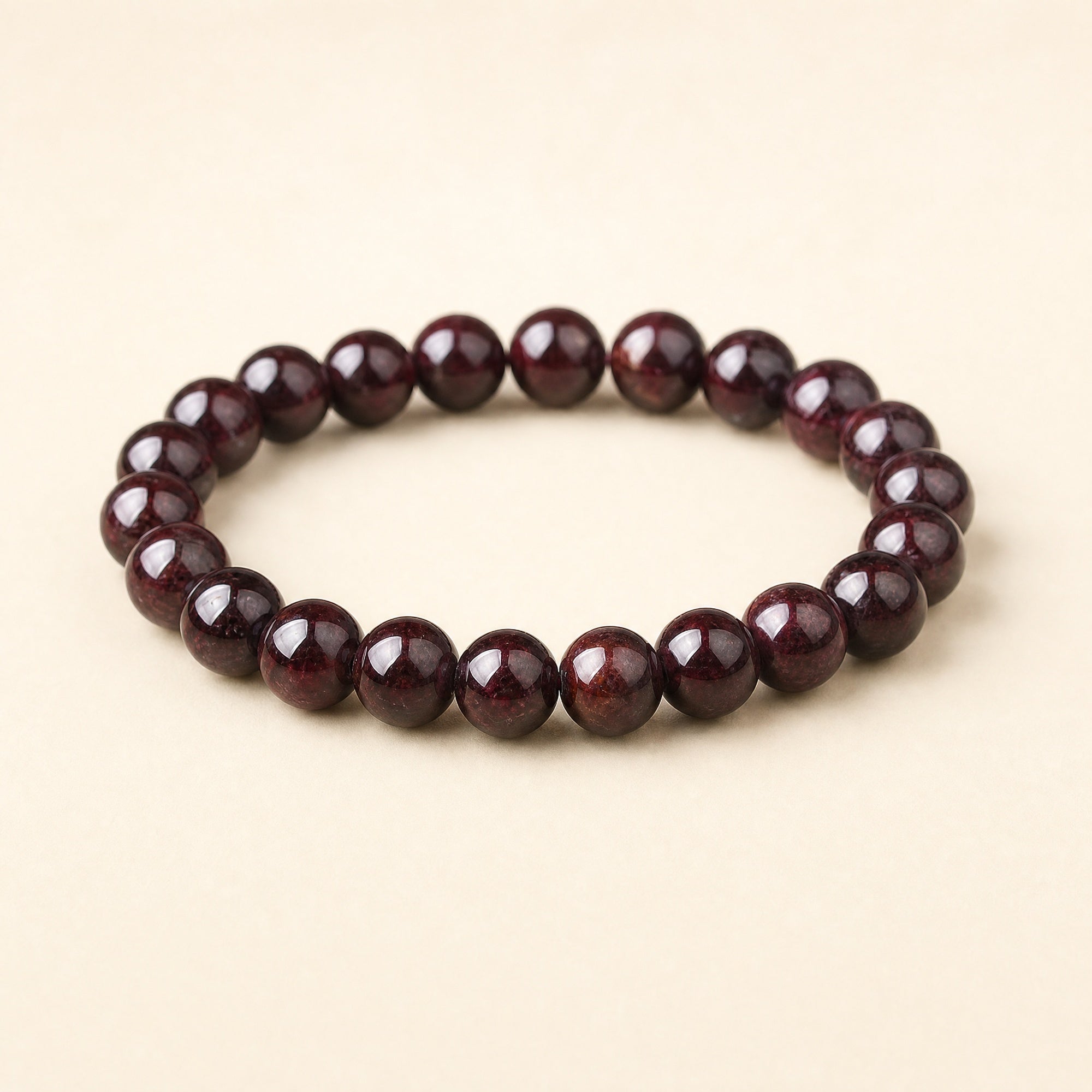
Garnet Bracelet
A quiet bracelet for turning this intention into a small daily ritual.
Shop This Authentic Piece →Decision Table: Which Green Garnet Fits Your Goal?
| Your priority | Best pick | Why | Watch-outs |
|---|---|---|---|
| Everyday ring you can actually wear | Tsavorite | Hardness ~6.5–7.5, strong brilliance, cleaner crystal than emerald | Choose a protective bezel or halo for high-wear use |
| Maximum sparkle / collector value | Demantoid | Highest brilliance of the green garnets | Over 2 ct is extremely rare—expect premium pricing and limited options |
| Budget-friendly green with presence | Mint tsavorite / smaller stones | Lighter color tier keeps cost accessible | Confirm the green is natural, not the result of treatment |
| Display or specimen collecting | Uvarovite drusy | Distinctive crystal formation | Not suited to faceted solitaire jewelry use |
Everyday Uses: Jewelry, Décor, and Energy Practices
Green garnet works across several everyday contexts:
- Jewelry: Rings, earrings, necklaces, and pendants all suit tsavorite especially well because of its light transmission and toughness relative to emerald. Demantoid is best reserved for earrings, pendants, or occasional-wear rings where its brilliance can shine without heavy abrasion.
- Décor: Uvarovite drusy and small polished green garnet pieces are often displayed as specimens or used in accent décor, where their natural crystal texture becomes the focal point.
- Energy practices: Those who work with crystals may place green garnet in a workspace or carry it for grounding, renewal, and a sense of protective calm. These uses are best approached as supportive rituals rather than treatments.
Green Garnet vs. Emerald: Value, Durability, and Buying Advice
Green garnet and emerald share a color family but behave very differently as purchases:
- Durability: Emerald (Mohs ~7.5–8) is technically harder, but emeralds are commonly included and more brittle, so they chip and scratch more easily in practice. Green garnet is generally tougher in real-world wear.
- Value: Fine emerald historically commands higher per-carat prices at the top end due to name recognition and supply dynamics. However, top-quality tsavorite and demantoid can rival or exceed fine emerald in beauty, and GIA confirms these green garnets can match emerald's vivid hue. For equivalent visual impact, you often get more stone for your budget with tsavorite.
- Buying advice: Judge green garnet primarily on color (saturation and evenness), then clarity and cut. Always verify disclosure. A trusted seller operating under the Lumina Grade AAA Integrity Standard will confirm the stone is natural and untreated—no fracture-filling, no irradiation, no dye—and will provide origin.
How to Choose and Care for Green Garnet Stone
Use this checklist when selecting and maintaining your stone:
- Confirm the type: Ask whether it is tsavorite, demantoid, or uvarovite—this drives value and wear suitability.
- Check color in daylight: Green garnet can shift under different lighting; evaluate it in natural light before committing.
- Verify treatment status: Insist on natural, untreated stones per the Lumina Grade AAA Integrity Standard.
- Match to wear pattern: Choose bezel settings for rings you'll wear daily; save open settings for occasional pieces.
- Clean gently: Use lukewarm water, mild soap, and a soft brush; avoid steam cleaners and ultrasonic machines on heavily included stones.
- Store separately: Keep green garnet away from harder gems like diamond or sapphire to prevent surface scratches.
FAQ: Quick Answers to Common Green Garnet Questions
What is green garnet stone and what does it mean?
Green garnet is a green-colored member of the garnet family, most often a grossular (tsavorite) or andradite (demantoid) garnet. It is traditionally associated with spiritual protection and renewal, and it is valued in jewelry for its vivid green color and strong brilliance.
Is green garnet the same as tsavorite or demantoid?
Tsavorite and demantoid are specific types of green garnet, not the same as every green garnet. Tsavorite is a green grossular; demantoid is a green andradite. Uvarovite is a third green variety that usually forms small crystal drusy rather than large faceted gems.
How do I choose and care for green garnet jewelry?
Choose based on your wear pattern: tsavorite for daily rings, demantoid for brilliant occasional pieces. Verify the stone is natural and untreated, then clean gently with mild soap and water, and store it separately from harder gems. Garnets include many varieties, from popular red almandines to rare green tsavorites, each with its own distinct beauty and quality factors, as outlined by the GIA 4Cs guide to garnet.
Sources
- Garnet Engagement Ring: History, Meaning & Symbolism — GIA 4Cs
- Garnet Gemstone — GIA
- Grossular Garnet — Smithsonian National Museum of Natural History
Disclaimer: This article shares traditional and collecting knowledge about green garnet stone. It is not medical advice. Crystal and energy uses are described as supportive practices, not treatments. © 2026 Lumina Quartz.
Product Facts From the Current Catalog
These details come from the active Lumina Quartz catalog record checked on 2026-10-08. They are product-listing facts, not laboratory results or invented wear-test claims.
| Listed product | Garnet Bracelet – Enduring Drive |
|---|---|
| Format | Bracelet |
| Listed price snapshot | 42.00 |
Price, availability, and options may change. Check the live product listing before choosing.