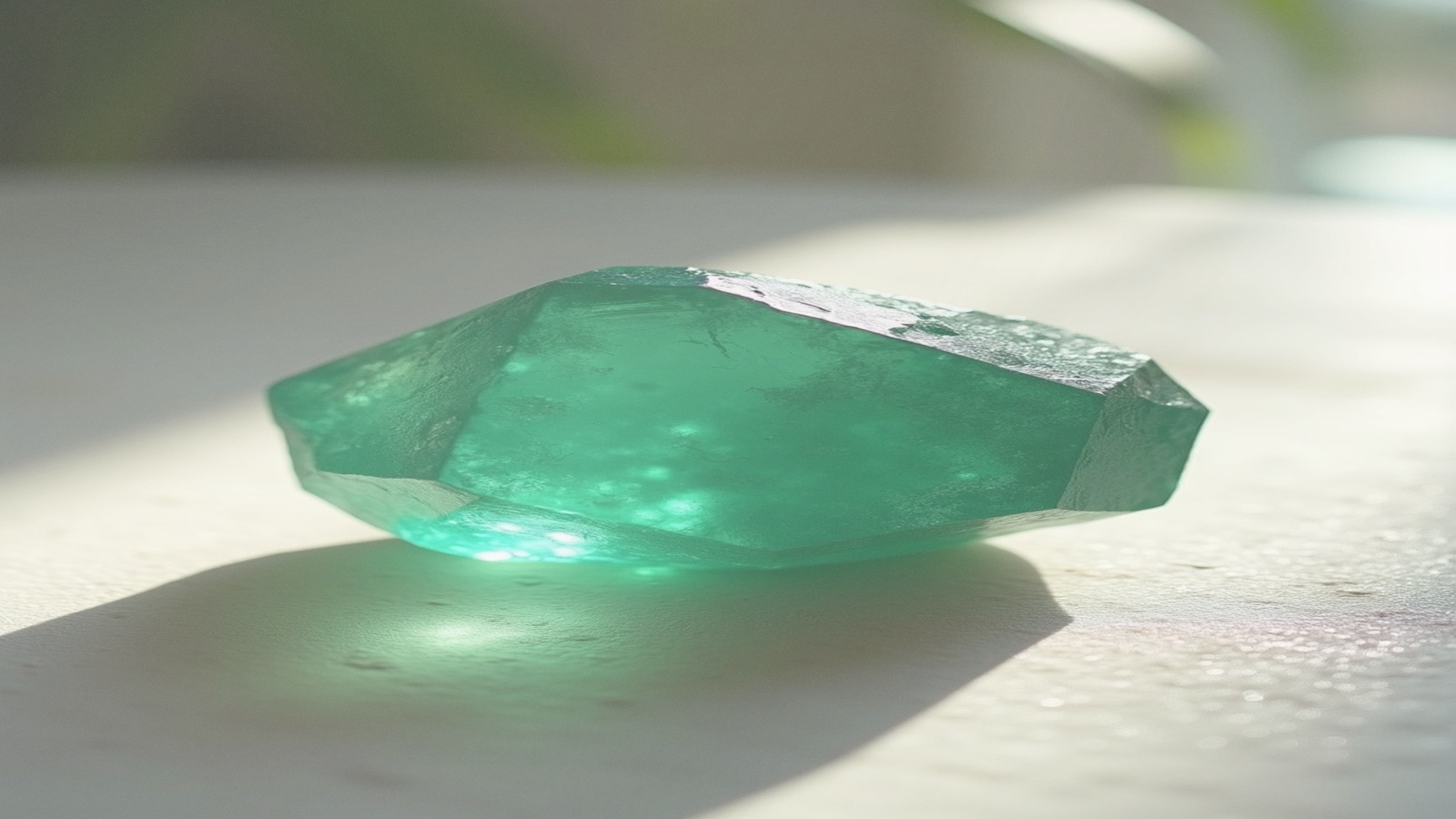
Emerald crystal is the green gem variety of the mineral beryl, and its famous color comes from trace amounts of chromium and vanadium within the crystal structure. In everyday terms, it is a beryllium aluminum cyclosilicate with a hardness that sits between quartz and topaz — beautiful enough for jewelry, soft enough that it asks for gentle handling. This guide walks through its science, symbolism, traditional energy associations, and practical ways to choose, wear, and care for one.
The 10-Second Executive Summary
- Direct Verdict: Emerald crystal is a genuine beryl gemstone valued for its green to bluish-green color, historic symbolism of renewal, and traditional association with the heart. It is a meaningful personal talisman and heirloom-quality gem, not a medical or therapeutic treatment.
- Mohs Hardness: 7.5–8. Durable for everyday rings but still vulnerable to chipping and to heat or chemical exposure — use protective settings and remove during hard physical work.
- Mineral Identity: Beryl (Be₃Al₂Si₆O₁₈); green color from chromium and/or vanadium traces.
- Notable Physical Trait: Natural emeralds are typically "oiled" or treated to improve clarity — a treatment that is standard and accepted when disclosed. Untreated, filler-free stones are rare and command a premium.
- Best Everyday Uses: Heart-centered meditation or journaling, a May birthstone gift, a signature ring or pendant, and a small display piece for a calm workspace.
What Is Emerald Crystal? Science, Color, and Origins
Emerald is the green variety of beryl, the same mineral family that produces aquamarine. The blue-green to pure green tones come from small amounts of chromium and vanadium substituting into the crystal lattice. From a materials standpoint, that makes emerald a beryllium aluminum silicate with a vitreous luster and a Mohs hardness of roughly 7.5 to 8 — harder than quartz, softer than sapphire or diamond.
Age matters for collectors: some of the oldest emeralds, from South Africa, are almost three billion years old, which says something about how long this material has been forming in the earth. Historically, emeralds have been found in Colombia, Brazil, Zambia, Zimbabwe, and Afghanistan, among other regions, and each source can produce a recognizable color character — Colombian stones are often admired for a warm, saturated green, while Zambian stones can lean cooler and bluer.
One honest note before we go further: emerald's beauty is closely tied to its inclusions. The internal "jardin" (French for garden) of fine fractures and inclusions is considered characteristic of natural emerald rather than a flaw to be eliminated. A perfectly clean, large emerald is exceptionally rare — which is why clarity grades and treatments matter so much in buying.
Emerald Meaning and Symbolism Through History
The name emerald traces to the Greek smaragdus, meaning "green gem," and throughout history emeralds have symbolized rebirth and renewal, often associated with spring and new beginnings. That thread runs unusually consistently across cultures: green as growing things, green as returning life.
In the Bible, emerald appears among the twelve precious stones described on the ceremonial dress of a priest in Exodus. In the Middle Ages, gemstone symbolism was woven into daily life and medicine; Hildegard von Bingen, the Benedictine abbess, wrote about illnesses she believed could be treated with emerald. We mention this as history, not as medical guidance — medieval gem medicine does not translate into modern clinical claims. What it does show is how long people have treated emerald as a stone of restoration and care.
Later, the gem became a symbol of status and enduring love in royal collections; the 75.47-carat Hooker Emerald, for instance, was worn by Ottoman Sultan Abdul Hamid II and is now held by the Smithsonian. When people ask what emerald crystal means spiritually today, the common reading is renewal, heartfelt commitment, and the courage to grow — associations carried by tradition rather than proven by experiment.
Emerald Healing Properties and Benefits
Let's be clear about categories. Emerald's physical and geological properties are documented science. Its "healing properties" are traditional and cultural — many people find them meaningful as personal reminders, but no crystal is a substitute for medical care, and emerald should never be used to treat or manage a health condition. With that boundary set, here is how the stone is traditionally understood.
Emotional Balance, Eternal Love, and Heart Healing
Emerald is often associated with steadiness in the emotional realm — the idea of a calm, green center you can return to when feelings run high. In love contexts, it is traditionally linked with loyalty and long-term commitment rather than passionate novelty, which is why it appears so often in anniversary and engagement-adjacent gifts. Many people use it as a tangible reminder to speak kindly to themselves and to the people they love; that reminder value is real even if the mechanism is personal rather than physiological.
Mental Clarity, Creativity, and Focus
In crystal traditions, green stones are frequently connected to fresh perspective and creative flow. Emerald in particular is often described as a stone for seeing a situation clearly and starting again — a fitting match for its rebirth symbolism. A practical way to use it: keep a small emerald near your desk or journal and treat it as a cue to begin a writing session or clear a tangled decision. The stone does not think for you, but a consistent ritual object can support focus the way a good workspace does.
Emerald and the Heart Chakra: How to Work With Its Energy
In chakra traditions, emerald is most commonly associated with the heart chakra (anahata), the energy center linked to compassion, connection, and emotional openness. The association is symbolic and culturally rooted, not measurable — think of it as a framework for reflection rather than a wiring diagram.
If you want to work with emerald in this way, a simple, grounded practice looks like this:
- Settle first. Sit comfortably, hold the stone in your non-dominant hand, and take a few slow breaths until you feel present.
- Set a single intention. One sentence is enough — for example, "I will respond to this person with patience." Vague wishes tend to dissolve; specific intentions stick.
- Place it deliberately. Many people rest the stone near the center of the chest during quiet reflection, or simply keep it in view during a difficult conversation.
- Close with an action. Write down one concrete thing you will do today that matches the intention. The stone is the reminder; the action is the work.
This is a mindfulness routine dressed in symbolism. That is honest, and it is also enough.
Everyday Uses: Jewelry, Meditation, Home Decor, and Gifting
Emerald's hardness of 7.5–8 makes it a viable everyday gem, but with caveats. It is fine for rings, pendants, and earrings when the setting protects the stone — a bezel setting or a halo that shields the edges is kinder than an exposed prong setting. Because emerald is often oiled or otherwise clarity-enhanced, avoid steam cleaners, ultrasonic cleaners, and household chemicals, which can strip fillers or stress the stone. Warm water, a soft brush, and a quick dry are the safe routine.
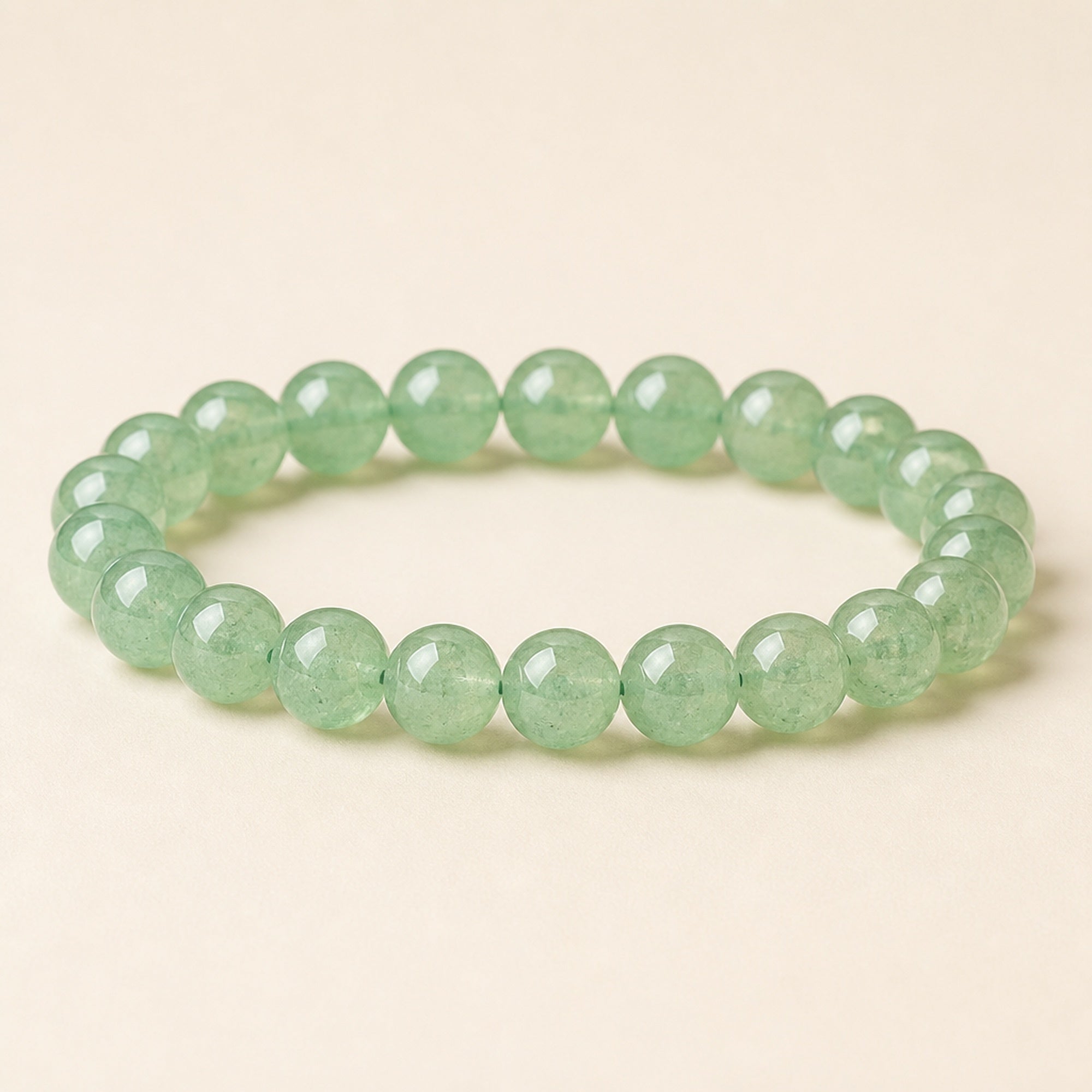
A related color-family option
Green Strawberry Quartz Bracelet – Gentle Renewal
This broader color-family option is not presented as Emerald. We only identify jewelry as Emerald when that exact material is verified.
Explore this related optionBeyond jewelry, emerald works well in three everyday roles:
- Meditation or journaling anchor: a small tumbled or polished emerald kept on a desk or altar serves as a consistent visual cue.
- Home decor: a raw specimen or polished point on a shelf or windowsill-adjacent surface brings the renewal symbolism into a room. Keep it out of direct, prolonged sunlight, which can fade some gem colors over time.
- Gifting: emerald's renewal and loyalty associations make it a thoughtful choice for milestones — new jobs, new homes, new chapters, and May birthdays especially.
Emerald as the May Birthstone and a Meaningful Gift
Emerald is the traditional birthstone for May, which gives it a built-in gifting story. The emotional logic is tidy: May is a spring month, and emerald has symbolized spring-like renewal for millennia. If you are choosing an emerald as a gift, lead with the recipient's taste rather than the symbolism alone — a person who wears silver and cool colors may prefer a bluer Zambian stone, while someone drawn to warm golds may love a saturated Colombian-style green.
For a first emerald, a pendant or a pair of stud earrings is often a lower-risk choice than a daily-wear ring, since the stone is less exposed to knocks. For a milestone gift, a ring in a protective setting is a beautiful and defensible choice — just pair it with care instructions so the recipient knows to remove it for gym sessions, gardening, and cleaning.
How to Choose, Cleanse, and Care for Your Emerald Crystal
Buying an emerald is mostly a clarity-and-treatment conversation, and a good seller will meet you there openly. At Lumina Quartz, we apply the Lumina Grade AAA Integrity Standard to our gem selection: natural rough and gems are documented for origin, with no undisclosed chemical resin filling, no irradiation, and no dyeing presented as natural color. Standard oiling that improves clarity is disclosed clearly rather than hidden, because "treated" is not a dirty word — "undisclosed" is.
Emerald Buying Checklist: A Step-by-Step Check
- Ask what the treatment is. Natural emeralds are commonly oiled to improve clarity. Ask which filler was used, whether it is minor or significant, and whether it is stable over time. Untreated stones exist but are rare and priced accordingly.
- Look at the jardin honestly. Some internal inclusions are normal and expected in natural emerald. Beware stones that are perfectly clean at a low price — that is a signal to ask questions, not a bargain.
- Judge color in neutral light. Emerald should read green to bluish-green. Very pale stones are still emerald by mineralogy but sit at the low end of the color scale; very dark stones can look dull indoors.
- Check the setting against your lifestyle. If you will wear it daily, choose a bezel or protected setting and accept that emerald is not a "never take it off" stone.
- Confirm the care rules. No ultrasonic or steam cleaning, no household chemicals, no prolonged direct sun. Warm water and a soft cloth only.
- Cleanse symbolically, not abrasively. If you follow crystal-cleansing traditions, moonlight, sound, or a brief rest on a clean cloth are all gentle options. Skip saltwater soaks and harsh sun, which can damage the stone or its treatment.
Emerald vs. Similar Green Crystals: A Quick Buying Guide
Green is a crowded category, and a little comparison prevents expensive confusion:
- Emerald vs. green beryl: All emerald is green beryl, but not all green beryl is emerald — the trade generally reserves "emerald" for stones with sufficient chromium or vanadium color. Pale green beryl is often sold at a fraction of the price.
- Emerald vs. peridot: Peridot is an olivine with a distinctly yellowish-green, often lighter tone and a lower hardness (about 6.5–7). It is a lovely everyday stone but softer and more chip-prone than emerald.
- Emerald vs. green tourmaline: Tourmaline offers a wider color range and comparable durability (about 7–7.5), and clean green tourmaline is often easier to find. Emerald's appeal is its specific historical and symbolic weight as much as its color.
- Emerald vs. dyed quartz or glass: These imitations can look vivid but usually lack the characteristic jardin and the subtle color variation of natural emerald. A loupe and a treatment disclosure will separate them quickly.
The short version: buy emerald for its color, history, and symbolism — and buy it from a seller who will tell you exactly what has been done to the stone.
Frequently Asked Questions
What does emerald crystal mean spiritually?
Spiritually, emerald is most often associated with rebirth, renewal, and heartfelt commitment — a meaning carried from its Greek name smaragdus and centuries of spring symbolism. Many people also use it as a personal reminder of growth and patience rather than as a literal energy source.
What are the healing properties and benefits of emerald crystal?
In crystal traditions, emerald is linked with emotional steadiness, compassion, and clear perspective, and it is often associated with the heart chakra. These are cultural and symbolic associations, not medical benefits — emerald is not a treatment for any health condition.
How do I use and care for an emerald crystal in everyday life?
Wear it in a protective setting, keep it as a meditation or journaling anchor, or display it away from prolonged direct sun. Clean with warm water and a soft cloth, avoid ultrasonic and steam cleaners and household chemicals, and remove it for hard physical work.
Sources
- GIA — Emerald History and Lore
- GIA GemKids — Emerald
- GIA 4Cs — Emerald vs. Diamond
- mindat.org — Beryl var: Emerald
© 2026 Lumina Quartz. This guide shares mineral facts and cultural traditions; it is not medical advice. Crystal symbolism is personal, and any health concern belongs with a qualified professional.