The Complete Everyday Guide to Angelite Jewelry: Meaning and Uses
Table of Contents
- What Is Angelite Jewelry? Meaning and Origins
- 10-Second Executive Summary / The Verdict Box
- Angelite vs. Celestite and Other Blue Stones: How to Tell Them Apart
- Comparison Table: Angelite vs. Celestite vs. Blue Lace Agate vs. Blue Calcite
- Angelite Healing Properties and Everyday Uses
- Is Angelite Safe for Everyday Wear? Durability and Wear Tips
- How to Style Angelite Jewelry for Everyday Outfits
- How to Clean, Charge, and Care for Angelite Jewelry
- How to Choose Authentic Angelite Jewelry (Buying Checklist)
- FAQ: Angelite Jewelry Meaning and Uses
- What is angelite jewelry and what does it mean?
- Is angelite safe to wear every day?
- How do you clean and care for angelite jewelry?
- Sources
What Is Angelite Jewelry? Meaning and Origins
Angelite jewelry is jewelry made from angelite, a semi-transparent, light blue-grey stone that is actually a fine-grained variety of the mineral anhydrite (calcium sulfate). It is most commonly sourced from Peru, where lapidary workshops cut and polish it into beads, cabochons, and pendants. The name "angelite" is a trade name rather than a formal mineral species — Mindat records it as "a trade name for a semi-transparent light blue-grey fine-grained anhydrite marketed as a gem material from Peru." Metaphysically, angelite is often associated with calm communication, gentle self-expression, and a soft, grounded sense of peace — which is why it's frequently worn as a necklace or bracelet rather than a high-impact ring.
10-Second Executive Summary / The Verdict Box
- Direct Verdict: Angelite jewelry is best suited to gentle-wear pieces — necklaces, earrings, pendants, and light bracelets. It is not an ideal everyday ring or heavy-stacking stone.
- Mohs Hardness: Approximately 3.5. This is soft. It scratches more easily than quartz (7), amethyst (7), or even fluorite (4).
- Material Reality: Angelite is a variety of anhydrite, not a separate mineral species. It is distinct from celestite, which is softer still (Mohs ~3) and typically more transparent and higher-gloss.
- Key Care Rule: Keep it away from water. Anhydrite can be slowly affected by moisture over time; remove before showering, swimming, or washing dishes.
- Best For: Calm, intentional daily wear — a pendant or earrings you put on for grounding and gentle expression, not a stone you wear through gym sessions or garden work.
Angelite vs. Celestite and Other Blue Stones: How to Tell Them Apart
Blue stones get confused constantly, and angelite sits right in the middle of that confusion. The table below uses physical and visual cues you can actually check by hand. Note that while angelite and celestite look similar, they differ in hardness, transparency, and typical form.
Comparison Table: Angelite vs. Celestite vs. Blue Lace Agate vs. Blue Calcite
| Stone | Mohs Hardness | Typical Look | How It's Usually Sold | Everyday Wear Fit |
|---|---|---|---|---|
| Angelite (anhydrite) | ~3.5 | Opaque to semi-translucent, milky blue-grey, matte-to-satin finish | Beads, cabochons, pendants, tumbled stones | Gentle wear only — necklaces, earrings, hair pieces |
| Celestite | ~3 | More transparent, higher glassy luster, often pale ice-blue, frequently in crystal clusters | Specimen clusters, occasional beads | Poor for jewelry; too soft and often brittle |
| Blue Lace Agate | ~6.5–7 | Banded, lacy white-and-blue patterns, waxy luster | Beads, cabochons, rings | Good for daily wear, including rings |
| Blue Calcite | ~3 | Translucent to opaque, often more saturated sky-blue, waxy feel | Palm stones, occasional pendants | Poor for jewelry; better as a pocket or display stone |
Quick field test: If a blue stone feels cold, looks slightly chalky at the edges, and scratches with a copper coin, it's likely angelite or celestite. If it rings hard against glass and refuses a coin scratch, you're probably holding agate or quartz.
Angelite Healing Properties and Everyday Uses
Angelite is often associated with softness in speech and steady emotional ground. In crystal practice, it is used less for "high energy" work and more for the quiet moments: a difficult conversation, a meditation before sleep, a day when you need to feel held rather than pushed. Common everyday uses include:
- Throat-area support: Worn as a pendant, angelite is often associated with speaking gently and honestly rather than forcefully.
- Grounding before rest: Placed on a bedside table or worn as a bracelet, it may support a calmer transition into sleep.
- Meditation focus: Held in the palm during breathwork, it offers a cool, smooth tactile anchor.
- Compassion practice: Some people like to pair angelite with a short affirmation as a personal reminder to slow down and check in with how they want to treat others. Choose a phrase that feels meaningful to you, say it quietly before or after wearing the stone, and treat the ritual as a habit of reflection rather than a guarantee of any outcome.
Keep expectations honest: these are traditional associations, not clinical outcomes. Angelite may support a felt sense of calm, but it is not a treatment for anxiety, sleep disorders, or any medical condition.
Is Angelite Safe for Everyday Wear? Durability and Wear Tips
This is the question that matters most, and the answer is: yes, with limits. At Mohs 3.5, angelite is soft enough to be scratched by a copper coin, a steel key, or the clasp of another bracelet. For that reason, many jewelers recommend reserving angelite for pieces that receive only gentle wear, such as necklaces, earrings, and hair adornment. That guidance is practical, not restrictive.
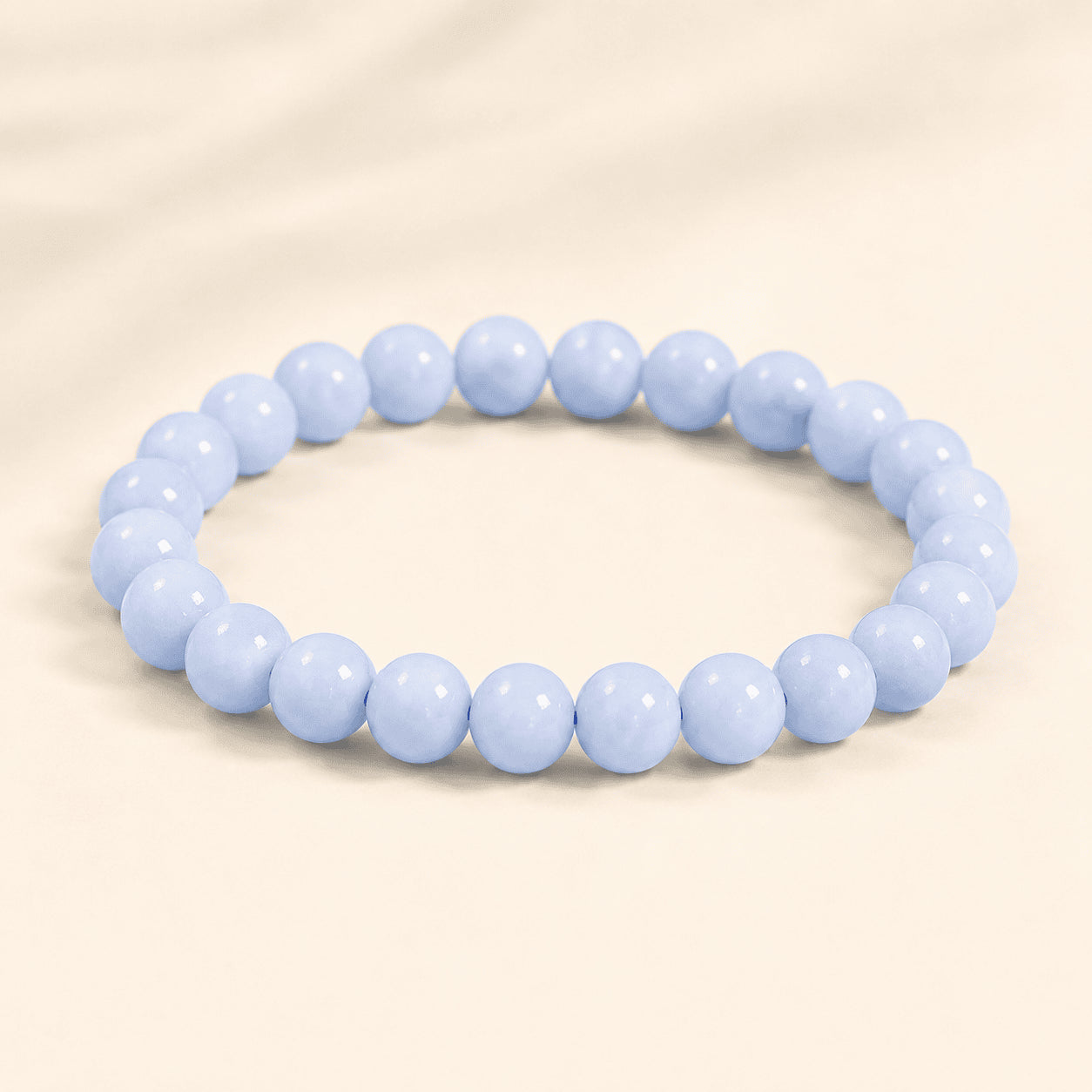
Angelite Bracelet
A quiet bracelet for turning this intention into a small daily ritual.
Shop This Authentic Piece →- Best everyday formats: Pendant necklaces, stud or drop earrings, hair pins, beaded bracelets worn alone.
- Risky formats: Rings (constant knocks), stacked bracelets (metal-on-stone abrasion), anklets (floor contact).
- Remove before: Showers, swimming, dishes, cleaning with solvents, workouts, and sleep if you tend to toss and turn.
- Storage: A soft pouch or a compartment away from harder stones — never loose in a bowl with quartz or agate.
How to Style Angelite Jewelry for Everyday Outfits
Angelite's milky blue-grey reads as quiet, not flashy. That makes it unusually easy to wear daily. A few practical pairings:
- With denim and white: A single angelite pendant on a fine silver chain keeps the palette cool and unforced.
- With linen and cream: Small angelite drop earrings echo the softness of natural fabrics.
- With silver, not gold: The stone's cool undertone sits more naturally with silver, white gold, or oxidized metal. Warm gold can make it look washed out.
- One piece, not five: Because the stone is soft and visually muted, a single angelite piece often lands better than a full matching set.
How to Clean, Charge, and Care for Angelite Jewelry
Angelite is one of the few stones where the standard "rinse under water" advice is genuinely wrong. Anhydrite can be affected by prolonged moisture, so keep it dry.
- Clean: Wipe with a soft, dry microfiber cloth. For deeper cleaning, use a barely damp cloth and dry immediately — do not soak.
- Avoid: Ultrasonic cleaners, steam cleaners, salt water, and chemical jewelry dips. All can damage the surface.
- Charge: Use moonlight, a selenite slab, or sound (a singing bowl or gentle chime). Avoid prolonged direct sunlight, which may fade the pale blue over time.
- Store: Individually in a soft pouch. Keep away from harder stones and from metal that can scratch.
How to Choose Authentic Angelite Jewelry (Buying Checklist)
The market includes dyed anhydrite, blue-dyed howlite, and glass sold as angelite. Use a step-by-step check rather than a single "look":
- Step 1 — Check the color distribution. Genuine angelite is evenly pale blue-grey, sometimes with white veining. Dye tends to pool in cracks and look unnaturally saturated in crevices.
- Step 2 — Look at the finish. Real angelite is usually matte to satin, not glassy. A mirror-shine blue bead is more likely glass or dyed agate.
- Step 3 — Ask about treatment. A reputable seller states whether the stone is natural, dyed, or stabilized. Under the Lumina Grade AAA Integrity Standard, angelite is offered as natural, un-dyed, and never irradiated — no chemical resin filling of cracks and no color enhancement.
- Step 4 — Weigh the price against hardness. Because angelite is soft and inexpensive to source, a high price should reflect craftsmanship (setting, chain, design), not "rarity."
- Step 5 — Inspect the setting. For a soft stone, a bezel or well-protected prong setting matters more than the stone's size.
If a listing cannot answer Step 3 clearly, treat that as your answer.
FAQ: Angelite Jewelry Meaning and Uses
What is angelite jewelry and what does it mean?
Angelite jewelry is made from a fine-grained blue-grey variety of anhydrite, most often sourced from Peru. It is traditionally associated with calm communication, gentle self-expression, and grounded peace — which is why it is usually worn as a pendant, earring, or light bracelet rather than a ring.
Is angelite safe to wear every day?
Yes, for gentle-wear pieces. At Mohs 3.5, angelite scratches easily, so it is best kept to necklaces, earrings, and hair adornment, and removed before showers, swimming, workouts, and cleaning. Avoid everyday rings and stacked bracelets.
How do you clean and care for angelite jewelry?
Wipe it with a dry soft cloth and keep it away from water, salt, steam, and chemical cleaners — anhydrite can be affected by prolonged moisture. Charge it with moonlight, selenite, or sound rather than sunlight, and store it in its own soft pouch.
Sources
This article shares traditional and cultural associations with angelite and does not provide medical advice. Crystal properties described here are not a substitute for professional care. © 2026 Lumina Quartz.
Product Facts From the Current Catalog
These details come from the active Lumina Quartz catalog record checked on 2026-10-06. They are product-listing facts, not laboratory results or invented wear-test claims.
| Listed product | Angelite Bracelet – Gentle Reassurance |
|---|---|
| Format | Bracelet |
| Listed price snapshot | 75.00 |
Price, availability, and options may change. Check the live product listing before choosing.