The Complete Everyday Guide to Aligning Chakras With Crystals: Meaning and Uses
Table of Contents
- 10-Second Executive Summary / The Verdict Box
- What Chakra Alignment Really Means (and What Crystals Can and Can't Do)
- The 7 Chakras at a Glance: Colors, Locations, and Signs of Imbalance
- The Color-to-Chakra Method for Choosing Crystals
- Crystal Pairings for Each Chakra, Root to Crown
- Root and Sacral: Grounding and Creative Flow
- Solar Plexus and Heart: Confidence and Connection
- Throat, Third Eye, and Crown: Expression, Intuition, and Awareness
- Decision Table: Which Method Fits Your Situation?
- Everyday Ways to Align Chakras With Crystals
- A 10-Minute Crystal Layout Practice
- Wearing, Carrying, and Placing Crystals in Your Space
- Frequently Asked Questions
- How do I know which crystal is right for each chakra?
- Can I wear or carry chakra crystals every day, and how do I cleanse them?
- How long does it take to align chakras with crystals, and how often should I practice?
- Can crystals really balance chakras, or is it just a placebo?
- What is the best crystal layout for a full chakra alignment at home?
- A Gentle Closing Note
- Sources
To align chakras with crystals, most people start by matching a stone's color to the chakra they want to work with — red for the root, violet for the crown — then wear, carry, or lay the stones on the body during a short, regular practice. Crystals are best understood as focus tools for a contemplative ritual, not as medical treatment: they may support mindful attention and are often associated with symbolic meaning, but no crystal has been shown to "balance" energy centers in a measurable way.
10-Second Executive Summary / The Verdict Box
- Direct Verdict: Crystal–chakra work is a symbolic, mindfulness-based practice. Color matching (red → root, orange → sacral, yellow → solar plexus, green/pink → heart, blue → throat, indigo → third eye, violet/white → crown) is the simplest, most repeatable method.
- Mohs Hardness to know: Quartz (including amethyst and rose quartz) ≈ 7; garnet ≈ 6.5–7.5; lapis lazuli ≈ 5–6; turquoise ≈ 5–6; sodalite ≈ 5.5–6; hematite ≈ 5–6.5; carnelian ≈ 6.5–7. Softer stones scratch and stain more easily, so keep them away from water, perfume, and abrasive handling.
- Best use case: A 10-minute daily or weekly layout combined with journaling or breathwork — a calming ritual, not a replacement for medical or mental-health care.
- Quality anchor: Look for natural, untreated stones. Lumina Grade AAA Integrity Standard means natural rough, zero chemical resin-filling, and no irradiation or dyeing.
What Chakra Alignment Really Means (and What Crystals Can and Can't Do)
The word chakra comes from Sanskrit and means "wheel" or "cycle" — in Buddhist contexts it also symbolizes the dharma wheel, as the National Museum of Asian Art explains. The seven-body chakra system as it is popular today was largely introduced to English-language readers through early twentieth-century works such as C.W. Leadbeater's monograph and Arthur Avalon's translation of the Ṣaṭ-Cakra-Nirūpaṇa, both preserved in Smithsonian library collections (Leadbeater; Avalon translation). That history matters: chakras are a cultural and spiritual framework, not an anatomical structure.
So what can crystals do? They can serve as tangible anchors for attention — holding a stone during breathwork may support focus, and the ritual itself is often associated with calm and self-reflection. What they cannot do is diagnose, treat, or cure anything. Use crystal work as a gentle contemplative practice alongside, not instead of, qualified care.
The 7 Chakras at a Glance: Colors, Locations, and Signs of Imbalance
Traditional descriptions associate each chakra with a color, a location along the spine, and a set of themes. In common modern usage these themes are framed as "signs of imbalance" — useful journaling prompts rather than clinical symptoms.
| Chakra | Color | Location | Themes often associated with it |
|---|---|---|---|
| Root (Muladhara) | Red | Base of spine | Grounding, security, feeling settled |
| Sacral (Svadhisthana) | Orange | Lower abdomen | Creativity, flow, pleasure in daily life |
| Solar Plexus (Manipura) | Yellow | Upper abdomen | Confidence, personal agency, boundaries |
| Heart (Anahata) | Green / pink | Center of chest | Connection, compassion, self-acceptance |
| Throat (Vishuddha) | Blue | Throat | Expression, honest speech, listening |
| Third Eye (Ajna) | Indigo | Between the brows | Intuition, insight, perspective |
| Crown (Sahasrara) | Violet / white | Top of head | Awareness, meaning, spaciousness |
Historical depictions of these centers appear in Indian manuscript and devotional art traditions, including material documented in the exhibition Yoga: The Art of Transformation at the National Museum of Asian Art. Treat the table above as a working map for reflection, not a fixed doctrine — different lineages describe the centers differently.
The Color-to-Chakra Method for Choosing Crystals
If you are new to this, the color match is the most practical entry point: pick the chakra theme you want to reflect on, choose a stone in the corresponding hue, and note whether you are drawn to it. That last part is not science — it is a way of engaging your own attention honestly.
Two checks keep the method grounded:
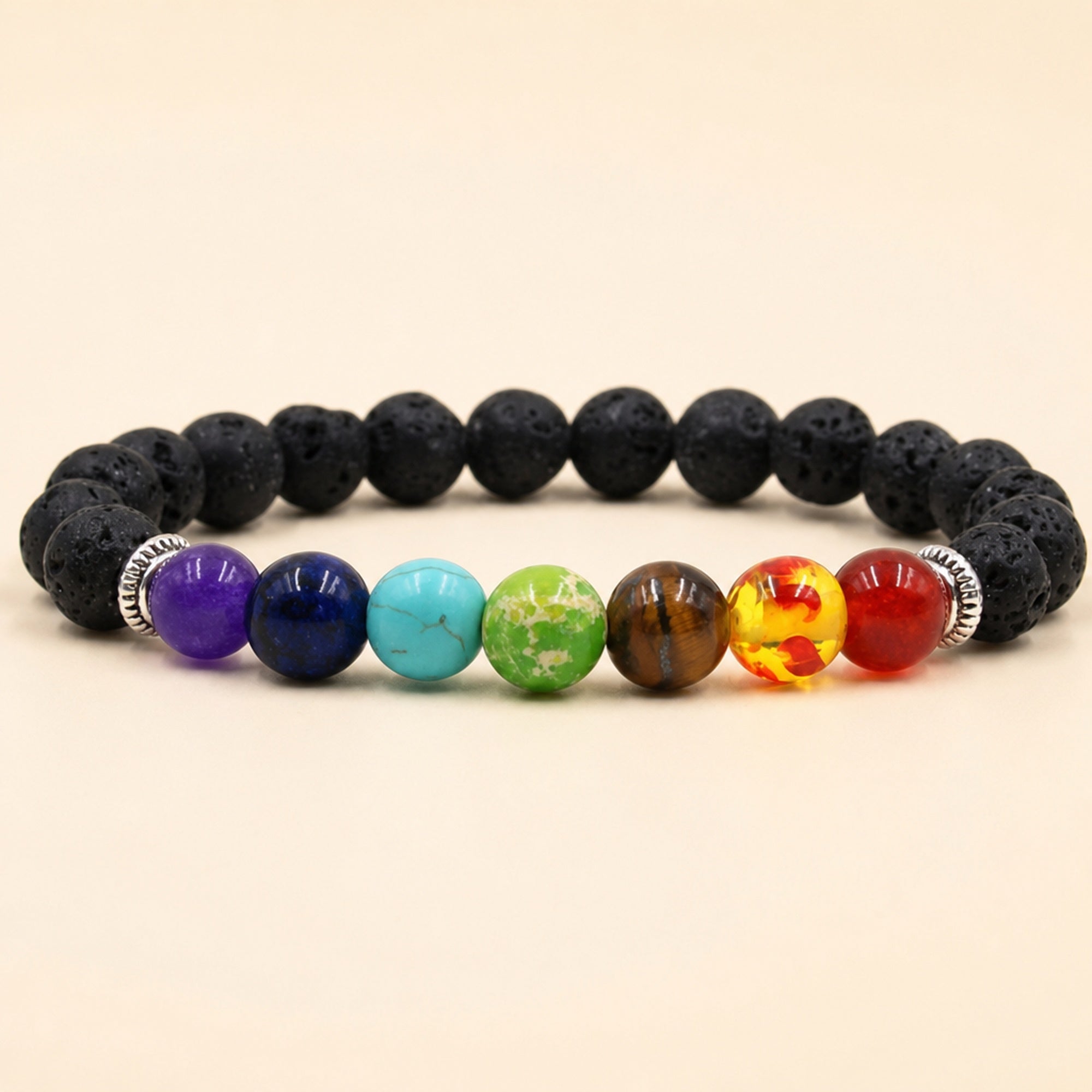
Seven Chakra Bracelet
A quiet bracelet for turning this intention into a small daily ritual.
Shop This Authentic Piece →- Physical check: confirm the stone's identity and Mohs hardness before daily wear. A soft stone like turquoise (≈5–6) can be scratched by a quartz point (≈7) in the same pouch.
- Integrity check: in our selection we apply the Lumina Grade AAA Integrity Standard — natural rough material, zero chemical resin-filling, and no irradiation or dyeing. Dyed stones can mimic vivid chakra colors, so ask whether the color is natural or enhanced, and expect an honest "enhanced" when it is.
Stones that look almost too saturated — neon pink "rose quartz," uniform cobalt "lapis," perfectly even turquoise — are worth questioning. Natural variation, veining, and small inclusions are usually signs of authenticity, not flaws.
Crystal Pairings for Each Chakra, Root to Crown
The pairings below are conventional associations, offered as a starting vocabulary. Where a stone's hardness or treatment status matters for daily use, that is noted, because it is checkable fact.
Root and Sacral: Grounding and Creative Flow
- Root — red jasper, garnet, hematite. Garnet sits around Mohs 6.5–7.5 and stands up well to daily wear; hematite (≈5–6.5) is heavier and can chip, so a pendant or pocket stone may suit it better than a ring.
- Sacral — carnelian, orange calcite, sunstone. Carnelian (≈6.5–7) is durable enough for a bracelet; orange calcite is softer and better kept on a desk or altar tray.
Solar Plexus and Heart: Confidence and Connection
- Solar plexus — citrine, yellow jasper, pyrite. Be aware that much commercial "citrine" is heat-treated amethyst; natural citrine is paler and rarer. Under our integrity standard, treatment should be disclosed, never disguised.
- Heart — rose quartz, green aventurine, malachite (handle with care). Rose quartz and aventurine (both quartz-family, ≈7) are forgiving for everyday carry. Malachite is softer and copper-bearing; keep it dry and away from acids, and never grind or inhale its dust.
Throat, Third Eye, and Crown: Expression, Intuition, and Awareness
- Throat — blue lace agate, aquamarine, sodalite. Sodalite (≈5.5–6) and blue lace agate are best worn as pendants rather than stacked against harder stones.
- Third eye — lapis lazuli, iolite, amethyst. Lapis (≈5–6) is a classic indigo stone but porous and sensitive to water and perfume — take it off before swimming.
- Crown — clear quartz, amethyst, selenite (dry use only). Clear quartz and amethyst (≈7) are the workhorses; selenite is very soft and water-soluble, so keep it dry and display it rather than wear it.
Decision Table: Which Method Fits Your Situation?
Use this comparison to choose a practice instead of guessing.
| If your goal is… | Best-fit approach | Why it fits | Boundary to respect |
|---|---|---|---|
| A first, low-effort ritual | One stone, one chakra, worn or carried daily | Simplest to repeat; minimal setup and cleaning | Keep soft stones (lapis, turquoise, sodalite) away from water and perfume |
| Reflection on several themes at once | Short body layout, 3–7 stones, 10 minutes | Pairs physical placement with breathwork and journaling | Not a substitute for therapy or medical advice |
| A shared or family practice | Color-matched set on a tray with written prompts | Turns the practice into conversation and self-inquiry | Keep small stones away from young children and pets (choking risk) |
| Space and atmosphere | One anchor stone per room with a stated intention | Uses the stone as a visual reminder, which is its clearest everyday function | Selenite and halite must stay dry; quartz can scratch wooden surfaces |
Everyday Ways to Align Chakras With Crystals
Consistency matters more than complexity. A few minutes most days will do more for your attention than an elaborate one-off session — and unlike a "prescription," the pace is yours to set.
A 10-Minute Crystal Layout Practice
- Minute 0–1 — Set the frame. Lie down or sit comfortably. Choose one theme (for example, "grounding" or "speaking honestly") rather than all seven at once.
- Minute 1–3 — Place the stones. Lay stones along the body's midline at the matching locations: base of spine, lower abdomen, upper abdomen, chest, throat, brow, top of head. You do not need a stone at every point — three is plenty.
- Minute 3–6 — Breathe with attention. Rest one hand on the heart stone. Breathe slowly and notice where your attention wanders; that noticing is the practice.
- Minute 6–9 — Journal one line. Write what came up in a sentence. Keep it plain and honest.
- Minute 9–10 — Close and tidy. Remove the stones, return them to their tray, and note anything you want to revisit next time.
Wearing, Carrying, and Placing Crystals in Your Space
- Wear: a pendant at the throat or chest keeps the stone visible and out of the way of keys and tools. Choose quartz-family stones (≈7) for rings and bracelets, which take the most knocks.
- Carry: a single pocket stone works as a tactile reminder — a brief touch before a meeting or difficult conversation gently cues the intention you set.
- Place: put an anchor stone where you will see it at a fixed moment — beside your laptop, on the kitchen sill. The reminder, not the mineral, does the psychological work.
- Cleanse sensibly: dust with a soft dry cloth; rinse only water-safe stones like quartz (pure water only on stones that tolerate it). Avoid harsh cleansers, ultrasonic cleaners, and saltwater soaks, which can damage softer or porous stones.
- Store by hardness: keep soft stones in their own pouch so they are not scratched by quartz points.
Frequently Asked Questions
How do I know which crystal is right for each chakra?
Start with the conventional color match — red for root, orange for sacral, yellow for solar plexus, green or pink for heart, blue for throat, indigo for third eye, violet or white for crown — then choose a stone whose hardness suits how you will use it. Above all, confirm the stone is natural and untreated under a transparent standard such as Lumina Grade AAA Integrity Standard.
Can I wear or carry chakra crystals every day, and how do I cleanse them?
Yes, daily wear is fine for durable stones like quartz-family crystals, while softer or porous stones such as lapis lazuli and turquoise need gentler handling. Cleanse simply: dust with a dry cloth and use a brief pure-water rinse only on water-safe stones, avoiding saltwater soaks and harsh cleaners.
How long does it take to align chakras with crystals, and how often should I practice?
There is no fixed timeline, because this is a symbolic and reflective practice rather than a measurable treatment. A 10-minute layout two or three times a week, or a single worn stone each day, is a realistic rhythm — let your own experience, not a promise, guide the frequency.
Can crystals really balance chakras, or is it just a placebo?
No study establishes that crystals balance chakras, so the honest answer is that the benefit lies in focused attention and ritual, which may support calm — often associated with that "placebo" effect, which is itself a real psychological response. Enjoy the practice as a contemplative tool, not as medical care.
What is the best crystal layout for a full chakra alignment at home?
A simple approach is a seven-point layout along the body's midline while lying down, with a stone at each traditional location and one hand on the heart. Three stones along the midline are an equally valid shorthand when you want a shorter practice.
A Gentle Closing Note
Aligning chakras with crystals works best as a quiet, repeatable ritual of attention: a color you can trust, a stone you can hold, and a few honest minutes with yourself. Choose natural stones, treat them kindly according to their hardness, and let the practice stay small enough to keep.
Sources
This article is for educational and reflective purposes only and is not medical advice. Crystals are not a treatment for any physical or mental health condition. Consult a qualified professional for health concerns. © 2026 Lumina Quartz.
Product Facts From the Current Catalog
These details come from the active Lumina Quartz catalog record checked on 2026-10-23. They are product-listing facts, not laboratory results or invented wear-test claims.
| Listed product | Seven Chakra Bracelet – Balanced Ritual (8mm Natural Stones) |
|---|---|
| Format | Bracelet |
| Listed price snapshot | 34.99 |
Price, availability, and options may change. Check the live product listing before choosing.