The Complete Everyday Guide to Agate Flower: Meaning and Uses

Table of Contents
- The 10-Second Executive Summary / The Verdict Box
- What Is Agate Flower? A Clear Definition
- Chalcedony, Plumes, and Why the “Flowers” Are Natural
- Flower Agate vs. Cherry Blossom, Sakura, and Plume Agate
- Where It Comes From: Madagascar and Its 2018 Market Arrival
- Agate Flower Meaning: Growth, Self-Belief, and Blossoming
- Heart and Solar Plexus Chakra Associations
- Everyday Uses: How to Wear, Carry, and Display It
- Desk, Meditation, and New-Chapter Rituals
- How to Choose Quality Agate Flower Pieces
- Reading Plumes, Color, and Shape (Towers, Spheres, Bracelets)
- Decision Checklist: Is This Piece Right for You?
- How to Care For and Cleanse Flower Agate
- FAQ: Agate Flower
- Is agate flower a real natural stone?
- What is flower agate used for?
- Is flower agate the same as cherry blossom agate, and how hard is it?
- Sources
Agate flower (flower agate) is a natural chalcedony-quartz stone defined not by a botanical flower but by plume-like inclusions that formed inside the silica before the stone hardened. It is real, it is quartz-family material, and its “flowers” are mineral growths, not paint, dye, or carving.
The 10-Second Executive Summary / The Verdict Box
- Direct Verdict: Agate flower is a genuine natural stone — a plume-bearing variety of chalcedony (fine-grained quartz). The best pieces are unheated, undyed, and untumbled into obscurity. When you shop, ask for natural rough, no chemical resin-filling, and no irradiation or dye enhancement, and expect a clear answer.
- Mohs Hardness: 6.5–7 (quartz-family range) — a good everyday stone, harder than opal or turquoise but softer than sapphire or diamond; it scratches at quartz and can be scratched by things like topaz or corundum.
- Chemical reality: Porous enough that agate has had a long documented history of artificial coloring through absorbed fluids — a reason to ask how a piece was prepared rather than assume vibrant color is natural.
- Best suited to: Everyday wear, desk or display pieces, meditation companions, and “new chapter” rituals where a growth-and-self-belief symbol is what you want — as a personal reminder object, not a medical or therapeutic intervention.
- Skip if: You need a high-impact stone for constant hard knocks, or you are paying premium prices for a bowl of plumes you cannot verify.
What Is Agate Flower? A Clear Definition
“Agate flower” is the trade name for a chalcedony-quartz stone whose translucent to milky body contains radiating, feathery inclusions that look like blossoms or fern fronds. Gemologically the material belongs with agate, which is a fine-grained variety of quartz known as chalcedony, often banded and often colored by microscopic mineral inclusions — as the Smithsonian’s mineral collection notes, agate colors frequently come from tiny iron oxide inclusions inside the quartz (Smithsonian National Museum of Natural History). In flower agate, those inclusions form plumes rather than concentric bands.
Chalcedony, Plumes, and Why the “Flowers” Are Natural
The plumes are growth features. As silica-rich fluid filled a cavity in volcanic host rock — the classic agate setting described by the Smithsonian — mineral-rich solutions crystallized in radiating sprays before the whole mass solidified. That is why a good plume has depth: it sits inside the stone and changes as the light moves, rather than sitting flat on the surface like an applied design. This is also the honest distinction to keep in mind: the plumes are natural, while the color can be natural or enhanced, because agate is porous enough to be penetrated by coloring fluids, a practice documented at length in historic agate-coloring methods preserved on Mindat (Daniel Russell, Mindat). Enhancement is not automatically fraud — but you should know what you are buying.
Flower Agate vs. Cherry Blossom, Sakura, and Plume Agate
These names overlap in the marketplace, and it helps to separate them by feature rather than by label. Flower agate usually refers to white, cream, peach, or soft pink plumes in a milky chalcedony body. “Cherry blossom agate” and “sakura agate” are common marketing aliases for pink-toned material with blossom-like sprays. “Plume agate” is the broader geological term for agate with plume inclusions of any color. The practical rule: the name is commercial, the structure is geological. Judge by plume definition, body clarity, and honest disclosure of treatment — not by which poetic name is on the tag.
Where It Comes From: Madagascar and Its 2018 Market Arrival
Flower agate is most commonly described as coming from Madagascar, where it reached the wider gem and crystal market around 2018. Its arrival is recent enough that its popularity rests on visual appeal and the growth symbolism the trade attached to it, rather than on a long historical tradition. Keep that in perspective: a stone can be genuinely beautiful and genuinely new to the market at the same time, and those are separate facts from any claim about its effects. If a seller presents flower agate as an ancient or traditional stone, treat that as a story, not a sourced historical record.
Agate Flower Meaning: Growth, Self-Belief, and Blossoming
The modern meaning of agate flower is built on a visual metaphor: a flower growing inside stone. In crystal culture it is often associated with personal growth, patience, self-belief, and the idea of blossoming into a next version of yourself. That is cultural and personal symbolism, not a mineral property and not a clinical claim. Crystal meanings like this may support intention-setting and reflection for some people; they are not a substitute for professional care. For many people, a stone is simply a meaningful object to hold or display, and agate’s documented history as an amulet material — the Smithsonian’s collections include an agate amulet object — shows that people have long used agate in this symbolic way (National Museum of American History).
Heart and Solar Plexus Chakra Associations
In chakra frameworks, flower agate is often placed with the heart chakra for its soft, blooming imagery and with the solar plexus for its association with steady self-confidence. Those assignments are part of a symbolic system rather than a measurable science. Use them as a vocabulary for intention if they are useful to you — for example, heart for openness and connection, solar plexus for calm self-trust — and let the stone simply be a reminder object.
Everyday Uses: How to Wear, Carry, and Display It
Agate flower works best as a low-drama everyday stone. At Mohs 6.5–7 it tolerates normal wear on a beaded bracelet or pendant but is not a stone to bang against countertops. A few practical formats:
- Wear: a polished bracelet, pendant, or ring in a protective setting; remove before heavy lifting, gardening, or gym work to avoid chips and abrasion.
- Carry: a small tumbled piece or palm stone in a pocket or pouch — a tactile anchor for a written intention, kept purely as a personal reminder.
- Display: a tower, freeform, or sphere near your desk or bedside, ideally out of direct, prolonged sunlight if the piece is dye-enhanced, since some treatments are less stable and colors may fade over time.
Desk, Meditation, and New-Chapter Rituals
Because the stone’s symbolism centers on growth, it pairs naturally with beginnings: a new job, a move, a course, a recovery of a habit. A simple, honest ritual is to place the piece where you will see it during the task it represents and pair it with one concrete action — a single note about what “blossoming” means for you this season, checked weekly. In meditation, holding a smooth piece can serve as a grounding tactile cue; treat that as a focus aid, not a therapeutic intervention. Cleanse and recharge it in the ways described below, and let the ritual be about your attention, not the rock’s power.
How to Choose Quality Agate Flower Pieces
Quality here is mostly about plume definition and honest disclosure. Look for a piece that shows plumes with depth and soft natural tone rather than neon color pooled in fractures. Because agate has long been colored by allowing fluids to penetrate its porosity, a suspiciously saturated pink or uniform blue at a low price deserves a direct question: is this natural color or enhanced?
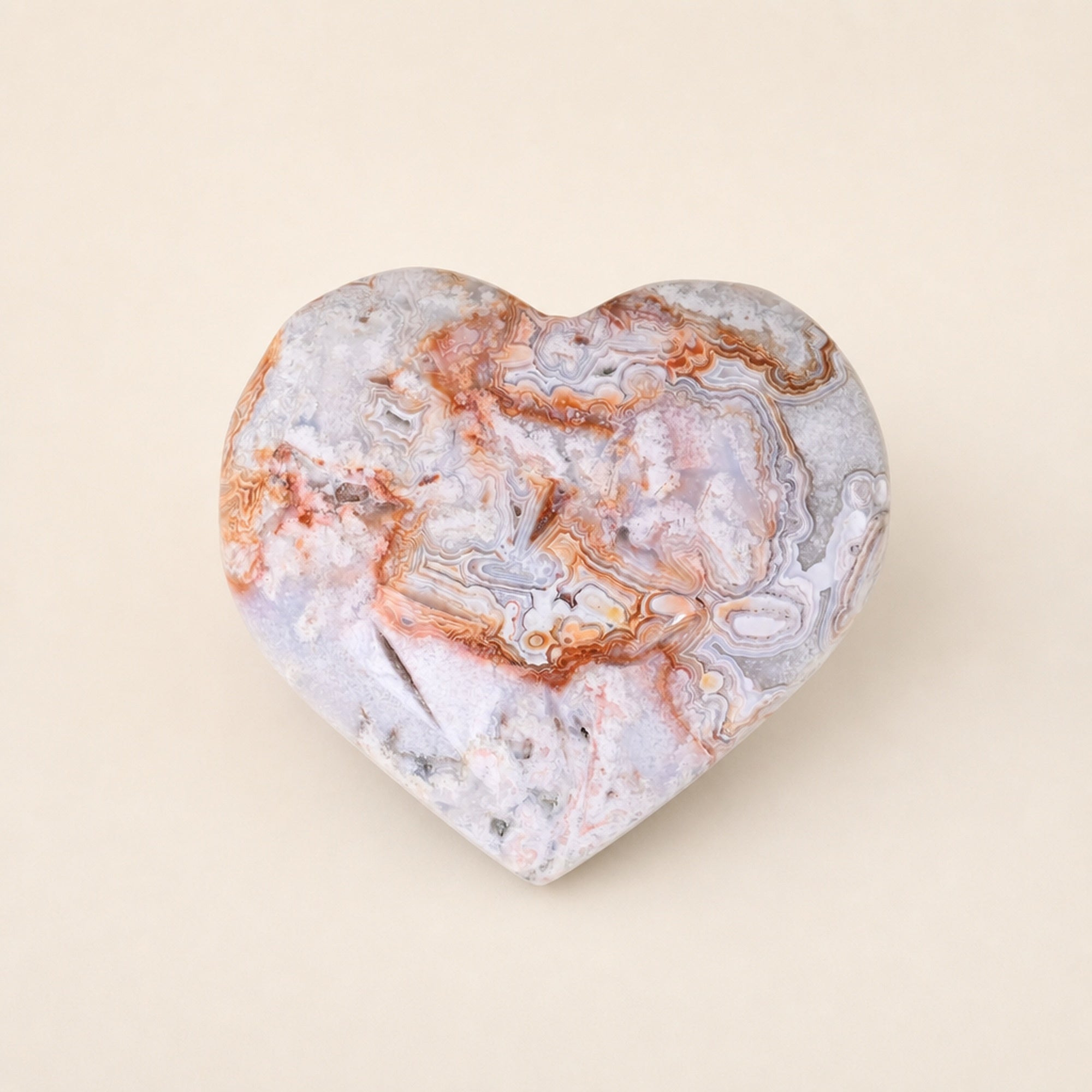
A related stone-family option
Crazy Lace Agate Heart Stone – Joyful Movement
This is a related variety in the same stone family, not a Agate product. We only identify jewelry as Agate when that exact material is verified.
Explore this related optionReading Plumes, Color, and Shape (Towers, Spheres, Bracelets)
Use this decision table before you buy:
| Feature | What “good” looks like | What deserves caution |
|---|---|---|
| Plumes | Distinct, layered sprays with interior depth; visible from multiple angles | Faint, flat, or smeared patterns; markings only on the surface |
| Color | Soft cream, peach, blush; tone consistent with natural iron-based color | Uniform neon pink or blue; color concentrated in cracks and pits |
| Body | Translucent to milky chalcedony with clean polish and no resin-filled pits | Sticky or plastic feel, visible filler in cavities, cloudy resin sheen |
| Shape | Towers: plumes flow through the column; spheres: pattern reads from all sides; bracelets: beads matched in tone and drill quality | Shapes that slice the plume into thin, unreadable fragments; mismatched bead sets sold as “natural variation” to excuse low grade |
Decision Checklist: Is This Piece Right for You?
- Confirm the material. Ask whether the stone is natural chalcedony-quartz with natural plume inclusions, and whether the color is natural or enhanced. Agate’s porosity makes coloring possible, so “agate” alone does not answer the question.
- Match hardness to use. Mohs 6.5–7 is fine for daily wear in a protected setting; it is not the stone for rough activity, and it will scratch softer materials like pearls or opal if stored loose in the same pouch.
- Decide what “meaning” you want. If you want a growth-and-self-belief reminder, flower agate’s symbolism fits; if you are looking for a stone to address anxiety or sleep, no stone is the right purchase — seek appropriate professional support instead.
- Check the treatment question at checkout. A seller who can answer clearly about dye, resin, and irradiation is more trustworthy than one who only offers poetic names. The answer you want is: natural color, no filling, no enhancement.
- Judge the plume in person or with video. Static photos can hide flat patterns; ask for a short video in natural light.
- Set care expectations. Water and sunlight are generally tolerated by chalcedony, but dyed pieces may fade in prolonged sun and should not soak. Wipe with a soft cloth, store separately, and avoid harsh chemicals.
Boundary note: flower agate is a decorative and symbolic object, not a health product. Its cultural meaning is real as culture; its mineral properties are real as geology; it should not be relied on for any physical or mental health outcome.
How to Care For and Cleanse Flower Agate
Care is simple: clean with lukewarm water and a soft cloth, dry fully, and store away from harder stones. On the common question of water and sunlight — chalcedony is not water-soluble and tolerates brief rinsing, but porous dyed agate can absorb or lose color with soaking and prolonged sun exposure, so treat any vibrant piece more gently. For cleansing, many people use running water, a soft cloth, or moonlight; these are cultural practices, not measurements. What matters is that the piece stays undamaged, dry, and separate from sharp or harder items.
FAQ: Agate Flower
Is agate flower a real natural stone?
Yes — it is a genuine chalcedony-quartz variety with natural plume inclusions. The stone is natural even when its color has been enhanced, which is why asking about dye, resin, and irradiation matters.
What is flower agate used for?
Mostly as a symbolic and decorative stone for everyday wear, display, and growth-oriented intentions; in crystal culture it is often associated with self-belief and blossoming. Treat these associations as personal symbolism rather than established effects.
Is flower agate the same as cherry blossom agate, and how hard is it?
“Cherry blossom agate” and “sakura agate” are common trade aliases for pink-toned material, not a separate gem species. Flower agate sits at Mohs 6.5–7, so it is safe for everyday wear but softer than topaz or corundum.
Sources
- Smithsonian National Museum of Natural History — Quartz (var. agate)
- Daniel Russell, Mindat — Historic Methods of Artificially Coloring Agates
- National Museum of American History — Agate Amulet
© 2026 Lumina Quartz. This article offers cultural and gemological information, not medical advice. Crystal meanings are symbolic and personal; they are not a substitute for professional care.