The Complete Everyday Guide to Agate Definition: Meaning and Uses

Table of Contents
- 10-Second Executive Summary / The Verdict Box
- What Is the Definition of Agate?
- Agate vs. Chalcedony, Quartz, and Onyx: What's the Difference?
- How Agate Forms: Banding, Colors, and Patterns Explained
- The Most Common Types of Agate and What They Look Like
- Agate Meaning and History: From Ancient Amulets to Modern Healing
- Practical Uses of Agate: Jewelry Care, Styling, and Buying Tips
- How to Spot Treated or Dyed Agate
- How to Care for Agate Jewelry
- Decision Table: Is This Stone Actually Agate?
- Frequently Asked Questions
- What is the simple definition of agate?
- Is agate a crystal or a rock?
- How do you tell real agate from fake agate?
- Sources
Agate is defined as a fine-grained, banded variety of chalcedony — the microcrystalline form of quartz — in which concentric or parallel layers of color and translucency are visible in the stone. If you are searching for a clear, practical agate definition, that single sentence is the geological core; everything else — pattern names, dye practices, care rules — builds on it. The Smithsonian describes agate as chalcedony that shows concentric color banding, with colors often caused by microscopic iron oxide inclusions.[1] That definition matters because it separates agate from generic "crystal" language and gives you real criteria for judging what is in your hand.
10-Second Executive Summary / The Verdict Box
- Direct Verdict: Agate = banded chalcedony (microcrystalline quartz). If it has no banding, many sellers and geologists would call it chalcedony or jasper instead.
- Mineral family: Quartz (silica, SiO₂), microcrystalline variety.
- Mohs hardness: 6.5–7 — hard enough for daily jewelry, still softer than corundum or diamond.
- Key diagnostic feature: Visible concentric or parallel banding; translucency varies layer to layer.
- Best suited for: Everyday rings, pendants, and beads where pattern is the design; display specimens where banding is the point.
- Not suited for: High-impact sports wear without a protective setting; ultrasonic cleaning of dyed or fracture-filled pieces.
- Quality anchor: The Lumina Grade AAA Integrity Standard — natural rough, zero chemical resin filling, no irradiation or dye enhancement — is the benchmark we use when describing an honest agate listing.
What Is the Definition of Agate?
The simplest working definition is this: agate is a banded form of chalcedony, and chalcedony is quartz with crystals too small to see individually. Because the crystals are microscopic, agate breaks with a smooth, slightly waxy fracture rather than showing crystal faces. The Smithsonian's collection entry states it plainly — agate is a fine-grained variety of quartz known as chalcedony that shows concentric color banding.[1]
Two qualifiers keep the definition honest. First, the banding must be visible as a pattern; a uniformly gray translucent stone is chalcedony, not agate, in most trade usage. Second, agate is a variety name, not a separate mineral species — its chemistry is silica, shared with quartz, jasper, and flint. When a listing calls agate a "crystal," it is using the word loosely; agate is a rock-forming aggregate of quartz microcrystals rather than a single crystal like clear quartz point.
Agate vs. Chalcedony, Quartz, and Onyx: What's the Difference?
These four names get mixed constantly, and the confusion usually comes from overlapping geology and loose trade language. The table below sorts them by composition and the feature a buyer can actually see.
| Name | Composition | Visible feature | Practical takeaway |
|---|---|---|---|
| Agate | Microcrystalline quartz (chalcedony) | Concentric, curved, or parallel banding in color or translucency | Banding is the definition; no banding, no agate label in strict use |
| Chalcedony | Microcrystalline quartz | Uniform or gently mottled; no distinct banding | The parent category — agate is a subset of chalcedony |
| Quartz (macrocrystalline) | SiO₂ with visible crystals | Crystal faces, points, transparency | Different formation path; harder to confuse in hand |
| Onyx | Chalcedony with straight, parallel bands | Flat, ruler-straight layers, often black-and-white | A banding-style term; sellers may use it for contrast, not geology |
The distinction that matters most for buyers: agate's bands curve and follow the cavity it grew in, while onyx bands are typically straight and parallel. Both are chalcedony, so neither is "fake" — the label simply describes the pattern. If a seller cannot tell you which pattern they are selling, treat the descriptive detail as missing, not as proof of quality.
How Agate Forms: Banding, Colors, and Patterns Explained
Agate forms in cavities inside volcanic rock, where silica-rich water deposits quartz in successive layers against the cavity walls.[1] Each deposition episode can carry slightly different trace chemistry, so each layer gets a slightly different color or opacity. That is the physical origin of banding — not paint, not design, but chemistry recorded layer by layer.
Color in natural agate most often comes from microscopic mineral inclusions; iron oxides, for instance, can produce reds, yellows, and browns.[1] Because agate is porous, it is also unusually receptive to coloring fluids — a property documented in historic agate-dyeing methods, where craftspeople used the stone's porosity to introduce color deep into the layers.[2] This is why dyeing is not a modern shortcut but a centuries-old practice, and why "is it dyed?" is a legitimate question rather than a moral accusation.
The Most Common Types of Agate and What They Look Like
Pattern names are descriptive, not scientific classifications. Use them as visual shorthand, then verify the physical details:
- Banded agate: The textbook type — curved concentric rings visible on a polished face or slice.
- Fortification agate: Bands that angle and meet like the walls of a fort; common in nodule slices.
- Moss agate: Greenish, dendritic inclusions that look like plant growth; technically a chalcedony with inclusions rather than classic banding.
- Blue lace agate: Fine, pale blue-white banding; admired for delicate contrast.
- Crazy lace agate: Dense, twisting lace-like patterns rather than clean concentric rings.
When you shop, ask which pattern family the stone belongs to and whether the color is natural. A piece that fits the Lumina Grade AAA Integrity Standard should be describable in those plain terms — natural rough, no resin filling, no dye or irradiation — because the pattern itself is the selling point, not an enhanced color story.
Agate Meaning and History: From Ancient Amulets to Modern Healing
Agate has a long cultural record as an ornamental and protective stone. Museum collections include agate amulets, and agate objects appear in historical collections as carved and personal items.[3] Across cultures, banded stones have often been associated with grounding, protection, and steadiness — symbolic meanings that people may find meaningful as personal reminders.
It is important to keep two categories separate. The mineral facts — hardness, banding, porosity, composition — are testable. The cultural and personal meanings are symbolic traditions, not medical effects. Agate jewelry is often associated with calm and stability in popular lore, and many wearers use it as a mindfulness cue; it does not treat, cure, or regulate any health condition. Choosing an agate because its pattern helps you pause is a valid personal practice; expecting it to act on your body is not something the evidence supports.
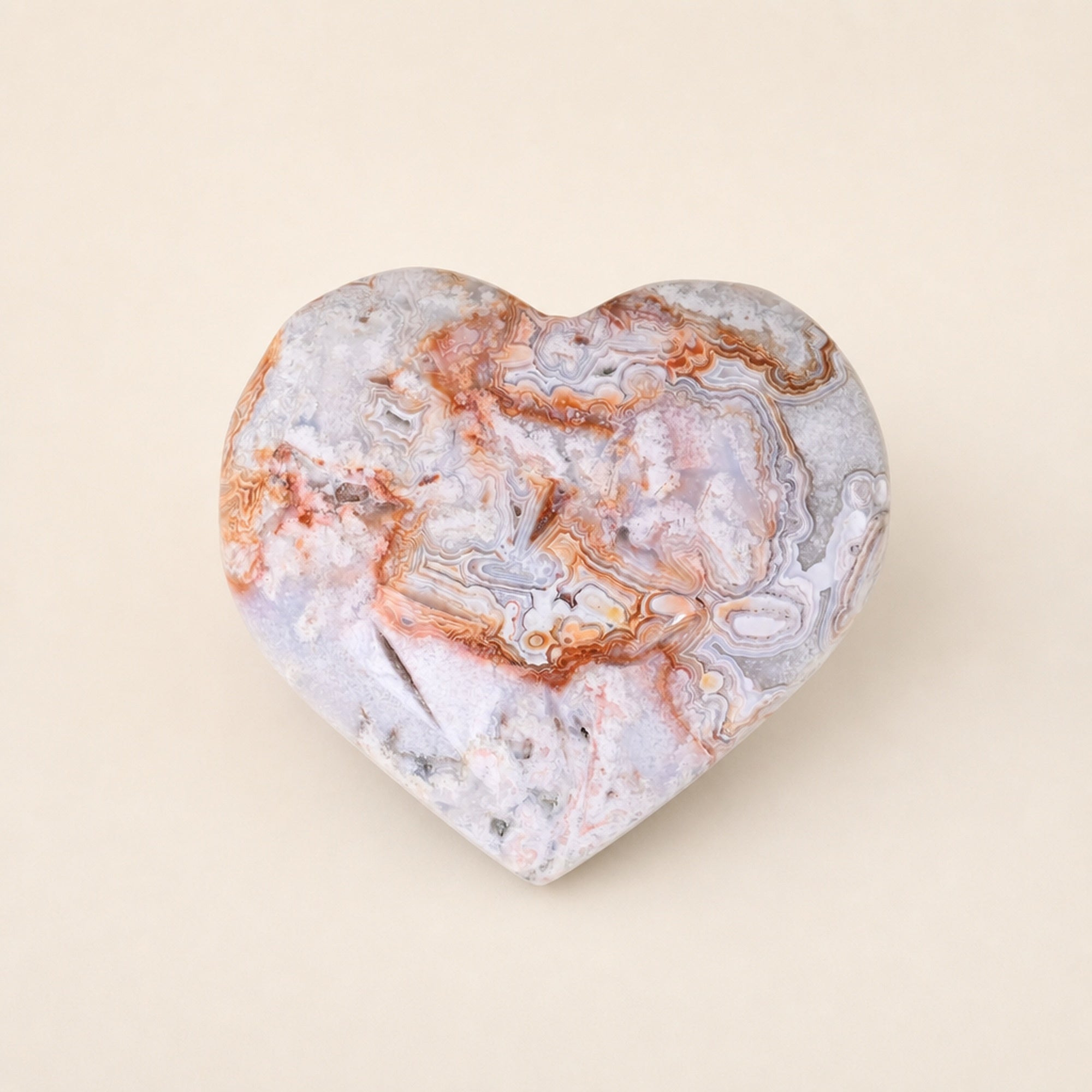
A related stone-family option
Crazy Lace Agate Heart Stone – Joyful Movement
This is a related variety in the same stone family, not a Agate product. We only identify jewelry as Agate when that exact material is verified.
Explore this related optionPractical Uses of Agate: Jewelry Care, Styling, and Buying Tips
At Mohs 6.5–7, agate is a practical everyday stone: durable enough for rings and bracelets, but still scratchable by harder materials like diamond, sapphire, or even a stray grain of sand. That single fact drives most buying and care decisions.
How to Spot Treated or Dyed Agate
Dyeing is historically normal for agate, so the goal is disclosure, not purity theater. Use this decision checklist:
- Look at the band edges. In dyed agate, color often pools more heavily along fractures and band boundaries; natural color usually follows the layers more evenly.
- Ask about porosity. Because agate accepts coloring fluids through its porosity,[2] a seller who knows the trade should be able to say plainly whether dye was used.
- Question suspiciously uniform color. A vivid, perfectly even hue across a banded stone is a prompt to ask, not proof of treatment.
- Check for filling and irradiation claims. Under the Lumina Grade AAA Integrity Standard, natural rough, zero chemical resin filling, and no irradiation or dye enhancement are stated up front — so ask for the same clarity from any seller.
- Compare price to pattern. Intricate natural banding is uncommon; a very low price for intense color is a reason to verify, not to celebrate.
How to Care for Agate Jewelry
- Clean with lukewarm water and a soft cloth; avoid harsh chemicals and ultrasonic cleaners on dyed, porous, or fracture-filled pieces.
- Store separately from harder stones to prevent scratches at Mohs 7 and below.
- Remove before high-impact activity or exposure to heat and sudden temperature change.
- Re-check prongs and settings periodically, especially on rings worn daily.
For styling, let the banding lead: a fortification-agate slice works as a focal pendant, while fine blue lace pairs well with small metal accents that do not compete with the pattern. Buy the stone you can describe accurately — that is the most reliable quality signal.
Decision Table: Is This Stone Actually Agate?
Use this to sort a stone in under a minute, based on the definition and physical parameters above.
| What you observe | Likely label | What to do next |
|---|---|---|
| Curved concentric bands, varying translucency | Agate | Ask about dye and filling; confirm pattern family |
| Straight parallel bands | Onyx (chalcedony variety) | Same questions — pattern term, not a quality upgrade |
| Uniform color, waxy luster, no banding | Chalcedony | Fine as a stone; do not pay an "agate pattern" premium |
| Visible crystal faces or points | Macrocrystalline quartz | Different material; judge by clarity and termination |
| Color concentrated in cracks, unusually intense | Possibly dyed agate | Request disclosure; compare against the Lumina Grade AAA Integrity Standard |
Frequently Asked Questions
What is the simple definition of agate?
Agate is a banded, fine-grained variety of chalcedony — microcrystalline quartz — where concentric or parallel layers of color and translucency are visible.[1]
Is agate a crystal or a rock?
Agate is best described as an aggregate of microcrystalline quartz rather than a single crystal; in trade language "crystal" is used loosely, but geologically it is a variety of chalcedony.
How do you tell real agate from fake agate?
Check for natural banding that follows the layers, ask directly about dye and resin filling (dyeing is a historic practice because agate is porous[2]), and prefer sellers who state natural rough and no enhancement, as in the Lumina Grade AAA Integrity Standard.
Sources
- Smithsonian National Museum of Natural History — Quartz (var. agate)
- mindat.org — Historic Methods of Artificially Coloring Agates
- National Museum of American History — Agate Amulet
This article is for educational and stylistic guidance only. Agate's cultural and personal meanings are symbolic traditions, not medical claims; no stone is described here as treating or preventing any condition. © 2026 Lumina Quartz.