Sodalite Crystal: Meaning, Healing Properties, and Daily Benefits
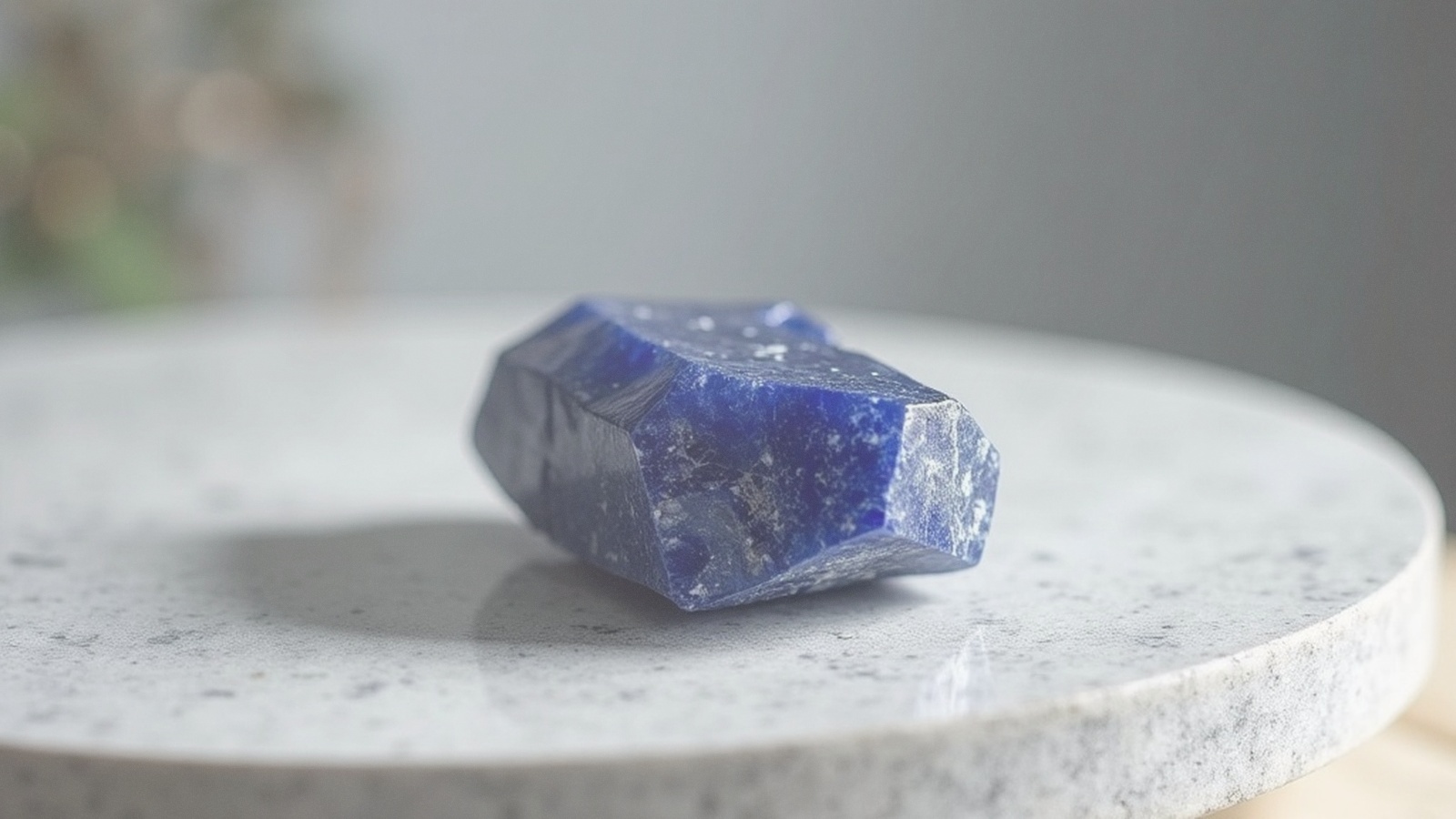
Table of Contents
- 10-Second Executive Summary
- What Is Sodalite? Meaning, Color, and Formation
- Sodalite Crystal Benefits: What It's Known For
- Mental Clarity, Logic, and Focus
- Communication, Confidence, and the Throat Chakra
- Sodalite and the Zodiac: Sagittarius, Virgo, and Pisces
- How to Use Sodalite Daily: Jewelry, Meditation, and Workspace
- Sodalite vs. Lapis Lazuli: How to Tell Them Apart
- Sodalite vs. Lapis Lazuli — Comparison Table
- Cleansing, Charging, and Caring for Your Sodalite
- Choosing Your Sodalite: What to Look For
- FAQ: Common Questions About Sodalite Crystal Benefits
- What are the main benefits of sodalite crystal?
- How do you use sodalite for healing and daily life?
- How do you cleanse, charge, and care for a sodalite crystal?
- Sources
Sodalite is a sodium aluminum silicate chloride mineral that crystal practitioners most often associate with mental clarity, rational thinking, and calm, truthful communication. Its deep blue-to-violet color comes from its mineral structure rather than dye, and it registers 5.5–6 on the Mohs hardness scale, which means it is soft enough to scratch with a steel knife and should be worn with reasonable care.
10-Second Executive Summary
- Direct Verdict: Sodalite is best understood as a "logic and communication" stone. Practitioners value it for quieting mental noise, supporting clear reasoning, and encouraging honest self-expression — not for dramatic energetic effects.
- Mohs Hardness: 5.5–6. It scratches more easily than quartz (7) or lapis lazuli variants, so avoid knocking it against metal or harder stones.
- Chemical Composition: Na₈(Al₆Si₆O₂₄)Cl₂ — a feldspathoid mineral, distinct from lazurite (the main blue mineral in lapis lazuli).
- Associated Chakras: Throat (primary) and Third Eye.
- Associated Zodiac Signs: Sagittarius, Virgo, and Pisces.
- Best Used For: Study or work focus, public speaking nerves, journaling and honest reflection, and as a calm anchor during air travel or stressful transitions.
What Is Sodalite? Meaning, Color, and Formation
Sodalite is a feldspathoid mineral with the chemical formula Na₈(Al₆Si₆O₂₄)Cl₂, as documented by mineral databases such as Mindat. It typically forms in silica-poor igneous rocks such as nepheline syenite, and it also appears in some volcanic and metamorphic environments. In its most recognizable form, sodalite is a rich royal blue, sometimes veined with white calcite or flecked with other minerals. Less commonly it appears violet, gray, or even colorless. Large deposits have been mined in Brazil, Canada (Ontario), Namibia, and Greenland. The stone is sometimes called "the poet's stone" or "the stone of truth" in crystal lore because it is believed to unite logic with intuition — a framing frequently repeated across crystal references, though it is a traditional association rather than a scientifically verified property.
Sodalite Crystal Benefits: What It's Known For
Sodalite is a mineral, and references to its benefits often focus on personal mental habits rather than the body. Collectors and enthusiasts sometimes keep a piece nearby as a reminder to pause, think clearly, and choose words carefully. You might set a small stone on your desk or carry one in a pocket as a cue for rational thinking and honest self-expression. The Mindat mineral database notes that no information on health risks for this material has been entered, and mineral specimens should always be handled with care. Any personal meaning you assign to the stone is your own choice.
Mental Clarity, Logic, and Focus
Sodalite is often chosen by students, writers, and analytical workers. Its energetic profile is often described as "cool and organizing," in contrast to warmer, more emotionally stimulating stones. If you tend to spiral in overthinking or analysis paralysis, sodalite is traditionally used to help shorten that loop. A common practice is to hold sodalite briefly before beginning a task that requires sustained reasoning, then set it aside while you work.
Communication, Confidence, and the Throat Chakra
Sodalite is primarily linked to the throat chakra and secondarily to the third eye. In crystal traditions, throat chakra stones are used when someone struggles to say what they actually mean — whether in a meeting, a difficult conversation, or a creative project. Sodalite is often associated with calm honesty rather than forceful speaking, so it is more often recommended for people who over-edit themselves than for people who need restraint.
Sodalite and the Zodiac: Sagittarius, Virgo, and Pisces
Some people enjoy matching sodalite with astrological signs as a personal or decorative choice. You can decide for yourself whether to connect it with a particular sign; there is no requirement to do so.
- Sagittarius: associated with wisdom and open-mindedness.
- Virgo: associated with the stone's logical, calming qualities.
- Pisces: associated with emotional balance and intuition.
It is also sometimes listed as a November birthstone alongside other blue stones. Astrological correlation is a symbolic framework, not a fixed rule — if you feel drawn to sodalite regardless of your sign, the traditional advice is simply to use it.
How to Use Sodalite Daily: Jewelry, Meditation, and Workspace
Because sodalite is soft (5.5–6 on the Mohs scale), how you use it matters. Practical placements include:
- Workspace: Keep a tumbled piece or small sphere on the desk near where you plan or write. This is the most common use for focus and clear thinking.
- Meditation: Hold it in your non-dominant hand or place it at the throat or brow during silent practice. Traditional instructions suggest pairing it with slow breathing rather than a specific mantra.
- Jewelry: A pendant or beaded bracelet works well, but because the stone scratches relatively easily, remove sodalite rings and bracelets before gym sessions, gardening, or handling other stones.
- Travel: A pocket stone is a common personal habit for travel—a small object to hold or check before a flight. If you like the idea, keep one in your bag as a reminder to stay organized and breathe steadily; this is simply a personal routine, not a treatment for anxiety.
- Journaling: Placing sodalite beside a journal is a common practice for people working on honesty or difficult self-reflection.
Sodalite vs. Lapis Lazuli: How to Tell Them Apart
This is the most common confusion in the sodalite market, so it deserves a direct comparison rather than a general answer.
Sodalite vs. Lapis Lazuli — Comparison Table
| Feature | Sodalite | Lapis Lazuli |
|---|---|---|
| Primary blue mineral | Sodalite (Na₈(Al₆Si₆O₂₄)Cl₂) | Lazurite |
| Typical color | Royal blue to violet-blue, often with white veins | Deep ultramarine blue, often with golden pyrite flecks and white calcite |
| White veining | Common and can look cloudy | Present but usually more patchy |
| Pyrite flecks | Rare | Common (the "gold" in lapis) |
| Mohs hardness | 5.5–6 | 5–6 (lazurite), often lower overall |
| UV reaction | May fluoresce orange-pink under UV in some specimens | Generally does not show that specific reaction |
| Common uses | Clarity, logic, communication work; casual jewelry | Wisdom, spiritual work; higher-end jewelry |
| Market price | Generally more affordable | Typically more expensive at equal quality |
A practical shortcut: if you see golden metallic flecks, you are almost certainly looking at lapis lazuli. If the blue is uniform with modest white veining and no pyrite, sodalite is the likely candidate.
Cleansing, Charging, and Caring for Your Sodalite
Sodalite is a water-safe mineral, but it is soft, so the more important variable is friction, not moisture. A workable routine:
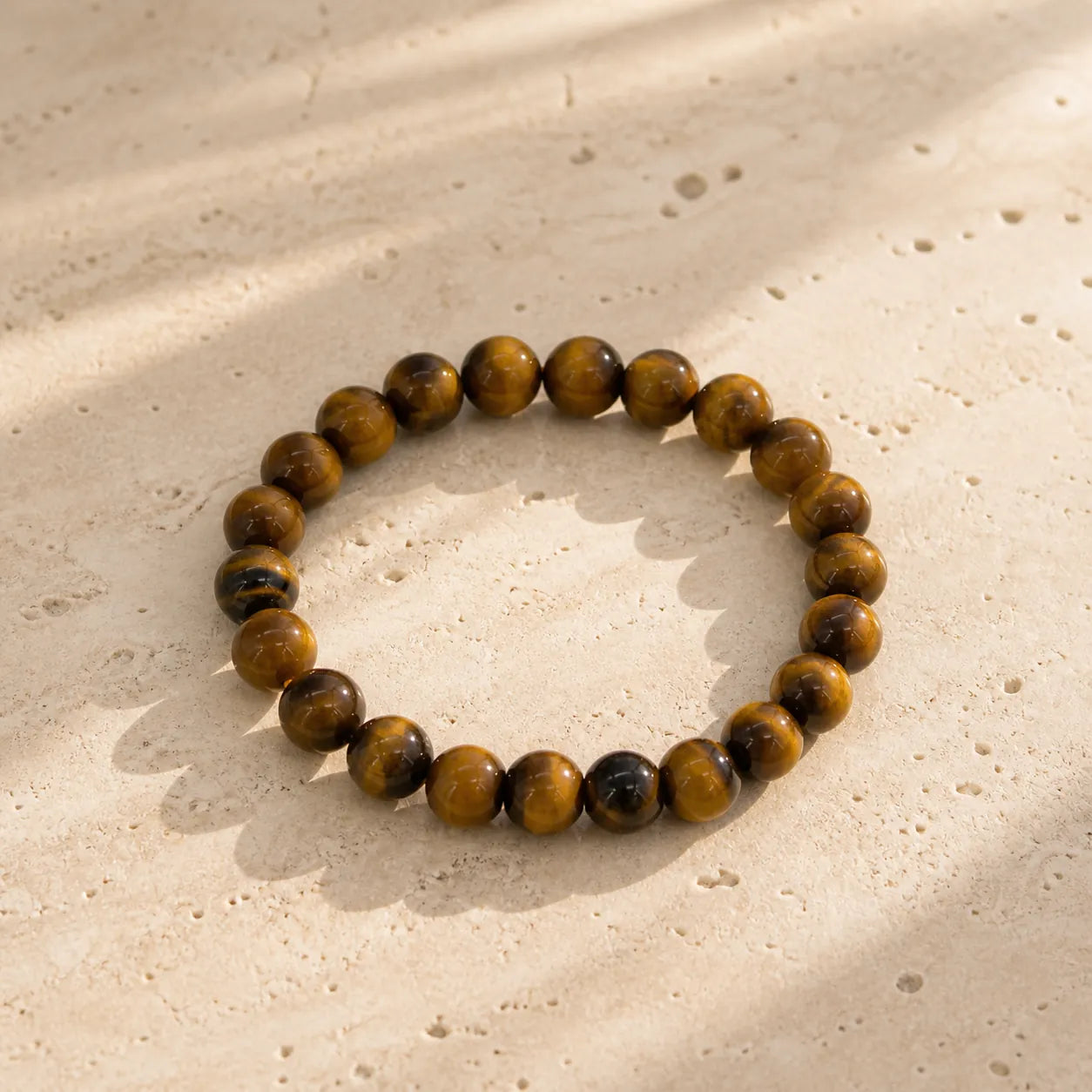
A related intention option
Tiger Eye Bracelet – Decisive Focus
This is a related focus option, not a Sodalite product. We only identify jewelry as Sodalite when that exact material is verified.
Explore this related option- Cleanse gently. Rinse briefly under cool running water, or use smoke from incense or palo santo. Avoid salt burial if your piece is polished — abrasive salt can dull the surface. Skip ultrasonic cleaners entirely.
- Charge by intention. Sodalite does not require sunlight, and prolonged direct sun may fade some blues over time. Moonlight or simply holding the stone while setting an intention for clarity or honest speech is traditional and effective for most people.
- Dry thoroughly. Pat dry with a soft cloth. Do not leave a polished sodalite piece sitting in water.
- Store separately. Keep sodalite in a soft pouch apart from quartz, sapphire, or other harder stones to avoid scratches.
- Remove before intense activity. Gym equipment, dishwashing, and jewelry stacking are the three most common causes of surface damage.
Choosing Your Sodalite: What to Look For
Three checks cover most of the buying decision:
- Color saturation and consistency. A good sodalite has even, deep royal blue with limited muddy transitions. Heavy gray-brown areas usually mean a lower grade cut.
- Even polish. Run a fingertip across the surface. Flat spots, waxy patches, or a dull finish often indicate resin or wax treatment, which is common in the lower end of the market.
- Veining that matches the stone's nature. White calcite veining is normal and expected in sodalite. Uniformly milky-white "blue" stones with no veining at all should prompt a closer look, since natural sodalite almost always shows some structural character.
This is where the Lumina Grade AAA Integrity Standard applies: we select natural, mine-authentic sodalite with no chemical resin filling, no irradiation, and no dye enhancement — because clarity of stone and clarity of intention should match.
FAQ: Common Questions About Sodalite Crystal Benefits
What are the main benefits of sodalite crystal?
Sodalite is traditionally associated with mental clarity, logical thinking, honest communication, and emotional steadiness. It is most often chosen by people who want help quieting internal noise or speaking more openly.
How do you use sodalite for healing and daily life?
Common uses include keeping a piece on a desk for focus, holding it during meditation, wearing it as a pendant near the throat, and carrying a pocket stone for travel anxiety. These are supportive practices, not medical treatments.
How do you cleanse, charge, and care for a sodalite crystal?
Rinse briefly with cool water or pass through smoke to cleanse, then charge under moonlight or by setting an intention. Because sodalite is 5.5–6 on the Mohs scale, store it separately from harder stones and remove it before physical activity.
Sources
This article reflects traditional crystal lore and general mineral information. It is not medical advice. Crystal practices are supportive and symbolic; they are not a substitute for professional care.
© 2026 Lumina Quartz