Purple Agate: Spiritual Meaning, Symbolism, and Daily Use

Table of Contents
- 10-Second Executive Summary / The Verdict Box
- What Is Purple Agate? Composition, Colors, and Formation
- Purple Agate Spiritual Meaning and Symbolism
- Intuition, Higher Consciousness, and the Violet Vibration
- Decision Table: Is Purple Agate the Right Stone for Your Purpose?
- Step-by-Step Fit Check
- Chakras and Energetic Alignment: Crown and Third Eye
- Emotional and Mental Benefits: Calm, Clarity, and Balance
- Daily Use: Meditation, Jewelry, and Home Rituals
- Purple Agate vs. Amethyst and Grape Agate: Key Differences
- How to Choose, Cleanse, and Care for Purple Agate
- FAQ: Purple Agate Meaning, Uses, and Buying Tips
- What does purple agate symbolize spiritually?
- Which chakras is purple agate connected to?
- How do you use purple agate in daily life?
- Is purple agate natural or dyed?
- How do you cleanse and recharge purple agate?
- Sources
Purple agate is a variety of chalcedony quartz that takes its violet, lavender, or plum tones from trace impurities and the way its layered bands scatter light; in crystal traditions it is most often associated with intuition, inner calm, and the crown and third eye chakras, and it is commonly used in meditation, as jewelry, or as a grounding object for reflective rituals. Because natural purple agate exists but is far rarer than dyed or heat-treated material, knowing how to read color zoning and banding is the single most useful buying skill.
10-Second Executive Summary / The Verdict Box
- Direct Verdict: Purple agate is a banded chalcedony quartz valued in crystal practice for intuition and calm, but it is a decorative mineral, not a medical or psychological treatment.
- Mineral identity: Agate is a fibrous, banded form of chalcedony (microcrystalline quartz); chemical formula SiO₂.
- Mohs Hardness: 6.5–7 for quartz/chalcedony, so it resists scratches in daily wear but can chip with hard impact.
- Crystal system: Trigonal (microcrystalline quartz); purple color usually comes from trace impurities and light scattering through bands, and may also be produced by dyeing.
- Chakra associations: Crown (seventh) and third eye (sixth) in common modern crystal practice.
- Best for: meditation focal pieces, beaded jewelry, bedside or desk grounding objects, and quiet evening rituals.
- Buying benchmark: Look for natural banding, color zoning, and honest disclosure of treatment; prefer pieces sold with clear written treatment disclosure and avoid vendors who insist everything is untreated.
- Care: Warm water, mild soap, soft cloth; avoid prolonged sun, harsh acids, and ultrasonic cleaners on dyed or filled pieces.
What Is Purple Agate? Composition, Colors, and Formation
Agate is chalcedony — microcrystalline quartz with a chemical composition of silicon dioxide (SiO₂) — that forms in concentric or parallel bands inside cavities of volcanic rock, typically where silica-rich fluids deposit layer after layer. The U.S. Geological Survey classifies agate among the ornamental and decorative minerals rather than the precious gem class, which matches its role in jewelry and object design. Purple agate is the violet-to-lavender expression of that same material.
Natural violet tones in agate are uncommon and generally subtle. Much of the vivid purple agate sold today is dyed or heat-treated, a long-established practice in the gem trade. GIA's gem news reporting has documented dyed and treated quartz materials entering the market, which is a useful reminder that treatment disclosure matters more than the romance of a color story. Geologically, the "purple" you see is a combination of trace coloration and the way light moves through fine banding — so the banding pattern itself is your best naturalness clue.
Two practical consequences follow. First, purple agate is durable enough for everyday rings and bracelets at Mohs 6.5–7, though it will not survive a hard knock as gracefully as a tougher stone. Second, its value rests on pattern quality, translucency, and honest sourcing rather than on rarity alone.
Purple Agate Spiritual Meaning and Symbolism
Intuition, Higher Consciousness, and the Violet Vibration
In modern crystal traditions, purple agate is often associated with intuition, quiet reflection, and connection to something larger than the self. The violet end of the spectrum is frequently linked in these traditions to higher consciousness, which is why purple stones so often appear in meditation practice. Purple agate's specific character comes from the combination: agate's layered, grounding structure paired with a color tradition of introspection.
Keep the categories clean. The banding and hardness are verifiable mineral facts. The intuition symbolism is cultural and personal — it may support a reflective mindset or serve as a meaningful reminder, but it is not a demonstrated effect on mood, the nervous system, or mental health. Many people find that holding a specific stone during a breathing practice helps them anchor attention; that is the value of ritual, not a mineral property.
Decision Table: Is Purple Agate the Right Stone for Your Purpose?
Use this table to decide quickly. It compares what purple agate actually offers against common alternatives, so you can choose by purpose rather than by color alone.
| Your purpose | Purple agate fit | What to watch for |
|---|---|---|
| Meditation focal stone | Strong fit — banded surface gives the eye a natural anchor | Prefer palm-size tumbled or cabochon pieces with clear banding |
| Everyday ring or bracelet | Moderate fit — Mohs 6.5–7 is scratch-resistant but chip-prone | Choose bezel settings to protect edges |
| Vivid saturated purple look | Weak fit for natural material — strong violet usually signals dye | Ask for written treatment disclosure |
| High-contrast violet clarity | Consider amethyst instead — crystalline quartz with natural violet color | Amethyst is a single crystal, not banded |
| Botryoidal grape-like clusters | Consider grape agate — a different mineral form | Do not assume the two are interchangeable |
| Gift with meaning | Strong fit — symbolism is easy to explain and non-medical | Pair with a note framing it as a reminder, not a remedy |
Step-by-Step Fit Check
- Name your primary purpose (meditation, wear, display, gift).
- Match it to the table row above; note whether the fit is strong, moderate, or weak.
- If the purpose is wear, confirm the setting protects the stone's edges.
- If the purpose is color fidelity, decide in advance whether you accept treated material with disclosure.
- Write down your budget ceiling before browsing, since pattern quality drives price more than rarity claims.
Applicability boundary: this table helps with aesthetic and practical choices. It does not evaluate any health or therapeutic claim, and none should be inferred from it.
Chakras and Energetic Alignment: Crown and Third Eye
In common modern chakra frameworks, purple agate is placed with the crown chakra (seventh, at the top of the head) and the third eye chakra (sixth, between the brows). Crown associations tend to be described as connection, stillness, and openness; third eye associations tend to be described as insight and inner seeing. These are interpretive traditions, not anatomy.
If you work within this framework, the practical move is placement and attention rather than expectation. Some practitioners rest a purple agate on the forehead during quiet meditation or hold it at heart level while breathing slowly. Others simply keep a piece on a desk as a visual cue to pause. What matters is consistency and honesty about what the practice is doing: creating a structured moment of calm, not producing a measurable physiological change.
Emotional and Mental Benefits: Calm, Clarity, and Balance
In crystal traditions, purple agate is often associated with calm, clarity, and balance — a steadying presence that may support a more reflective frame of mind. People sometimes describe reaching for it in moments of mental noise, which is a reasonable use of ritual. The honest framing is this: it may support a calming routine, and it is often associated with clarity, but any felt benefit is likely coming from the pause, the breath, and the intention the stone represents.
Daily Use: Meditation, Jewelry, and Home Rituals
Purple agate fits easily into ordinary days because it is durable, affordable, and visually quiet. Three approaches work well:
- Meditation. Hold a tumbled piece or gaze at the bands while following a slow breathing count. Begin with three to five minutes; the banding gives restless attention somewhere gentle to land.
- Jewelry. Beaded bracelets, pendants, and bezel-set rings keep the stone close as a reminder. Bezel settings protect the softer edges of the piece during daily wear.
- Home rituals. Place a cluster or slice on a bedside table or desk as a cue for evening wind-down. Some people keep one near a journal so the act of picking it up marks the start of reflective writing.
A simple, repeatable sequence: choose one fixed time of day, pick up the stone, take five slow breaths, and name one thing you want to carry into the next hour. That is enough. The ritual earns its meaning through repetition, not through elaborate setup.
Purple Agate vs. Amethyst and Grape Agate: Key Differences
These three are frequently confused, and the differences are structural, not just visual.
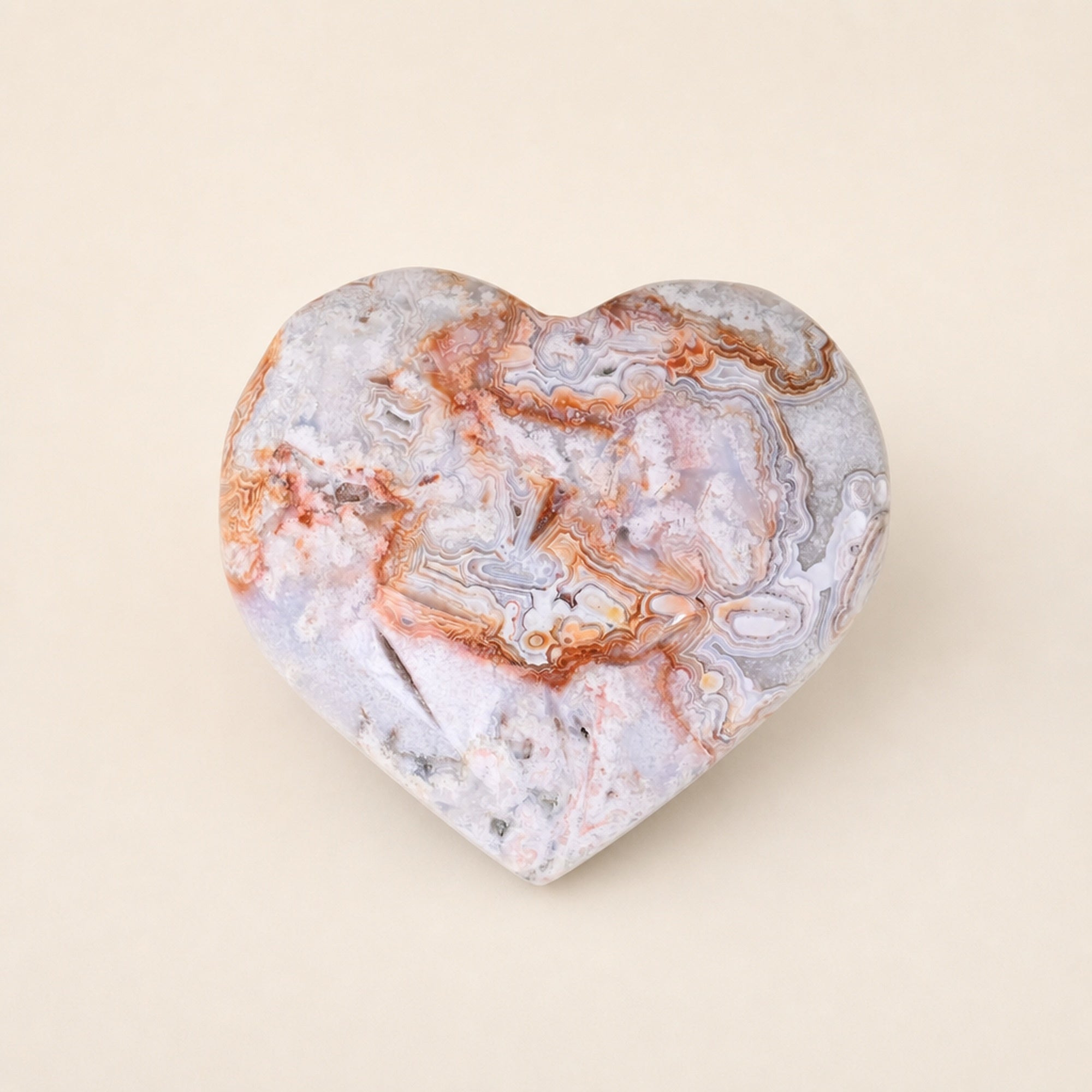
A related stone-family option
Crazy Lace Agate Heart Stone – Joyful Movement
This is a related variety in the same stone family, not a Agate product. We only identify jewelry as Agate when that exact material is verified.
Explore this related option- Purple agate is banded, microcrystalline chalcedony. Its patterns are layered and often translucent at the edges. Natural violet is subtle; vivid violet is usually treated.
- Amethyst is macrocrystalline quartz — a single crystal with visible points and natural violet color, traditionally linked to trace iron in the earth. It is not banded. The GIA has reported synthetic amethyst in the market, so origin and disclosure matter here too.
- Grape agate is a distinct botryoidal form, typically appearing as small spherical clusters rather than flat banding. It is not a purple-banded agate and should not be sold as one.
Quick test logic: if the piece shows crisp parallel or concentric bands, you are likely looking at agate; if it shows a single crystalline point with even violet color, think amethyst; if it looks like a cluster of tiny grapes, think grape agate.
How to Choose, Cleanse, and Care for Purple Agate
Start with a five-step buying check. First, examine the banding under natural light — natural agate shows irregular, organic layers, while dye often pools in cracks and looks uniform across the surface. Second, ask directly whether the piece is dyed, heat-treated, or resin-filled, and get the answer in writing. Third, judge cut and polish: sharp facets and a smooth dome indicate careful work. Fourth, check for honesty in labeling — a seller who names treatments is more trustworthy than one who insists everything is "natural." Fifth, treat any claim of special processing or superior origin as advertising until it is documented in writing.
For cleansing and care, warm water with a drop of mild soap and a soft cloth is sufficient for most pieces. Avoid prolonged direct sun, which can fade dyed color, and skip ultrasonic or steam cleaners on treated or filled stones. Energetic cleansing is a personal tradition — many people simply rinse a piece, let it dry overnight on a windowsill, or set an intention while holding it. None of these methods has a verified effect on the stone's physical properties; they are practices of attention.
FAQ: Purple Agate Meaning, Uses, and Buying Tips
What does purple agate symbolize spiritually?
In modern crystal traditions, purple agate is often associated with intuition, inner calm, and connection to higher consciousness, drawing on the long cultural link between violet stones and reflection. These are symbolic associations rather than demonstrated effects.
Which chakras is purple agate connected to?
It is most commonly placed with the crown chakra (seventh) and the third eye chakra (sixth) in modern chakra practice. Placement is interpretive; many people use it simply as a focus for quiet breathing.
How do you use purple agate in daily life?
Hold a tumbled piece during short meditation, wear it as a bezel-set ring or beaded bracelet, or keep a slice on your desk as a visual cue to pause. A fixed time and a few slow breaths are enough to make the ritual meaningful.
Is purple agate natural or dyed?
Natural purple agate exists but is uncommon and usually subtle in color. Vivid, uniform violet is often the result of dyeing or heat treatment, so always ask for written treatment disclosure and check whether color pools in cracks.
How do you cleanse and recharge purple agate?
Clean it with warm water, mild soap, and a soft cloth, and avoid prolonged sun exposure and harsh chemicals. Energetic cleansing methods such as rinsing or resting it on a windowsill are personal traditions, not verified physical processes.
Sources
- GIA — Gems & Gemology, Spring 1991 (dyed and treated quartz materials; synthetic amethyst reporting)
- USGS — Corundum bulletin (classification of agate and quartz among ornamental minerals)
This article shares cultural symbolism and mineral information for educational purposes only. It is not medical or psychological advice, and crystal practices are not a substitute for professional care. © 2026 Lumina Quartz.
Crystal traditions are presented here as symbolic, cultural, and personal ritual practices. They are not medical tools; consult a qualified professional for health concerns.