Prehnite Crystal Meaning: Properties, Benefits, and How to Use It for Emotional Healing and Intuition
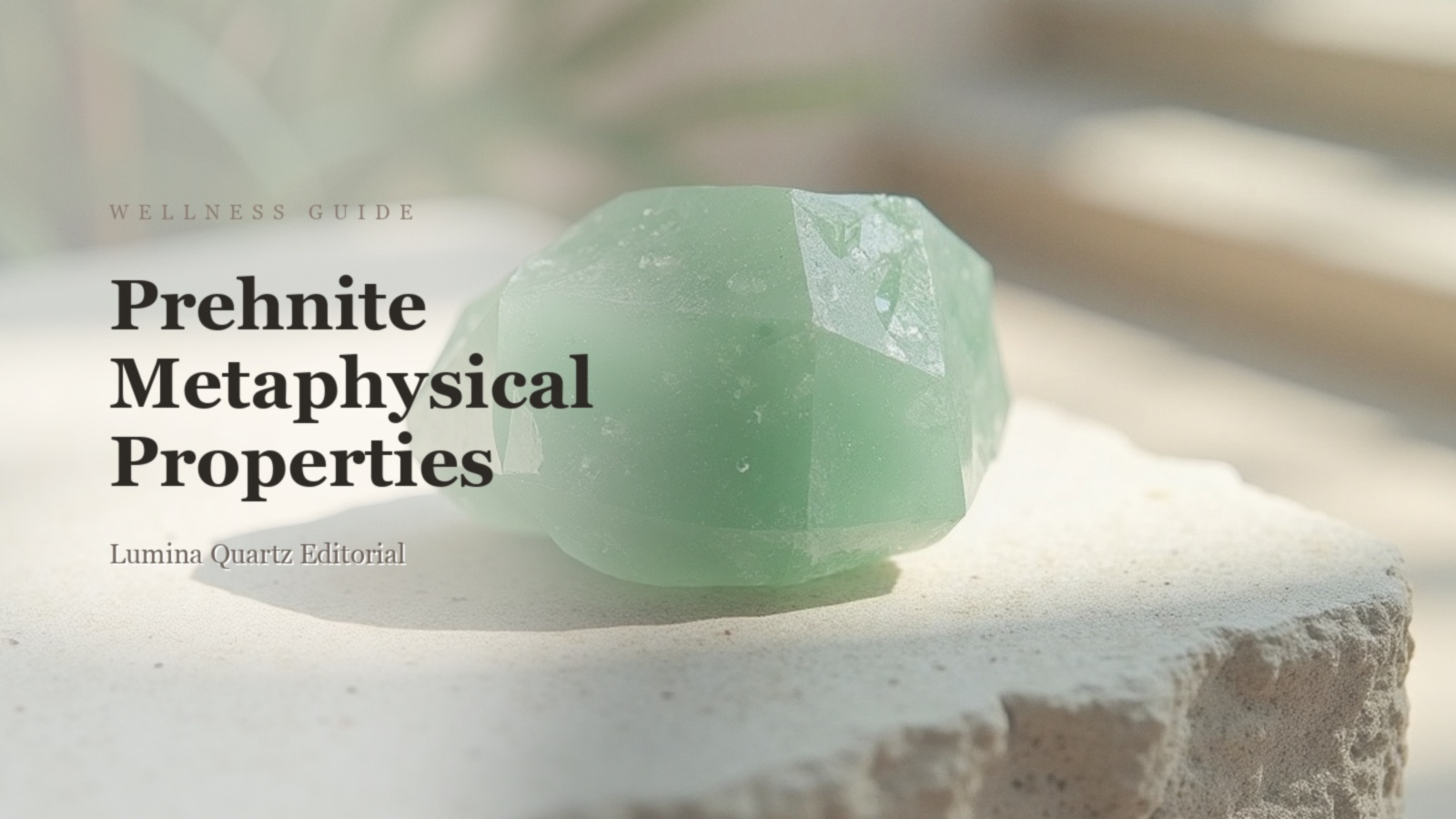
Table of Contents
- What is Prehnite?
- Physical Properties and Formation of Prehnite
- Colors and Sources of Prehnite
- Prehnite Metaphysical Properties
- Quiet Confidence and Emotional Healing
- Connection with Angels and Higher Realms
- Enhanced Intuition and Precognition
- The Heart Chakra and Prehnite
- How to Use Prehnite
- Wearing and Meditation
- Cleansing and Caring for Prehnite
- Buy Authentic Prehnite at Lumina Quartz
- Key Takeaways
- FAQ
Some crystals ask for attention. Prehnite is not one of them. It rests in the palm like a sliver of morning light — soft, luminous, translucent green with a golden inner glow. For those drawn to gentle forms of introspection, prehnite has long been regarded as a stone of quiet healing. In this guide, we explore prehnite metaphysical properties, how to work with this crystal in daily life, and what makes it so beloved among mindful crystal collectors.
What is Prehnite?
Prehnite is a calcium aluminium silicate mineral, chemically written as Ca2Al2Si3O10(OH)2. It was first documented in South Africa in the late 1700s and named after Colonel Hendrik von Prehn, the Dutch military commander who brought the earliest specimens to Europe. In mineralogy, prehnite is classified as a phyllosilicate and is recognised as a relatively common mineral that forms in low-temperature hydrothermal environments. Despite its long history, prehnite remains something of a hidden gem in the crystal world — appreciated by those who know it, yet still unfamiliar to many.
Physical Properties and Formation of Prehnite
Prehnite typically forms in cavities within basalt, diabase, and other volcanic rocks, often alongside zeolites and other secondary minerals. It crystallises in the orthorhombic system and is most commonly found as botryoidal masses — rounded, grape-like clusters that catch the light in a way that feels almost aqueous. The stone's internal structure can create a subtle shimmer, and some specimens display a soft cat's-eye effect when polished into cabochons.
On the Mohs hardness scale, prehnite measures between 6 and 6.5, which makes it durable enough for jewellery but still susceptible to scratching with careless handling. Its specific gravity sits between 2.8 and 2.95, and its natural lustre is vitreous to pearly, giving polished pieces a glassy, balmy sheen. Its translucency ranges from nearly transparent to opaque.
Colors and Sources of Prehnite
The classic colour of prehnite is a pale to medium green, often compared to the colour of freshly sprouted leaves or shallow sea water. Mineral references describe the full range as colourless to grey, yellow, yellow-green, or white, with pale brownish tones and very rare pale bluish material. Some specimens present a yellow-green or chartreuse character, while rarer pieces from certain localities may show peach or grey zones. Inclusions of black needle-like actinolite can occasionally be seen within the stone, creating a striking contrast that collectors prize.
Significant sources of prehnite include South Africa, Australia, India, China, Canada, Scotland, and the United States — early US specimens from localities such as Paterson, New Jersey, were studied by the US Geological Survey in the late 1800s. Newer deposits continue to appear; gemmological reporting has documented prehnite from the Philippines, where a white prehnite matrix is found speckled with green uvarovite garnet. Each locality produces its own subtle variation in colour and clarity. Australian prehnite is often vibrant and translucent, while South African material tends to be paler with a milky softness.
Prehnite Metaphysical Properties
Prehnite is widely regarded in the crystal community as a stone of unconditional love, inner peace, and spiritual protection. While it is not a substitute for professional medical or psychological care, prehnite metaphysical properties are often associated with emotional comfort, intuitive awakening, and a deepened sense of safety. It is a stone that does not shout; it whispers — and over time, those whispers can help quiet the noise within us.
Quiet Confidence and Emotional Healing
Prehnite's energy is often described as nurturing and maternal — not in a way that coddles, but in a way that reminds you of your own resilience. It is said to help soothe anxiety, calm an overactive mind, and release old emotional patterns that no longer serve you. For those who carry the weight of past wounds, prehnite may support a gentle process of forgiveness and self-compassion.
This stone is also associated with quiet confidence. Rather than fuelling ego or outward bravado, prehnite is believed to strengthen inner certainty — the kind that allows you to speak your truth without raising your voice, to set boundaries without guilt, and to trust your own choices even when the world questions them. In this sense, prehnite metaphysical properties align with a very modern need: the courage to be soft in a harsh world and still feel strong.
Connection with Angels and Higher Realms
In many spiritual traditions, prehnite is considered a stone of angelic communication. It is often associated with the higher heart chakra and the thymus area, which some believe serves as a bridge between the physical and spiritual heart. Practitioners who work with angelic guidance sometimes use prehnite as a focal point for meditation, prayer, or conscious connection with guides.
While we cannot verify the presence of angels or higher realms, we can say that prehnite's gentle, expansive quality often supports a meditative state in which people feel more open, protected, and receptive to guidance. If you use prehnite during moments of quiet reflection, you may find that your mind naturally drifts toward deeper questions — and that the answers come more softly, without force or struggle.
Enhanced Intuition and Precognition
Prehnite is frequently described as an intuition amplifier. It is said to enhance dream recall, vivid dreaming, and the subtle knowing that arrives before conscious thought — what some call a "gut feeling." Many crystal practitioners use prehnite when they are facing important decisions, as it may support clearer inner sight and help distinguish between fear-based thinking and genuine intuition.
Precognition, or the experience of sensing events before they occur, is often associated with the higher crown chakra and the third eye. Prehnite is sometimes placed on these centres during meditation to encourage the flow of intuitive information. It does not force prophecy, but it may help you become more aware of the signs and synchronicities already around you — the coincidences that sometimes feel too meaningful to be random.
The Heart Chakra and Prehnite
The heart chakra, located at the centre of the chest, is the seat of love, compassion, and emotional balance. Prehnite is strongly associated with this energy centre, particularly with the higher heart chakra, which is said to govern universal love and spiritual connection. Working with prehnite on the heart chakra may support emotional release, greater empathy, and a more open stance toward both giving and receiving love.
Because prehnite works so closely with the heart, it is often recommended for those who are healing from grief, heartbreak, or relational trauma. Its gentle green tone resonates with the restorative frequencies of nature itself — think of the first leaves after a long winter, or the calm colour of a deep forest pond. Prehnite does not rush healing; it accompanies it, holding space for the tender process of rebuilding trust in yourself and in others.
How to Use Prehnite
There is no single "right" way to work with prehnite. The stone responds well to intention, but honestly, it also responds well to simply being held. Below are some of the most common and accessible ways to incorporate prehnite into your daily rhythm.
Wearing and Meditation
Prehnite's hardness of 6 to 6.5 makes it suitable for pendants, rings, and beaded bracelets, though it is best worn in ways that avoid hard knocks — a pendant or gently set ring protects the stone better than a loose pocket companion. Many people wear prehnite close to the heart, letting it rest against the chest as a quiet anchor during the day.
For meditation, hold a polished piece in your non-dominant hand or lie it on the chest or brow. Begin with a few slow breaths, then set a simple intention — peace, clarity, or simply "I am safe to feel." Prehnite is especially supportive of reflective or heart-centred meditation rather than intense, goal-driven practice. Journaling after a session can help capture the soft insights that surface.
Crystal Healing Practices
In crystal healing layouts, prehnite is often paired with rose quartz for heart work, amethyst for calm intuition, or clear quartz to amplify its gentle current. Some practitioners place a small piece under the pillow to encourage peaceful rest and dream recall. Others keep prehnite on a desk or altar as a reminder to pause, soften, and listen inward. These practices are personal and intuitive — treat prehnite as a companion to your own reflection, not a replacement for it.
Cleansing and Caring for Prehnite
Cleaning Methods
Prehnite is softer than quartz, so gentle care keeps its sheen intact. Rinse briefly with lukewarm water and a drop of mild soap, use a soft cloth or brush, and pat dry. Avoid ultrasonic cleaners and steam cleaners, which can stress the stone. For energetic cleansing, moonlight, sound, and smudging are all kind to prehnite; many people also rest it on a bed of clear quartz.
Important Care Tips
Keep prehnite away from prolonged direct sunlight, which can fade its colour over time. Store it separately from harder stones such as sapphire or diamond to prevent scratches, and remove rings or bracelets before gardening, gym sessions, or household cleaning. Avoid harsh chemicals, hot water, and sudden temperature changes.
Prehnite at a Glance: What the Mineral Record Confirms
Because prehnite is often sold alongside lookalike stones, it helps to know which physical facts are firmly documented and which qualities belong to lore. This quick reference separates the two.
| Attribute | Documented Mineral Fact | Traditional / Lore Attribute |
|---|---|---|
| Chemical formula | Ca2Al2Si3O10(OH)2 | — |
| Hardness (Mohs) | 6 – 6.5 | — |
| Lustre | Vitreous to pearly | — |
| Crystal system | Orthorhombic; commonly botryoidal masses | — |
| Typical colour | Colourless, grey, yellow, yellow-green, white; rarely pale bluish | Green hue linked with the heart chakra |
| Associated qualities | — | Inner peace, quiet confidence, intuition, angelic connection |
Buy Authentic Prehnite at Lumina Quartz
If prehnite's gentle presence resonates with you, our curated collection at Lumina Quartz offers hand-selected pieces chosen for their colour, translucency, and calm energy — each one inspected for natural character and quality.
Key Takeaways
- Prehnite is a calcium aluminium silicate with a Mohs hardness of 6 to 6.5, best suited to gentle, protected wear.
- Its classic green colour ranges from pale and milky to vivid yellow-green, with origins spanning South Africa, Australia, India, China, Canada, Scotland, the United States, and the Philippines.
- In crystal tradition, prehnite is a stone of unconditional love, quiet confidence, and intuitive awakening.
- It is closely tied to the heart and higher heart chakras and is often used for emotional healing and reflection.
- Care is simple: lukewarm water, soft cloth, and protection from sunlight, chemicals, and harder stones.
FAQ
What is prehnite good for?
In crystal tradition, prehnite is valued as a calming, heart-centred stone associated with emotional healing, quiet confidence, intuition, and connection with higher guidance. Physically, it is a beautiful, translucent green mineral used in jewellery and collecting.
How hard is prehnite, and can I wear it daily?
Prehnite measures 6 to 6.5 on the Mohs scale, so it can be worn daily with care. Choose protected settings such as pendants or gently set rings, and remove the stone during rough activity to avoid scratches and chips.
How do I cleanse prehnite?
Rinse with lukewarm water and mild soap, pat dry with a soft cloth, and avoid ultrasonic or steam cleaners. For energetic cleansing, moonlight, sound, smudging, or resting beside clear quartz are all gentle options.
Which chakra is prehnite associated with?
Prehnite is most commonly associated with the heart chakra and the higher heart chakra, and is sometimes used with the third eye and crown during meditation for intuitive work.
Is prehnite the same as jade?
No. Prehnite and jade are different minerals with different hardness and chemistry. Prehnite is a calcium aluminium silicate, while jade refers to jadeite or nephrite. Buy from reputable sellers and ask for the mineral name in writing.
Related Reading
If prehnite's gentle energy speaks to you, you may also enjoy exploring these companion guides:
- Rose Quartz Crystal: A Gentle Guide to Meaning, Benefits, and Uses
- Kyanite Crystal Meaning: A Guide to Benefits, Uses, and Chakra Alignment
- Fluorite Meaning: Meaning, Properties, and Everyday Uses