Onyx Stone: Spiritual Meaning, Symbolism, and Daily Use
Table of Contents
- What Is Onyx Stone? Definition, Composition, and the Banding Test
- 10-Second Executive Summary / The Verdict Box
- Onyx Stone Meaning and Symbolism Through History
- From the Myth of Onux to Egyptian, Roman, and Persian Protective Amulets
- Spiritual Meaning and Healing Properties of Onyx
- Protection, Strength, Self-Mastery, and Grounding Energy by Chakra
- Onyx Color Meanings: Black, Green, Red, and White Onyx
- How to Use Onyx in Daily Life: Jewelry, Meditation, Feng Shui, and Gifting
- Choosing and Caring for Onyx Jewelry: Quality Cues, Agate Confusion, and Cleaning Tips
- Decision Table: Real Onyx vs. Agate vs. Treated "Fake Onyx"
- FAQ: Is Onyx Lucky? Who Should Wear It? and Other Common Questions
- What is the spiritual meaning of onyx stone?
- Is black onyx good luck or bad luck?
- How can you tell real onyx from agate or fake onyx?
- Sources
What Is Onyx Stone? Definition, Composition, and the Banding Test
Onyx is a banded variety of chalcedony, a form of microcrystalline quartz (SiO₂), defined by its straight, nearly parallel layers of color. If you are asking what onyx stone means, the shortest accurate answer is this: physically, it is a layered quartz gem whose parallel banding has made it a canvas for carving since antiquity; symbolically, it is most often associated with protection, strength, and self-mastery. The two meanings are linked — the stone's structure is literally built from distinct, orderly layers, which is why cultures from Egypt to Persia reached for it as a talisman of steadiness.
10-Second Executive Summary / The Verdict Box
- Direct Verdict: Onyx is a banded chalcedony traditionally associated with protection, grounding, and self-discipline. It is a symbolic and cultural stone, not a medical treatment.
- Mohs Hardness: Approximately 6.5–7 (quartz family), making it durable for daily jewelry with reasonable care.
- Composition: Silicon dioxide (SiO₂), microcrystalline; straight parallel banding is the diagnostic feature.
- Best For: Everyday rings and pendants, meditation anchors, feng shui placements, and meaningful gifting.
- Buyer Standard: Look for natural, untreated stone — the Lumina Grade AAA Integrity Standard (natural rough origin, zero chemical resin filling, no irradiation or dye) is our benchmark.
Onyx Stone Meaning and Symbolism Through History
The name onyx traces to the Greek onux, meaning "fingernail" or "claw," a reference to the pale, translucent layers that resemble a nail against flesh. According to Gem Society, onyx's straight, nearly parallel bands allowed skilled carvers to cut away layers to create cameos and intaglios with extraordinary depth and contrast. That structural feature is not a side note — it explains why onyx became a carving stone, a seal stone, and a protective amulet across cultures.
From the Myth of Onux to Egyptian, Roman, and Persian Protective Amulets
In classical tradition, the origin myth of onux is often told as a cautionary tale about vanity and transformation — a story that shaped the stone's association with humility and inner discipline. In ancient Egypt, dark banded stones were carved into scarabs and amulets for burial and daily wear. Roman seal rings used onyx intaglios because the layered stone held a crisp impression. Persian and later Islamic traditions often associated dark banded stone with warding and boundary-setting. These are cultural and historical meanings, not scientifically verified effects.
Spiritual Meaning and Healing Properties of Onyx
In modern crystal practice, onyx is most often associated with protection, strength, self-mastery, and grounding. Practitioners may use it as a focal object for intention-setting or as a reminder of personal boundaries. These are symbolic and reflective uses; onyx is not a substitute for medical or mental health care, and no stone can regulate the nervous system or treat a condition.
Protection, Strength, Self-Mastery, and Grounding Energy by Chakra
In chakra-based systems, black onyx is frequently linked with the root chakra (Muladhara), often associated with stability and a sense of being anchored. Red onyx is sometimes paired with the root or sacral region in symbolic color work, and green onyx with the heart center in some traditions. Treat these as cultural frameworks for reflection rather than physiological claims. A grounding practice might look like holding the stone during a breathing exercise or placing it on a desk as a visual cue for focus.
Onyx Color Meanings: Black, Green, Red, and White Onyx
Color meanings vary by tradition, and the gem trade uses trade names loosely. Black onyx is the most common commercial form and is often associated with protection and resolve. Green onyx, often dyed or heat-treated in the market, is symbolically tied to growth and calm. Red onyx (sardonyx when banded) is linked with vitality and courage in many cultural readings. White onyx is often associated with clarity and purification. Note that "onyx" in commerce can mean natural banded chalcedony or a dyed/treated stone, so ask for disclosure.
How to Use Onyx in Daily Life: Jewelry, Meditation, Feng Shui, and Gifting
Onyx is practical for daily wear because of its hardness, but it benefits from intentional use. Wear a black onyx pendant or ring as a personal reminder of a boundary you are practicing. In meditation, hold the stone and use its parallel banding as a visual anchor for steady attention. In feng shui, dark stone objects are sometimes placed near entryways or workspaces as symbols of protection and focus — placement is symbolic, not energetic physics. As a gift, onyx suits milestones that involve commitment, discipline, or a new chapter.
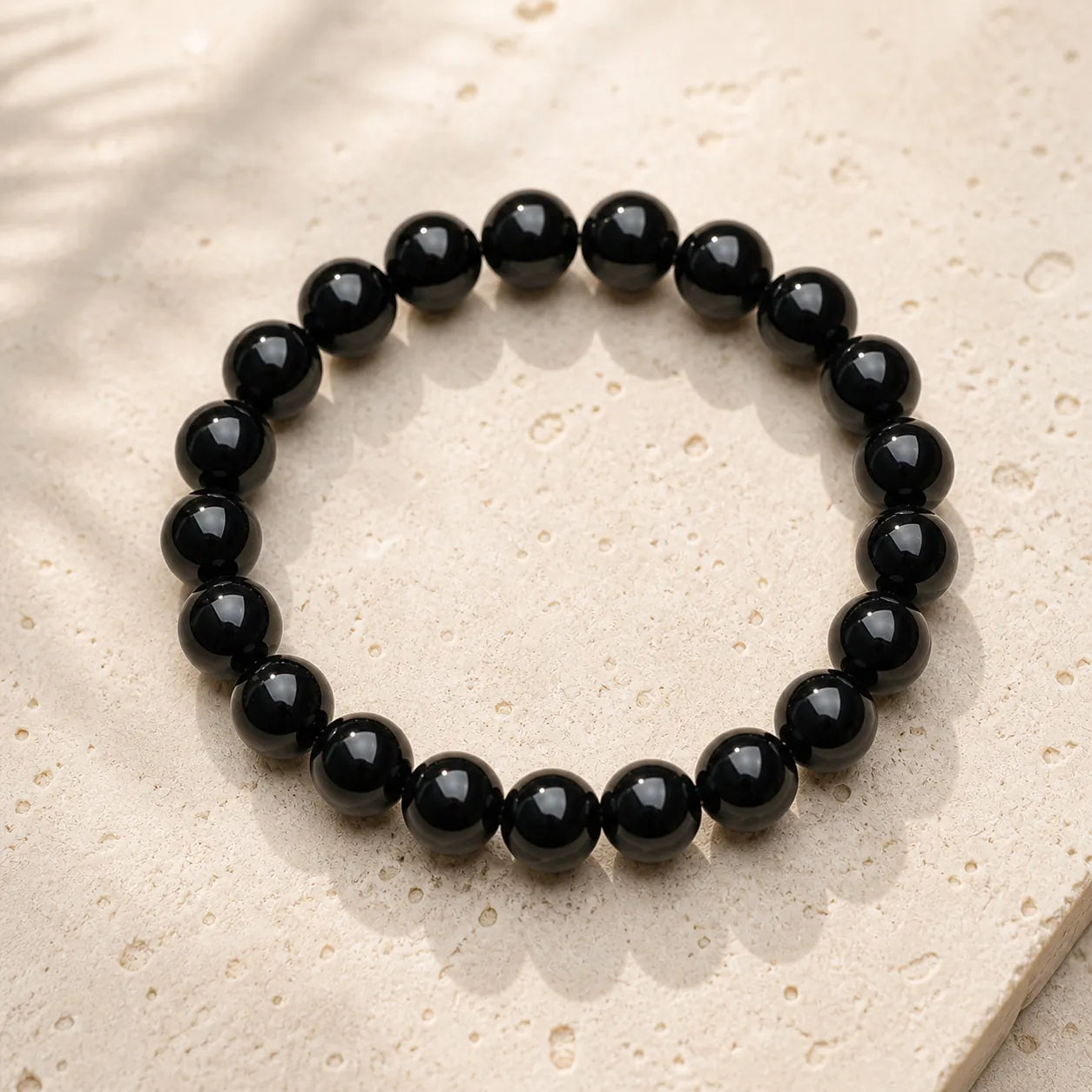
A related intention option
Black Obsidian Protection Bracelet
This is a related grounding, protection option, not a Onyx product. We only identify jewelry as Onyx when that exact material is verified.
Explore this related optionChoosing and Caring for Onyx Jewelry: Quality Cues, Agate Confusion, and Cleaning Tips
Onyx and agate are both chalcedony; the difference is banding. Onyx has straight, parallel bands, while agate typically shows curved or concentric banding. Many "black onyx" pieces sold today are dyed black chalcedony — disclose and verify. Under the Lumina Grade AAA Integrity Standard, we accept only natural rough origin with no chemical resin filling and no irradiation or dye. Ask sellers for treatment disclosure, examine banding under light, and check that color is consistent with natural variation rather than uniform saturation.
Decision Table: Real Onyx vs. Agate vs. Treated "Fake Onyx"
| Feature | Natural Onyx | Agate | Treated / Dyed "Onyx" |
|---|---|---|---|
| Banding pattern | Straight, nearly parallel layers | Curved, concentric, or irregular | Often absent or artificially masked by uniform dye |
| Color consistency | Natural variation between layers | Natural variation, often pastel | Suspiciously uniform, saturated, or "too perfect" |
| Hardness (Mohs) | ~6.5–7 | ~6.5–7 | Same base stone; dye may sit in surface fractures |
| Best use | Carvings, seals, daily jewelry | Beads, decorative cabochons | Budget fashion; verify disclosure before buying |
| Buyer action | Ask for natural-origin confirmation | Accept curved banding as agate | Request treatment disclosure; avoid undisclosed dye |
FAQ: Is Onyx Lucky? Who Should Wear It? and Other Common Questions
What is the spiritual meaning of onyx stone?
Onyx is most often associated with protection, strength, self-mastery, and grounding in crystal traditions. These are cultural and symbolic meanings, not medically verified effects.
Is black onyx good luck or bad luck?
In most traditions, black onyx is considered a protective and grounding stone rather than an unlucky one. Some folklore treats it as a warning stone — a reminder to stay honest with yourself — but it is not widely regarded as bad luck.
How can you tell real onyx from agate or fake onyx?
Check for straight, nearly parallel banding: that is onyx, while curved bands indicate agate. Uniform, overly saturated color and undisclosed dye are red flags — ask for treatment disclosure and compare against the Lumina Grade AAA Integrity Standard of natural origin, zero resin filling, and no irradiation or dye.
Sources
© 2026 Lumina Quartz. This article is for cultural, historical, and educational purposes only and is not medical advice.