Of Sodalite Stone: Spiritual Meaning, Symbolism, and Daily Use

Table of Contents
- What Is Sodalite? A Blue Stone of the Mind
- 10-Second Executive Summary / The Verdict Box
- The Meaning of Sodalite: Logic, Truth, and the Poet’s Stone
- Core Symbolism of Sodalite at a Glance
- Sodalite and the Chakras: Throat and Third Eye
- Sodalite vs. Lapis Lazuli: How to Tell Them Apart
- Decision Table: Sodalite vs. Lapis Lazuli
- Sodalite in Daily Life: Simple Ways to Work With It
- Desk, Pocket, and Meditation Practices
- Choosing and Caring for Your Sodalite Piece
- A Note on Sodalite’s Traditional Associations
- Frequently Asked Questions
- What is the spiritual meaning of sodalite stone?
- How do you tell sodalite from lapis lazuli?
- What chakras is sodalite connected to and what does sodalite do?
- Sources
What Is Sodalite? A Blue Stone of the Mind
Sodalite is a blue tectosilicate mineral with the formula Na₄(Si₃Al₃)O₁₂Cl, and it is often associated with clarity, logic, and honest communication in crystal lore rather than with physical healing. Its deep royal-blue color usually appears mottled with white calcite veining, and it ranks 5½–6 on the Mohs hardness scale—soft enough to reward careful handling and best worn as protected jewelry or kept as a pocket stone.
10-Second Executive Summary / The Verdict Box
- Direct Verdict: Sodalite is a blue feldspathoid mineral traditionally linked to clear thinking, truthful speech, and the throat and third-eye chakras; it is not a substitute for medical or psychological care.
- Mohs Hardness: 5½–6 (Mindat), so it is suitable for pendants and occasional wear but vulnerable to scratches and knocks.
- Specific Gravity: 2.27–2.33 (Mindat); GIA reports 2.28 for a faceted sodalite sample.
- Refractive Index: 1.484 and singly refractive, per GIA’s examination of a faceted orange-yellow sodalite.
- Best Use Cases: Desk-side reflection, journaling prompts, meditation focus, and conversation practice—not water exposure, rough wear, or ultrasonic cleaning.
The Meaning of Sodalite: Logic, Truth, and the Poet’s Stone
The spiritual meaning of sodalite is often described as “the stone of the thinking mind”: it is associated with orderly thought, self-honesty, and the courage to say what is true gently. In modern crystal symbolism, its blue-white pattern is read as a reminder that clarity and imperfection can coexist, which is why it is sometimes called the poet’s stone—poetry being the art of precise words that still leave room for feeling.
Core Symbolism of Sodalite at a Glance
- Mental clarity: often associated with untangling scattered thoughts before making a decision.
- Truthful speech: traditionally linked to speaking plainly without unnecessary harshness.
- Inner order: the white veining is read symbolically as structure within emotion.
- Study and focus: commonly used as a desk or study stone for concentration rituals.
- Discernment: may support the practice of asking “what do I actually know?” before reacting.
These are cultural and symbolic associations, not demonstrated physiological effects. Sodalite may support mindful routines, but it does not treat, cure, or prevent any condition.
Sodalite and the Chakras: Throat and Third Eye
Sodalite is most often connected to the throat chakra and the third eye. In that framework, the throat chakra is associated with expression and honest speech, while the third eye is associated with insight and clear perception. Sodalite’s blue color and often mottled white pattern fit neatly into that symbolic language, which is why it is frequently chosen for speaking practices, journaling, and meditation on discernment.
It is worth separating symbol from fact: the chakra system is a cultural and spiritual model, not a medical anatomy. What you can reliably do with sodalite is use it as a tactile anchor for a short breathing or reflection practice. If you are working through anxiety or intrusive thoughts, a stone may support a calming ritual, but it is not a treatment—please involve a qualified professional for persistent distress.
Sodalite vs. Lapis Lazuli: How to Tell Them Apart
The fastest way to tell sodalite from lapis lazuli is the veining and the pyrite. Sodalite typically shows white calcite veins and usually no golden pyrite flecks, while lapis lazuli is often a deeper, more opaque blue with pyrite inclusions and calcite patches. Sodalite also tends to be lighter in hand and somewhat less uniform in blue; lapis is a rock made largely of lazurite, while sodalite is a distinct mineral species.
Decision Table: Sodalite vs. Lapis Lazuli
| Feature | Sodalite | Lapis Lazuli |
|---|---|---|
| What it is | A single mineral species, Na₄(Si₃Al₃)O₁₂Cl (Mindat) | A rock composed mainly of lazurite with other minerals |
| Typical color | Royal to medium blue, often with white veining | Deep opaque blue, often with golden pyrite |
| Pyrite flecks | Usually absent | Common |
| White veining | Common calcite veining | Possible calcite patches, but different texture |
| Mohs hardness | 5½–6 (Mindat) | Typically around 5–6 depending on composition |
| Symbolic use | Logic, honest speech, study focus | Inner royalty, wisdom, deep insight |
Practical test: inspect the stone in daylight and look for even, deep blue with pyrite—if those are present, lean lapis. If you see bright white veins and a slightly lighter blue, lean sodalite. Neither test replaces professional gemological identification, but it is enough for most jewelry and collection decisions.
Sodalite in Daily Life: Simple Ways to Work With It
Use sodalite as a cue for a short, repeatable practice rather than as a passive charm. Place a tumbled piece where you tend to pause—your desk, your car console, or beside your journal—and give it one clear job: to remind you to slow down and choose your words.
Desk, Pocket, and Meditation Practices
- Desk reset: Before starting a task, hold the stone for three slow breaths, then write one sentence naming what you actually need to finish today.
- Pocket check: Carry a smooth tumbled sodalite in a soft pouch. When you notice it, ask yourself whether your next sentence is true, necessary, and kind.
- Throat-chakra meditation: Sit quietly, rest the stone near your throat or in your palm, and repeat a simple phrase such as “I can speak clearly and calmly.” This is a mindfulness exercise, not a medical intervention.
- Journaling prompt: Keep sodalite on your notebook and answer, “What am I avoiding saying, and what is the gentlest honest version of it?”
- Study anchor: Set a 25-minute focus timer, hold the stone at the start, and set it down when the timer ends. The stone marks the boundary of the work period.
Choosing and Caring for Your Sodalite Piece
Choose sodalite for saturated blue color, clean contrast in the white veining, and an absence of cracks or cloudy patches that suggest internal fractures. At Lumina Quartz, we apply the Lumina Grade AAA Integrity Standard when selecting stones: natural rough material, no chemical resin stabilization, and no irradiation or dye treatment. Because sodalite is often sold in tumbled, beaded, and carved forms, ask directly whether the color is natural and whether the stone has been stabilized.
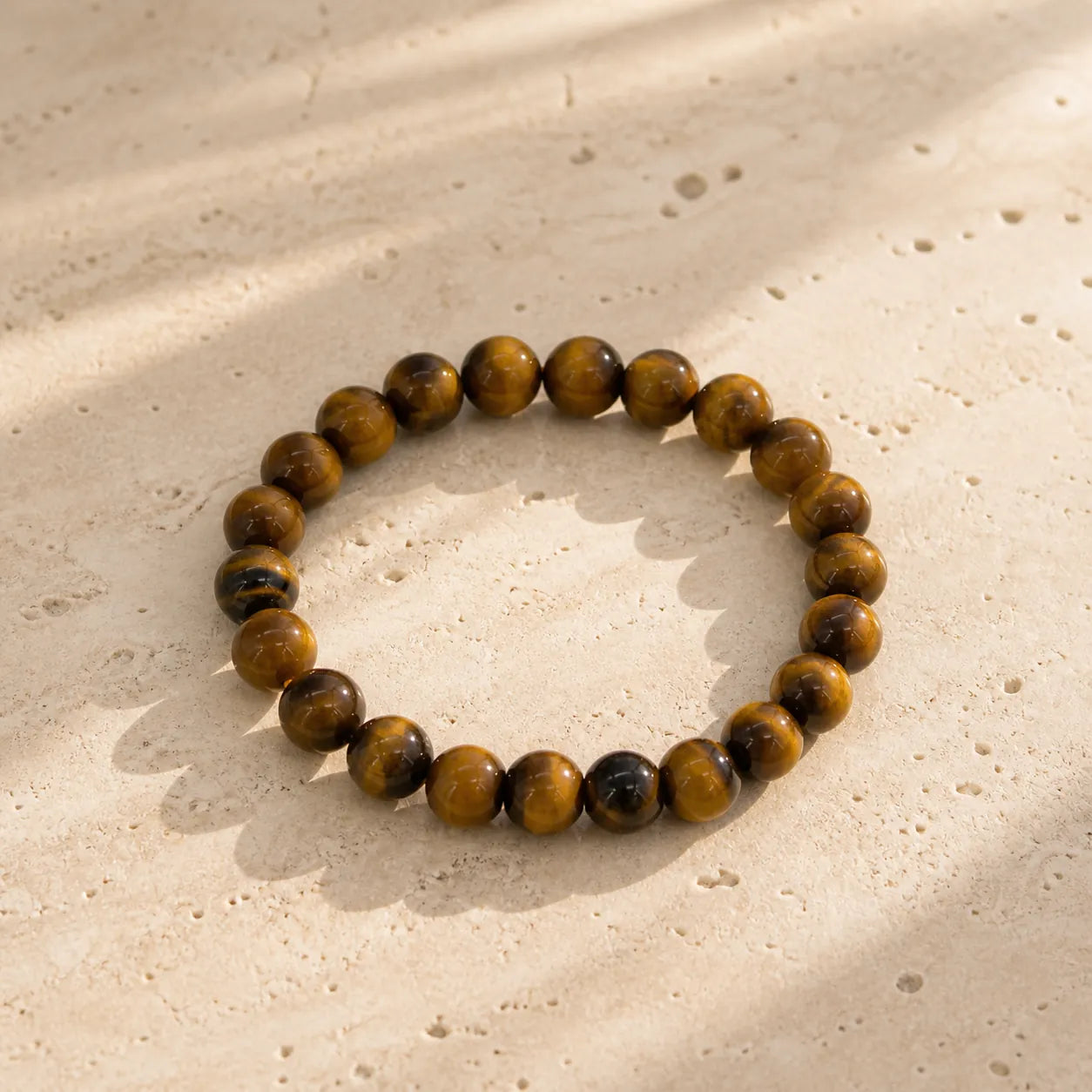
A related intention option
Tiger Eye Bracelet – Decisive Focus
This is a related focus option, not a Sodalite product. We only identify jewelry as Sodalite when that exact material is verified.
Explore this related optionCare is straightforward because sodalite is moderately soft. Clean it with lukewarm water and a soft cloth, dry it fully, and avoid ultrasonic cleaners, steam, harsh chemicals, and long sun exposure. Store it separately from harder stones such as quartz or sapphire so the surface does not scratch. Remove rings and bracelets before gardening, gym sessions, or dishwashing.
A Note on Sodalite’s Traditional Associations
Historically, sodalite was named for its sodium content and was first described from the Ilímaussaq complex in Greenland (Mindat). Its fluorescent variety, hackmanite, can show yellow-white or orange glow under ultraviolet light, a property documented in mineralogical references. In modern metaphysical writing, sodalite is often associated with calm self-expression and mental order, but those are cultural interpretations rather than measurable effects.
Hold the symbolism lightly and the practice sincerely: a stone can be a beautiful reminder to think before speaking, but the clarity is yours. If you are seeking support for persistent anxiety, intrusive thoughts, or communication difficulties, please speak with a qualified professional.
Frequently Asked Questions
What is the spiritual meaning of sodalite stone?
Sodalite is traditionally associated with mental clarity, truthful speech, and discernment, often linked to the throat and third-eye chakras. These are symbolic associations rather than proven physical effects.
How do you tell sodalite from lapis lazuli?
Look for white calcite veining and a lack of golden pyrite flecks—those point to sodalite, while pyrite and a deeper opaque blue suggest lapis lazuli. A jeweler’s identification is the reliable final check.
What chakras is sodalite connected to and what does sodalite do?
It is most often connected to the throat and third-eye chakras, and it is used as a mindfulness cue for clear speech and focused reflection. It is not a medical treatment and does not replace professional care.
Sources
- Mindat – Sodalite mineral data (formula, hardness, specific gravity)
- GIA – A Remarkable 16.71 ct Transparent Orange-Yellow Sodalite
- Webmineral – Sodalite physical properties
© 2026 Lumina Quartz. This article is for educational and cultural interest only and is not medical, psychological, or gemological identification advice.