Metaphysical Properties Of Moss Agate

Table of Contents
- What Is Moss Agate? Geology, Appearance & Why It's Called "Moss"
- 10-Second Executive Summary / The Verdict Box
- Core Metaphysical Properties of Moss Agate (Growth, Abundance, Emotional Balance)
- Moss Agate & the Chakras: Heart, Root & Earth Energy
- Emotional & Spiritual Healing: Patience, Renewal, Nature Connection
- Traditional Physical Healing Associations (With a Clear Wellness Disclaimer)
- How to Work With Moss Agate: Meditation, Crystal Grids, Jewelry & Gardening
- Real vs. Treated Moss Agate: A Step-by-Step Buying Checklist
- Caring for Your Moss Agate: Cleansing, Charging & Everyday Wear
- FAQ: Zodiac Signs, Birthstone Status, Real vs. Dyed Moss Agate
- What are the metaphysical properties of moss agate?
- What chakra is moss agate associated with?
- Is moss agate good for a specific zodiac sign or birthstone?
- How do you tell real moss agate from dyed moss agate?
- Sources
What Is Moss Agate? Geology, Appearance & Why It's Called "Moss"
Moss agate is a translucent to semi-translucent variety of chalcedony (microcrystalline quartz, formula SiO₂) whose "moss" is not moss at all — it is a network of green mineral inclusions, typically chlorite or hornblende, or brown-to-black dendritic oxides of iron and manganese trapped inside the silica. The stone is called "moss" because those inclusions branch and feather in patterns that often resemble moss, ferns, or miniature landscapes, which is why cutters and collectors sometimes call scenic varieties "tree agate" or "dendritic agate." Strictly speaking, most material sold as moss agate lacks the concentric banding that defines classic agate, so gemologically it sits closer to included chalcedony; the Smithsonian describes agate broadly as a fine-grained, banded chalcedony and notes that trade names like "moss agate" have grown up around color and pattern rather than strict mineralogy (Smithsonian NMNH).
Geologically, agates commonly form in cavities within volcanic rock, where silica-rich water deposits quartz layer by layer against the cavity wall; moss agate's inclusions are simply mineral guests caught in that silica gel as it hardened. Notable sources include Nova Scotia and Idaho (documented localities on Mindat), Armenia, and the famous Montana moss agate found as water-worn cobbles in the Yellowstone River drainage, where the dark tree-like dendrites are manganese and iron oxides (USGS; Mindat). On the Mohs scale, quartz-family material like this sits at about 6.5–7, making it durable enough for everyday jewelry but still softer than corundum or diamond.
10-Second Executive Summary / The Verdict Box
- Direct Verdict: Moss agate's metaphysical profile centers on growth, abundance, emotional steadiness, and nature connection — it is a grounding, slow-and-steady stone rather than a high-intensity one, and it works best as a daily touchstone for patience and renewal.
- Mineral identity: Chalcedony (microcrystalline quartz), SiO₂; green inclusions of chlorite/hornblende or iron/manganese dendrites.
- Mohs Hardness: ~6.5–7 — suitable for rings and pendants with normal care; avoid harsh abrasives and ultrasonic cleaners.
- Chakra association: Primarily heart chakra, with root/earth-chakra overtones.
- Best used for: Grounding meditation, abundance intentions, garden and plant rituals, and gentle emotional resets.
- Buying note: look for natural, un-dyed material with visible inclusions, and ask sellers for written treatment disclosure.
- Quick caveat: these are traditional and symbolic associations, not medical claims — see the wellness disclaimer below.
Core Metaphysical Properties of Moss Agate (Growth, Abundance, Emotional Balance)
In crystal lore, moss agate is most often associated with growth — not the explosive kind, but the patient, seasonal kind. Because its inclusions look like sprouting plants and forest floors, it has long been linked symbolically to fertility of ideas, projects, and gardens rather than literal fertility promises. Practitioners often pair it with intention-setting for slow, sustainable progress: starting a business, nurturing a creative practice, or rebuilding a habit after a setback.
Abundance is the second major theme. In this tradition, moss agate is less about sudden windfalls and more about recognizing and tending what is already growing in your life — a "tend your garden" approach to prosperity. It is frequently placed on abundance grids alongside green stones, or kept near a workspace or cash drawer as a visual reminder to water your own opportunities.
Emotional balance rounds out the core trio. Writers and practitioners often describe it as a calming, steadying companion that may support a sense of groundedness during transitional periods — moving house, changing jobs, ending a relationship. It is usually framed as a stone of perspective rather than emotional anesthesia: it is said to help you observe feelings with more patience, not to erase them.
Three honest notes on how this tradition works, and its limits:
- These properties are cultural and symbolic associations, not measured physical effects. Moss agate's color and pattern are the source of its meaning, much like a flower's bloom signals spring.
- The stone's real, verifiable qualities — durability, beauty, and its striking natural inclusions — are what make it a beloved gem for jewelry and carving, independent of any metaphysical claim.
- If you are drawn to moss agate, the most grounded way to use it is as a ritual anchor: a physical cue for intentions you already want to hold.
Moss Agate & the Chakras: Heart, Root & Earth Energy
Moss agate is most commonly associated with the heart chakra (anahata), the center traditionally linked to compassion, connection, and emotional openness. Its green tones align with the heart's color correspondence in chakra systems, and practitioners often recommend it for moments when you want to soften without becoming unguarded — a heart-opening stone that stays grounded.
It also carries strong root/earth-chakra overtones. Unlike airy, high-vibration stones, moss agate is described as earthy and stabilizing: the "moss" imagery roots it in soil, forests, and the slow work of growth. Many practitioners place it at the base of a crystal layout to "anchor" the energy of other stones, or hold it during grounding meditations when the goal is to feel present in the body rather than float away.
A practical contrast worth knowing: if you want a purely heart-centered, high-empathy session, rose quartz or rhodonite are the classic choices. If you want heart energy with a floor under it — compassion that doesn't leave you depleted — moss agate is the better fit. Think of it as the difference between a bouquet and a garden bed.
Emotional & Spiritual Healing: Patience, Renewal, Nature Connection
Emotionally, moss agate is most often associated with patience — the willingness to let things take the time they take. In crystal tradition, it is a stone for people in seasons of waiting: recovery, creative blocks, career plateaus, or the long middle of a project. It may support a gentler relationship with slow progress, and practitioners often describe holding it as a reminder that growth is usually invisible before it is obvious.
Renewal is its second emotional theme. Because moss and lichen reclaim bare rock over time, the stone is often used symbolically for fresh starts after hardship — not erasing the past, but beginning again on top of it. A common ritual is to hold the stone and name one thing you are ready to let compost, and one thing you want to plant in its place.
Spiritually, moss agate is strongly associated with nature connection. It is a favorite for outdoor meditation, forest bathing, and seasonal rituals; many practitioners keep a piece on an altar or windowsill to stay oriented toward the living world. It is also sometimes called a "gardener's stone" in folk tradition, though that label is cultural rather than geological.
These are symbolic and contemplative uses. They can be meaningful, but they are not therapy — if you are struggling with your mental health, a crystal is a companion to professional support, never a substitute for it.
Traditional Physical Healing Associations (With a Clear Wellness Disclaimer)
What we can say with confidence is physical in a different sense: the stone's durability and tactile appeal make it genuinely pleasant to hold and wear, and the act of pausing to touch a smooth, cool stone can be a useful mindfulness cue. Treat any physical "healing" language you encounter as cultural folklore, keep medical decisions with qualified professionals, and let the stone play its honest role: a beautiful object that helps you remember to slow down.
How to Work With Moss Agate: Meditation, Crystal Grids, Jewelry & Gardening
Because moss agate is a stone of patient growth, the most effective ways to work with it are repetitive, low-intensity rituals rather than one-off dramatic ceremonies. Here are practical approaches:
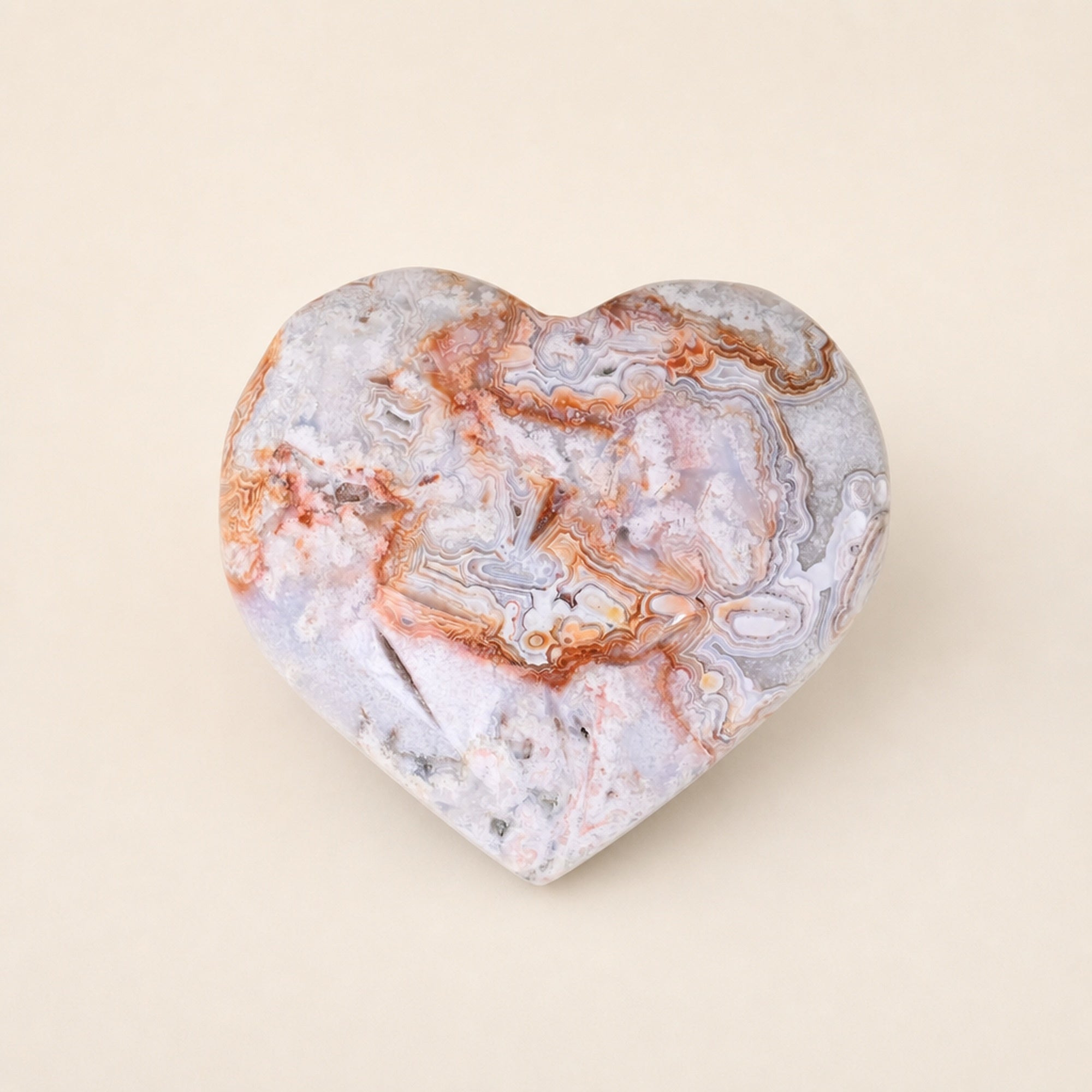
A related stone-family option
Crazy Lace Agate Heart Stone – Joyful Movement
This is a related variety in the same stone family, not a Agate product. We only identify jewelry as Agate when that exact material is verified.
Explore this related option- Daily grounding hold. Keep a tumbled piece in your pocket or on your desk. Once a day, hold it for 60 seconds, breathe slowly, and name one thing you are growing toward. The repetition — not the stone itself — builds the habit.
- Abundance grid. Place moss agate at the center or base of a grid, with the intention of "tending" rather than "attracting." Pair it with a written list of actions you will take this week; the grid is a visual reminder, not a substitute for effort.
- Meditation for patience. Sit with the stone in your palm during a 5–10 minute breath practice. When impatience arises, notice it, and return attention to the stone's cool weight. This is a classic grounding anchor technique.
- Jewelry as a wearable reminder. A pendant over the heart or a ring you see while typing works well; choose settings that protect the stone, since moss agate at ~6.5–7 Mohs can scratch against harder gems.
- Gardening ritual. Keep a piece in your potting area or among seedlings. Before planting, hold it and set an intention for the season — a symbolic pairing of the stone's moss imagery with actual green growth.
If you want a stone that works with high-energy ambition, moss agate is not the obvious pick — citrine or carnelian are more traditional for drive. Moss agate is the choice for sustainable growth: the gardener's pace, not the sprinter's.
Real vs. Treated Moss Agate: A Step-by-Step Buying Checklist
Because moss agate's value rests entirely on its natural inclusions, authenticity checks matter more than with almost any other quartz. Before you buy, decide first what you actually want the stone for — the table below sets the boundary between gemstone verification and metaphysical use.
| What you want from the stone | What can be verified | What stays symbolic | Best next step |
|---|---|---|---|
| Jewelry or display piece | Mineral identity, hardness (~6.5–7 Mohs), inclusion type, treatment disclosure | Pattern "meaning," scenic naming | Use the checklist below; ask for treatment disclosure in writing |
| Meditation or ritual anchor | That the piece is natural and pleasant to hold | Growth, abundance, patience themes | Choose any natural piece; the association comes from your intention |
| Gift with a story | Locality information where documented (e.g., Montana, Nova Scotia) | Zodiac and birthstone lore | Pair the stone with an accurate note on its mineral origin |
Then run this checklist:
- Look at the inclusions under light. Natural green patches come from chlorite or hornblende; dendritic patterns come from iron or manganese oxides. They should look suspended inside the translucent silica, with soft edges and varying depth — not pasted onto the surface or printed in flat, identical loops.
- Check for color pooling. Dye tends to concentrate in cracks and along inclusion borders. If green collects in fractures like ink in a crease, it is likely dyed. Genuine moss agate shows green distributed through the mineral inclusions themselves.
- Look for resin filling. A plastic-like sheen, tiny bubbles near the surface, or a warm, tacky feel can indicate resin or polymer filling used to stabilize fractures. Natural material has a cool, glassy feel.
- Ask about treatment — in writing. Reputable sellers will state whether a stone is natural, dyed, heated, or filled. Treat any claimed grading standard with healthy skepticism and ask what specific tests or disclosures support it.
- Compare pattern to price. Highly scenic, well-centered dendritic patterns command a premium; uniform, neon-green stones at a low price are a red flag for dyeing.
- Check the cut. A good cut preserves the scenic pattern across the face of the stone. Flat, patternless cabochons may be lower-grade material or treated.
Boundary note: this checklist identifies natural vs. treated material for gemstone purposes. It does not validate any metaphysical claim — those remain symbolic regardless of authenticity.
Caring for Your Moss Agate: Cleansing, Charging & Everyday Wear
Moss agate is tougher than it looks, but it is still a quartz-family stone with a Mohs hardness of about 6.5–7, so a few simple habits keep it beautiful:
- Cleansing: rinse with lukewarm water and a drop of mild soap, then pat dry with a soft cloth. Avoid harsh chemicals, bleach, and ultrasonic cleaners, which can stress inclusions or any natural fractures.
- Charging (symbolic): in crystal tradition, moss agate is often "charged" by moonlight or by resting on soil or near plants — fitting for a stone tied to nature. Placing it in indirect sunlight is fine, though long sun exposure can fade dyed material (a reason to buy natural in the first place).
- Everyday wear: store separately from harder stones like sapphire or diamond to prevent scratches; remove before swimming in chlorinated pools, gardening with abrasive soil, or using power tools.
- Jewelry care: check prongs and settings periodically, especially on rings, since the stone can chip at edges if struck.
FAQ: Zodiac Signs, Birthstone Status, Real vs. Dyed Moss Agate
What are the metaphysical properties of moss agate?
Moss agate is traditionally associated with growth, abundance, patience, emotional balance, renewal, and nature connection. These are symbolic and cultural associations rather than scientifically measured effects.
What chakra is moss agate associated with?
It is most commonly linked to the heart chakra, with strong root/earth-chakra overtones that make it feel grounding rather than airy. Practitioners often use it to anchor heart-centered intentions.
Is moss agate good for a specific zodiac sign or birthstone?
In popular crystal lore it is often suggested for Taurus, Virgo, and Capricorn, but moss agate is not a traditional or modern birthstone for any month — it is a variety of chalcedony, not a recognized birthstone category.
How do you tell real moss agate from dyed moss agate?
Natural green inclusions sit inside the translucent silica with soft edges and varied depth; dye tends to pool in cracks and look flat or neon. Ask sellers for written treatment disclosure, compare the pattern to the price, and favor pieces where the inclusions look suspended rather than surface-applied.
Sources
- Mindat — Moss Agate (mineral data, localities, composition)
- USGS — Gemstones: Chalcedony (Montana moss agate, inclusions)
- Smithsonian National Museum of Natural History — Quartz (var. agate)
- GIA — Gems & Gemology book review: Kentucky Agate
Disclaimer: The metaphysical properties described here are traditional and symbolic associations, not medical claims. Moss agate is not a treatment for any physical or mental health condition. Please consult qualified professionals for health concerns. © 2026 Lumina Quartz.
Crystal traditions are presented here as symbolic, cultural, and personal ritual practices. They are not medical tools; consult a qualified professional for health concerns.