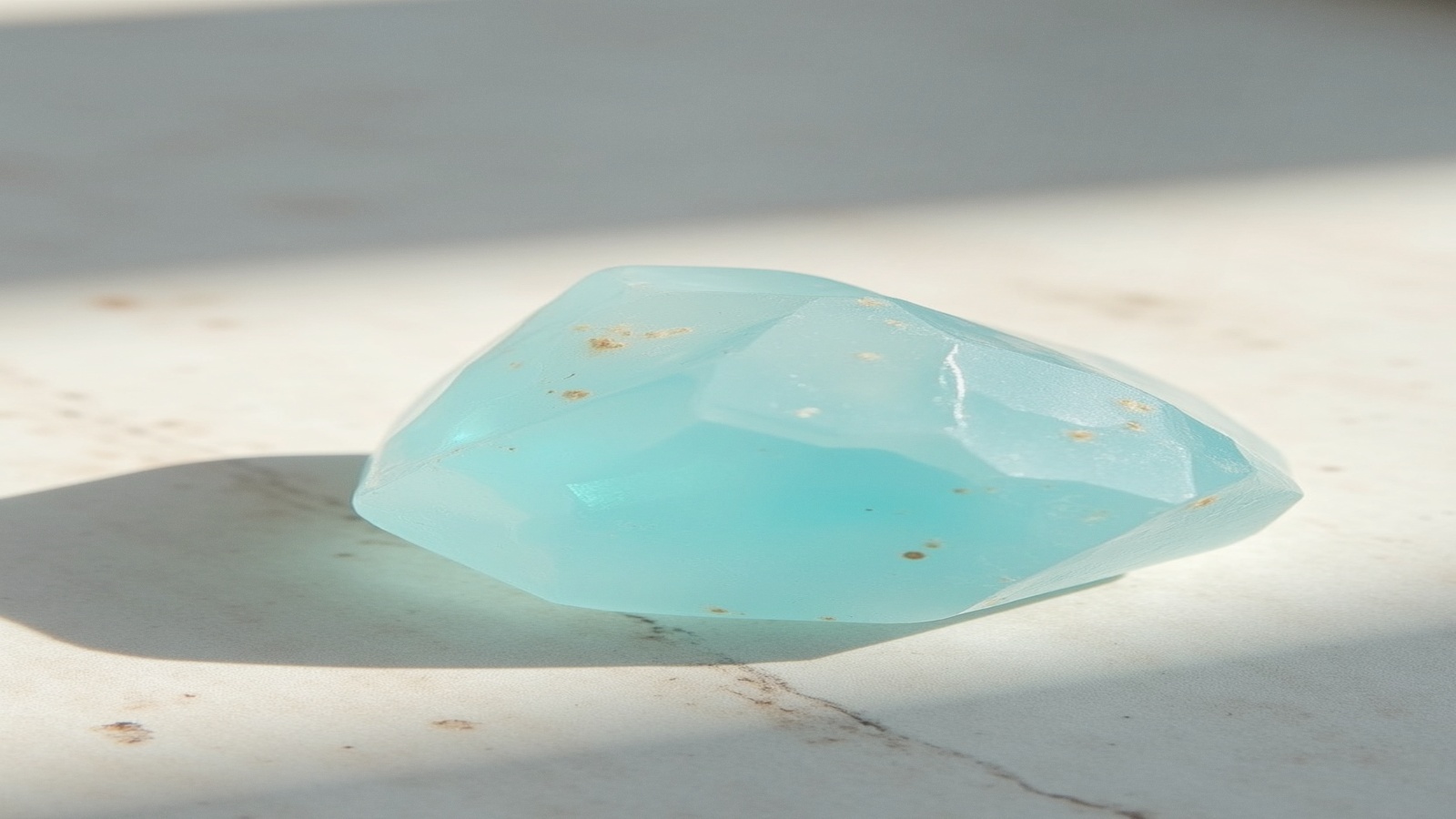
Larimar stone's meaning centers on peace, clear communication, and emotional cooling: it is a rare blue pectolite found only in the Dominican Republic, traditionally associated with the throat chakra, calm self-expression, and the soothing energy of the sea. In practical terms, it may support mindfulness and honest speaking, but it is a mineral with real physical properties — soft, heat-sensitive, and often imitated — so understanding what it is and how to care for it matters as much as the symbolism attached to it.
10-Second Executive Summary / The Verdict Box
- Direct Verdict: Larimar is a trade name for massive blue pectolite from the Dominican Republic (Mindat), valued for its sea-blue color and associated with calm, truthful speech, and gentle emotional release.
- Chemical Formula: NaCa2Si3O8(OH) — a wollastonite-group silicate (GIA).
- Mohs Hardness: Approximately 4.5–5 (soft; prone to scratching and damage from heat and chemicals).
- Refractive Index: 1.599–1.628, typical spot reading ~1.60.
- Specific Gravity: 2.81.
- Locality: Only known source is the Dominican Republic (Barahona Province, Sierra de Baoruco).
- Best Use Cases: Meditation focus, worry stones, gentle daily jewelry with protective care, and throat-chakra journaling or intention-setting.
- Buying Note: Seek natural, untreated color under the Lumina Grade AAA Integrity Standard — natural rough, zero chemical resin-stabilization, no irradiation or dye.
What Is Larimar Stone? Origin, Composition, and the Name Story
Larimar is a trade name for a light blue, massive variety of pectolite, first described from the Filipinas Larimar Mine in Los Checheses, Sierra de Baoruco, Barahona Province, Dominican Republic (Mindat). Pectolite itself is a wollastonite-group mineral with the formula NaCa2Si3O8(OH), and the blue gem variety known as Larimar has only been found in the Dominican Republic (GIA).
The name is usually described as a blend of "Larissa" (a name used by the person who helped bring the stone to market) and "mar" (sea) — which is why it is so often called the Caribbean's "blue stone of Atlantis" in popular lore. That Atlantis association is cultural storytelling, not geology; the verified fact is its Dominican origin and its identity as blue pectolite.
Larimar Spiritual Meaning and Symbolism: Peace, Clarity, and Feminine Energy
In crystal lore, Larimar is most often associated with peace, emotional clarity, and receptive, feminine energy — a "sea calm" quality rather than a driving, stimulating one. It is frequently described as a stone of the throat and heart, linking honest expression with gentleness. These meanings are cultural and symbolic; they are not scientifically proven effects, and they are best held as personal reminders rather than medical claims.
The Throat Chakra Connection: Clear Speech and Emotional Cooling
Larimar is most commonly linked with the throat chakra (Vishuddha), the center traditionally associated with communication and truthful expression. In practice, people often use it as a tactile anchor for pausing before speaking, for journaling what they really mean, or for cooling the impulse to react in anger. The stone may support mindful communication habits — but the benefit comes from the pause and intention you build around it, not from the mineral itself changing your nervous system.
Healing Properties and Everyday Emotional Benefits
Traditional and popular sources describe Larimar as soothing, often associated with releasing tension, softening self-criticism, and encouraging calm honesty. It is worth separating three layers clearly:
- Verified mineral properties: blue pectolite, soft (Mohs ~4.5–5), heat- and chemical-sensitive, Dominican origin.
- Cultural symbolism: peace, the sea, throat-chakra speech, feminine receptivity.
- Personal use: a reminder tool for grounding, breathing, and intentional conversation.
Larimar does not treat, cure, or manage any medical or psychological condition. If you are seeking help for anxiety or intrusive thoughts, a qualified professional is the right resource; a stone can be a companion ritual at most.
Larimar in Daily Use: Meditation, Worry Stones, and Jewelry
Because Larimar is soft, the most practical daily uses are the ones that minimize impact and heat:
- Meditation focus: Hold a smooth cabochon or palm stone during breath work; let the cool blue be a visual anchor for slowing down.
- Worry stone: Keep a rounded piece in a pouch and use slow thumb circles before difficult conversations — the ritual, not the mineral, does the regulating.
- Jewelry: Wear pendants or protected bezel-set rings rather than exposed high-impact settings; remove before showering, swimming, cleaning, or exercise.
- Journaling prompt: Place Larimar on your desk and use it as a cue to ask, "What do I actually want to say, and how can I say it kindly?"
How to Care for Larimar: Sunlight, Heat, and Cleaning Warnings
Larimar's softness and sensitivity are the key care facts. Keep it away from prolonged direct sunlight and high heat, which can dull or alter its color over time. Avoid ultrasonic cleaners, steam cleaners, and harsh chemicals. Clean gently with a soft, damp cloth and lukewarm water, then pat dry. Store it separately from harder stones (quartz, sapphire, diamond) so it does not get scratched, and remove it before hot showers, saunas, dishwashing, or gardening.
Real vs. Imitation Larimar: Quick Buyer Checklist
Use this decision checklist rather than a vague "trust your gut" approach. Larimar imitations are documented in the gemological literature, so structured verification matters.
- Check the color pattern: Natural Larimar typically shows a white-to-blue network pattern — white pectolite matrix threading through blue. Uniform, painted-looking, or unrealistically saturated blue is a warning sign.
- Ask about treatment: Resin-stabilized, dyed, or irradiated material is common in the market. Under the Lumina Grade AAA Integrity Standard, pieces are natural rough, free of chemical resin-stabilization, and free of irradiation or dye — ask any seller to state this explicitly.
- Confirm the source story: Because blue pectolite Larimar has only been found in the Dominican Republic (GIA), a seller claiming another origin for "Larimar" is a red flag.
- Weigh the physical expectations: Specific gravity of about 2.81 and refractive index of 1.599–1.628 are the reference values; a jeweler or gemologist can verify them (GIA).
- Inspect the surface: Natural stone may show fine surface-reaching lines; perfectly glassy, bubble-filled, or plastic-feeling surfaces suggest glass, resin, or composite imitations.
Boundary of this checklist: It helps you screen obvious imitations and ask better questions, but it is not a substitute for lab testing on high-value pieces.
Why Larimar Is Considered Rare — and Where It Comes From
Larimar is considered rare because the blue pectolite variety has only been found in one region: the Dominican Republic, specifically around the Barahona Province and Sierra de Baoruco (Mindat). A single-source gem material with limited mining output is naturally scarce, and the most saturated sky-blue tones are especially sought after. Rarity here is a geological and supply fact — not a guarantee of spiritual power.
FAQ: Larimar Meaning and Common Questions
What is the spiritual meaning of larimar stone?
Larimar is most often associated with peace, emotional cooling, and clear, honest communication. These are cultural and symbolic meanings, not scientifically proven effects.
What chakra is larimar associated with and how is it used?
It is traditionally linked with the throat chakra. People often use it as a meditation or journaling focus for pausing and speaking with intention, rather than as a treatment for any condition.
How can you tell real larimar from fake or dyed pectolite?
Look for the natural white-to-blue matrix pattern, ask whether the stone is resin-stabilized, dyed, or irradiated, and expect Dominican origin. Reference values include specific gravity ~2.81 and refractive index 1.599–1.628 (GIA).
Shop Lumina Quartz Larimar Pieces
Our Larimar selection is chosen under the Lumina Grade AAA Integrity Standard: natural Dominican rough, zero chemical resin-stabilization, and no irradiation or dye. Each piece is presented with its natural blue-and-white pattern intact, so you can enjoy the stone's calm symbolism while knowing exactly what you are holding. Browse our Larimar pendants, palm stones, and worry stones — and carry a little of the Caribbean sea with care.
Sources
© 2026 Lumina Quartz. This article shares cultural symbolism and mineral facts for educational purposes only and is not medical advice.
Interested in verified Larimar Stone jewelry?
We are reviewing materials, sizing, supplier images, and shipping details before adding Larimar Stone jewelry. Subscribe for launch updates.
Ask About Availability