Kambaba Jasper Bracelet Meaning: A Beginner's Guide to Mindful
Table of Contents
- What Is Kambaba Jasper?
- Origins and Formation
- Kambaba Jasper vs. Crocodile Jasper
- The Meaning and Symbolism of Kambaba Jasper
- Peace and Tranquility
- Grounding and Connection to Earth
- Healing Properties of Kambaba Jasper
- Emotional Healing
- Physical Healing
- Kambaba Jasper Bracelet Benefits at a Glance
- Kambaba Jasper, Crocodile Jasper, Nebula Stone: What's the Difference?
- How to Use a Kambaba Jasper Bracelet
- Wearing for Meditation
- Combining with Other Crystals
- How to Care for Your Kambaba Jasper Bracelet
- Cleansing and Charging
- Dos and Don'ts
- Key Takeaways
- Frequently Asked Questions
- Sources
There are stones that whisper, and stones that anchor. Kambaba jasper — with its deep green swirls and dark, fossil-like orbs — belongs to the latter. Worn close to the wrist, it becomes a quiet companion for anyone seeking calm, clarity, and a sense of being held by the earth. Whether you are new to crystals or simply curious about the kambaba jasper bracelet meaning, this beginner's guide invites you to explore its story, its symbolism, and the gentle ways it may support your everyday life.
This is not a promise of miracles. It is an honest, heart-led look at a stone that has been treasured for generations — and a gentle path to making its energy your own.
What Is Kambaba Jasper?
Kambaba jasper is a dense, deep-green stone marked by dark, circular "eyes" and swirling bands. It is most often sold as a fossil stone — a fossilized stromatolite, an ancient layered structure built by colonies of cyanobacteria, some of the earliest life on Earth. That is a beautiful story, and it is also a story that mineralogists continue to debate.
In collector and mineralogical circles, Kambaba jasper is frequently classified instead as a volcanic rock — a green, orb-textured material whose rounded markings are mineral structures rather than fossil remains. Discussion among mineral collectors on Mindat has also noted that trade-name material sold as "Kambaba Jasper" and material sold as "Nebula Stone" can in fact be geologically the same rock, which is a useful reminder that crystal-trade names do not always map neatly onto formal geology.
For a beginner, the honest takeaway is simple: the name is widely used, the geology is genuinely contested, and what matters most is that you know what you are buying and love the piece that arrives. Either way, you are holding something very old, formed long before anyone thought to give it a name.
Origins and Formation
The stone is most often sourced from Madagascar, with smaller deposits occasionally found in South Africa. Its colour ranges from mossy to forest green, and the dark orbs that give it such a hypnotic quality are what most people recognise first.
If the fossil interpretation is correct, those layers formed in shallow, warm seas as cyanobacteria trapped fine sediment in thin films, which later hardened and were gradually replaced by silica — a process called silicification. If the volcanic interpretation is correct, the orbs formed as molten material cooled and crystallised into rounded structures. Both explanations are stories written in deep time, and both end in the same smooth, weighty stone on your wrist. Every bracelet is a little different, because no two cuts of the rough stone repeat the same pattern.
Kambaba Jasper vs. Crocodile Jasper
If you have shopped for this stone, you may have seen it listed under two names: kambaba jasper and crocodile jasper. In most cases, they are the same material. "Crocodile jasper" is a nickname drawn from the stone's resemblance to reptilian skin — the dark circles and mottled texture create a scale-like effect on a polished surface. "Kambaba" is the more widely accepted name, though its exact origin is debated. Some believe it refers to a region in Madagascar; others suggest a local word or a miner's name.
The reassuring part: the kambaba jasper bracelet meaning and its properties do not change with the label. Choose the stone that calls to you through its colour, weight, and texture, rather than the name on the tag.
The Meaning and Symbolism of Kambaba Jasper
In the world of crystal healing, kambaba jasper is often associated with stillness and renewal. Its deep green tones echo the calm of a forest floor, while its dark orbs remind us of fertile soil, seeds waiting to sprout, and the quiet perseverance of nature. The kambaba jasper bracelet meaning is, at its heart, a reminder that growth does not always announce itself loudly — sometimes it simply happens beneath the surface, in the patient dark.
Peace and Tranquility
Kambaba jasper is widely regarded as a stone of peace. It is often associated with the heart and throat chakras, where it may support honest, gentle communication and emotional release. Many people choose to wear it during stressful days, finding that its earthy presence helps them pause before reacting.
This stone does not demand attention. Instead, it sits quietly on the wrist, inviting you to breathe. The slow, steady rhythm of the ancient layers is a gentle reminder that you, too, are allowed to move at your own pace.
Grounding and Connection to Earth
If there is one word that defines kambaba jasper, it is grounding. The stone is often associated with the root chakra, the energetic centre that anchors you to the earth beneath your feet. When life feels scattered or overwhelming, a kambaba jasper bracelet may serve as a tactile anchor — a small, smooth weight on your wrist that seems to say, "You are here. You are safe. This, too, shall pass."
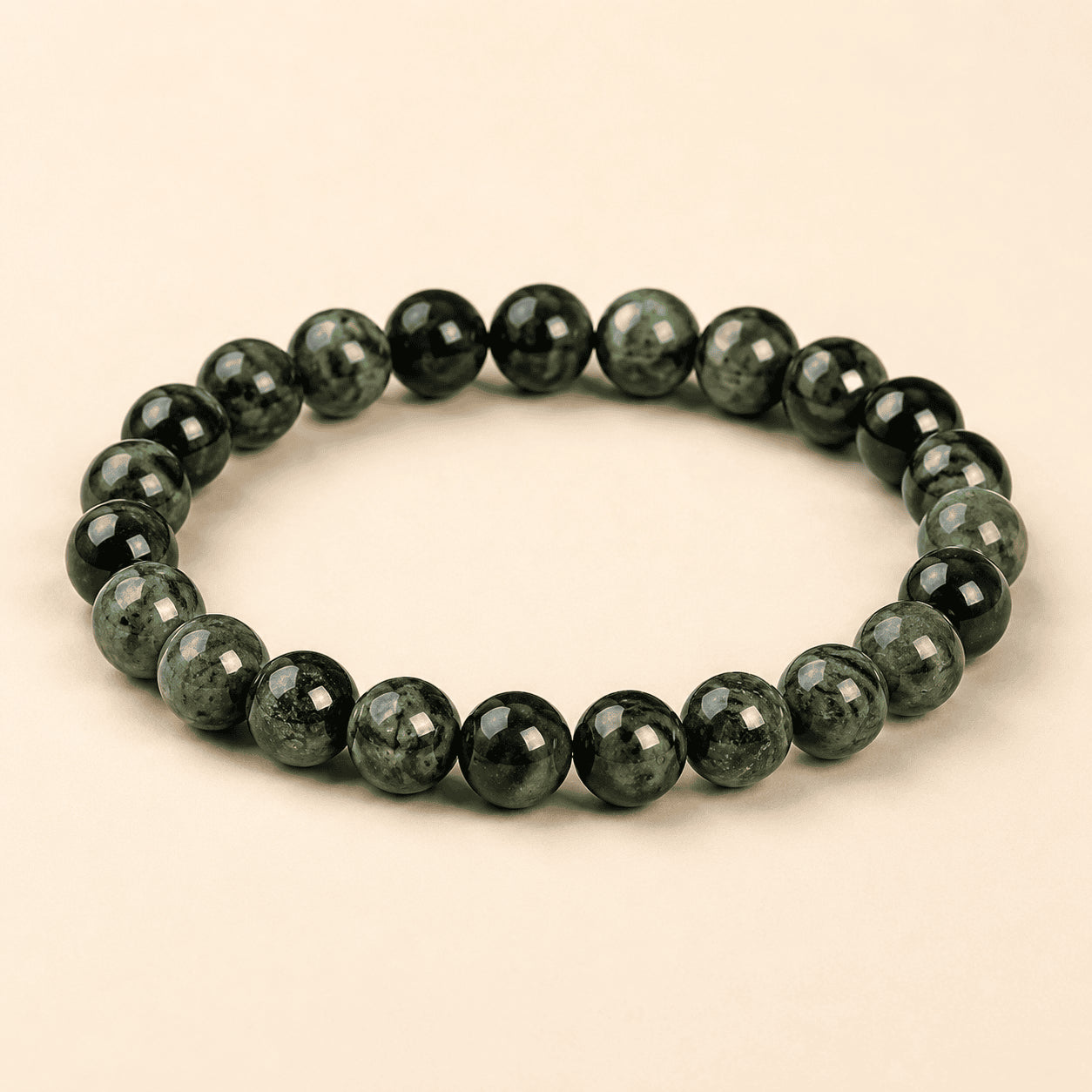
Kambaba Jasper Bracelet
A gentle ritual piece for bringing this intention into your daily routine.
Shop This Authentic Piece →For those who spend long hours before screens, or who live in busy urban environments, this connection to the earth can feel especially nourishing. The stone does not remove stress; it simply reminds you of a deeper, slower truth that exists beneath the noise — a truth you can return to again and again.
Healing Properties of Kambaba Jasper
It is important to say this clearly: kambaba jasper is not a medicine, and it is not a substitute for professional health care. Nothing here treats, cures, or prevents any condition. What a stone can do is serve as a supportive companion — a physical cue that helps you slow down, check in with yourself, and keep a calming intention close at hand. That is the frame in which the following properties are worth reading.
Emotional Healing
Emotionally, kambaba jasper is often described as a stone of patience and emotional steadiness. People who feel easily rattled, overstimulated, or caught in cycles of worry sometimes find that wearing it encourages a pause between feeling and reacting. It is frequently paired with the idea of gentle release — not pushing difficult emotions away, but letting them settle the way sediment settles in still water.
Many wearers describe a sense of being "held" or "steadied" during demanding seasons of life. That experience is personal and not guaranteed, and it is worth holding lightly: a bracelet can support a calming ritual, but it cannot do the emotional work for you.
Physical Healing
In traditional crystal lore, green stones in this family are sometimes associated with the heart, the throat, and a general sense of physical ease. Some wearers enjoy the simple tactile comfort of a cool, smooth stone against the skin, or find that it reminds them to breathe more slowly and unclench their shoulders.
These are comfort and mindfulness effects, not medical ones. If you have a health concern, please speak with a qualified healthcare professional — and enjoy your bracelet as a small, beautiful ritual alongside that care, never instead of it.
Kambaba Jasper Bracelet Benefits at a Glance
If you have been searching for kambaba jasper bracelet benefits, these are the practical, everyday ones most wearers actually notice:
- A built-in grounding cue. Reaching for the stone becomes a two-second reset during a busy day.
- A portable calm ritual. A breath, a touch, a slow exhale — repeatable anywhere.
- A mindful reminder. Something tangible that keeps an intention in view rather than in theory.
- Low-maintenance wear. A durable stone that suits daily use with simple care.
- A conversation piece with real age behind it. Whether volcanic or fossil, the material is ancient — and that alone can be quietly grounding.
Kambaba Jasper, Crocodile Jasper, Nebula Stone: What's the Difference?
Crystal-trade names and geological classifications do not always agree, and this stone is a good example. Use the table below as a buying guide rather than a scientific authority — the goal is simply that you know what you are looking at before you buy.
| Name you'll see | What it usually refers to | What to check before buying |
|---|---|---|
| Kambaba Jasper | The most common trade name for the green, orb-patterned stone, typically from Madagascar. | Clear photos of the actual strand or piece, and a seller who will answer questions about origin. |
| Crocodile Jasper | A nickname for the same or very similar material, describing its scale-like pattern. | A second photo in different light — pattern and colour can shift a great deal between shots. |
| Nebula Stone | Another trade name that mineral collectors report can refer to geologically similar material. | Treat names as labels, not guarantees. Buy the stone you can see, not the story attached to it. |
| "Fossil stromatolite" | A widely repeated description of the stone's origin that is actively debated by mineralogists. | Enjoy the lore, but don't pay a premium based solely on an unverified origin claim. |
One boundary worth keeping: a name change never changes the physical properties of a stone, and no trade label makes a bracelet a medical device. Buy for beauty, durability, and the ritual you want to build around it.
How to Use a Kambaba Jasper Bracelet
There is no complicated protocol. The simplest approach is to decide what you want the bracelet to mean, then let it remind you of that intention throughout the day.
Wearing for Meditation
Many people wear a kambaba jasper bracelet during meditation or breathwork, holding it lightly between the fingers or resting the wrist on the knee. The weight and coolness of the stone can act as a focal point — somewhere for a wandering attention to land.
A simple practice: sit comfortably, rest your hand over the bracelet, and take five slow breaths. On each exhale, let your shoulders drop. That is the whole ritual. Done daily, it becomes a reliable anchor.
Combining with Other Crystals
Kambaba jasper pairs naturally with other earth-toned, grounding stones. There is no rule that says you must combine anything at all, but if you enjoy layering:
- With smoky quartz for a steady, settling feel.
- With moss agate or green aventurine for a softer, greener palette.
- With clear quartz if you like the idea of a brightening contrast to the stone's deep tones.
Keep an eye on comfort and weight if you stack several bracelets — a wrist that feels pinched is not a calm wrist.
How to Care for Your Kambaba Jasper Bracelet
Kambaba jasper is a reasonably durable stone, but it is not indestructible. Treat it as you would any beloved piece: keep it away from harsh chemicals, sudden temperature changes, and prolonged direct sun, and store it somewhere it will not knock against harder stones.
Cleansing and Charging
For energetic cleansing, gentle methods are best. Wipe the beads with a soft, slightly damp cloth, then dry them fully. You can also rest the bracelet on a piece of selenite, in a bowl of dry sea salt for a short time, or near moonlight overnight.
Avoid leaving it in water for long periods, and skip ultrasonic or steam cleaners — moisture can work its way into the stringing over time.
Dos and Don'ts
- Do wipe the bracelet after wear to remove skin oils and dust.
- Do remove it before swimming, showering, or washing dishes.
- Do store it flat or in a soft pouch to protect the elastic or cord.
- Don't soak it in water or cleaning solutions.
- Don't leave it on a sunny windowsill for days at a time.
- Don't wear it during contact sports or heavy lifting, where the string can stretch or snap.
Key Takeaways
- Kambaba jasper is a deep green, orb-patterned stone, most often sourced from Madagascar.
- Its origin is debated — commonly described as fossil stromatolite, frequently classified as volcanic rock by mineralogists.
- "Kambaba jasper," "crocodile jasper," and "Nebula Stone" are trade names that can overlap geologically.
- It is associated with peace, patience, and grounding, especially through the root, heart, and throat chakras.
- Its real everyday value is as a mindfulness cue — not as a treatment for any condition.
- Care is simple: wipe, dry, store with care, and keep it away from water and chemicals.
Frequently Asked Questions
What is Kambaba Jasper?
Kambaba jasper is a dense green stone with dark, circular markings, most commonly sourced from Madagascar. It is widely sold as a fossilised stromatolite, though mineralogists have questioned that description and some classify it as a volcanic rock instead. Either way, it is an attractive, durable stone that is easy to wear daily and particularly popular as a bracelet.
What are the healing benefits of a Kambaba Jasper bracelet?
In crystal tradition, kambaba jasper is valued as a grounding and calming stone, often linked to the root, heart, and throat chakras. Wearers commonly describe feeling steadier, more patient, or more present. These are mindfulness and comfort benefits rather than medical ones — a bracelet is not a treatment, and it is not a substitute for professional care.
How should I cleanse and care for my Kambaba Jasper bracelet?
Wipe it with a soft, slightly damp cloth and dry it thoroughly. For energetic cleansing, rest it on selenite, in dry sea salt briefly, or in moonlight overnight. Remove it before swimming, showering, or cleaning, avoid soaking it in water, and store it in a soft pouch so the string keeps its shape.