How to Cleanse, Charge, and Care for Your Selenite In Water Safely
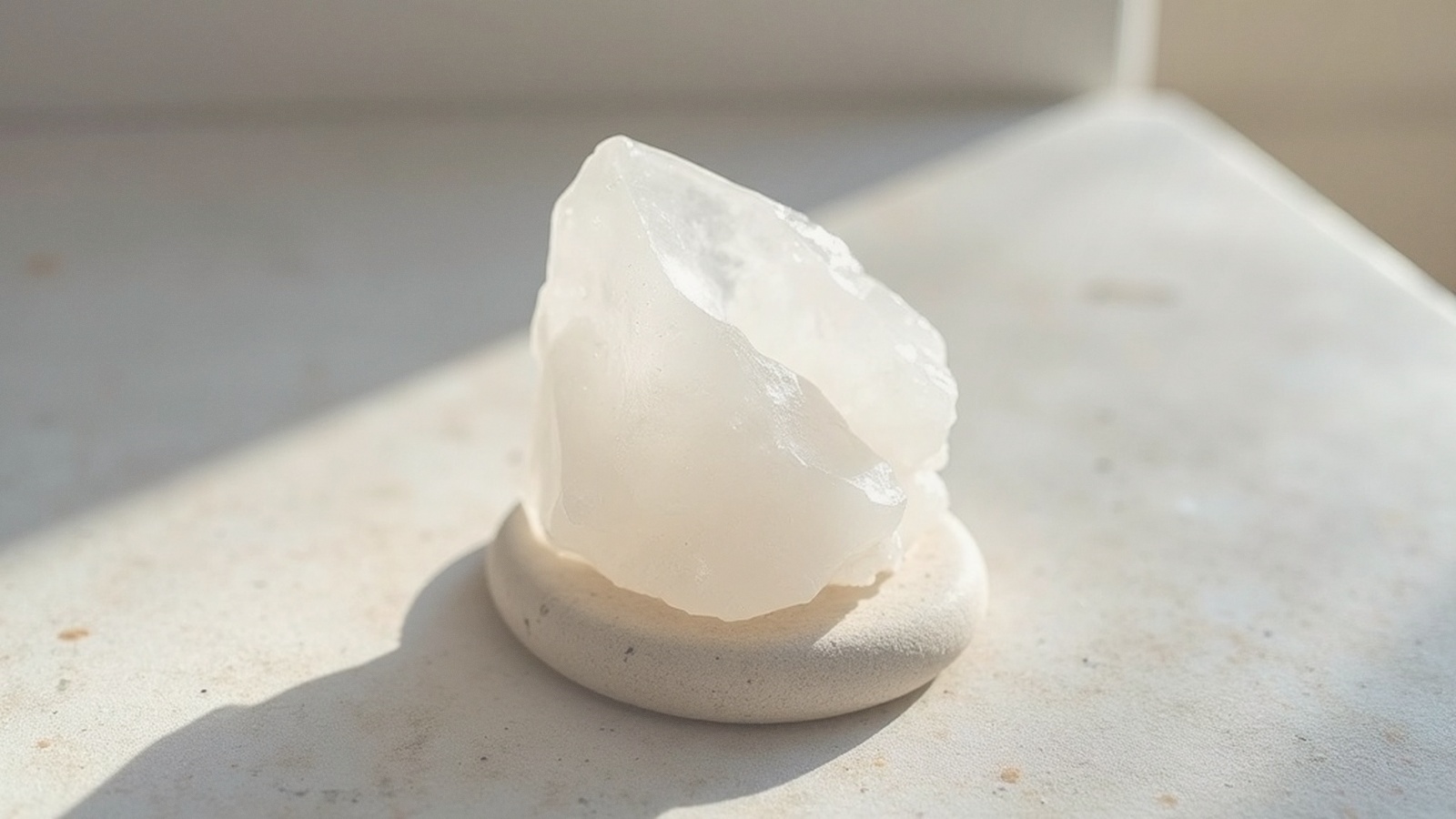
Table of Contents
- Short Answer — Selenite and Water Are Not Friends
- Why Selenite Dissolves in Water (Gypsum, Mohs 2, and What Actually Happens)
- Myth-Busting — "Selenite Is Self-Cleansing" and the Quick-Rinse Debate
- What Water Damage Looks Like — Sheen Loss, Cracks, and Cloudy Edges
- How to Cleanse Selenite Without Water (5 Safe Methods)
- Sound, Smoke, and Selenite Charging Plates
- Decision Table — Matching the Right Care Method to Your Selenite Piece
- How to Clean and Store Selenite So It Lasts
- Dusting, Stains, and Humidity Protection
- How to Charge Selenite — Moonlight, Selenite Bowls, and What to Skip
- Selenite in Water Around the Home — Sprays, Baths, and Selenite Water Safety
- Frequently Asked Questions
- Can selenite go in water?
- What happens if you put selenite in water — does it really dissolve?
- How do you cleanse selenite without water?
- Sources
Short Answer — Selenite and Water Are Not Friends
No, selenite should not go in water. Selenite is a form of gypsum (calcium sulfate dihydrate), a mineral that is slightly soluble in water, so soaking or long rinsing can pit the surface, dull its sheen, and eventually weaken the crystal. Clean it dry, cleanse it with sound or smoke, and keep it away from sinks, baths, and humid windowsills.
10-Second Executive Summary / The Verdict Box
- Direct Verdict: Do not soak, bathe, or spray selenite. Water can dissolve gypsum and cause surface damage. Cleanse it dry instead.
- Mineral: Gypsum, calcium sulfate dihydrate (CaSO₄·2H₂O)
- Mohs Hardness: 2 — soft enough to scratch with a fingernail
- Water Behavior: Slightly soluble; prolonged contact may dull, pit, or crack the surface
- Best Use Cases: Dry display, moonlight charging, smoke or sound cleansing, and selenite charging plates for other stones
- Lumina Standard: Choose stones that meet the Lumina Grade AAA Integrity Standard — natural, untreated gypsum with no chemical stabilization or dye.
Why Selenite Dissolves in Water (Gypsum, Mohs 2, and What Actually Happens)
Selenite is the crystalline form of gypsum, and gypsum is a hydrated sulfate mineral — its structure holds water molecules inside the crystal lattice. Because of this chemistry, gypsum is slightly soluble in water rather than fully waterproof. When water sits on selenite, it can slowly dissolve the outer surface, and if the stone dries unevenly, the dissolved material may recrystallize in cloudy patches or along edges.
Hardness matters here too. On the Mohs scale, selenite sits at about 2, which means a fingernail can scratch it. Soft stones are more vulnerable to handling damage, and water softens the surface further, making scratches and chips more likely during cleaning.
Myth-Busting — "Selenite Is Self-Cleansing" and the Quick-Rinse Debate
The idea that selenite is "self-cleansing" is a cultural and spiritual belief, not a mineral fact. Many crystal traditions hold that selenite clears stagnant energy from other stones or from a space, and people often pair it with other crystals as a charging plate. That belief can coexist with practical care, but it does not mean selenite never needs physical cleaning — dust, fingerprints, and skin oils still accumulate on the surface.
The "quick rinse" debate is where people get into trouble. A one-second splash under a tap may not visibly harm a sealed or polished piece, but there is no safe exposure threshold published for gypsum, and repeated brief rinses add up. The honest answer: skip the rinse. A dry microfiber cloth removes dust without risk, and it protects the sheen that makes selenite recognizable.
What Water Damage Looks Like — Sheen Loss, Cracks, and Cloudy Edges
Water damage on selenite usually shows up gradually rather than dramatically. Watch for these signs:
- Sheen loss: the pearly, fibrous luster turns matte or chalky, especially on carved pieces and bowls.
- Cloudy edges: white or milky patches along rims and bases where water pooled and dried.
- Surface pitting: tiny rough spots where the mineral has dissolved unevenly.
- Cracks and flaking: thin crystal layers may separate or crack after repeated wet-dry cycles.
Once damage occurs, it cannot be reversed by polishing at home — the material has been removed, not just stained. Prevention is the only real repair.
How to Cleanse Selenite Without Water (5 Safe Methods)
These methods support the spiritual practice of cleansing without exposing gypsum to moisture:
- Sound cleansing: ring a bell or use a singing bowl near the stone for a minute or two. No contact needed.
- Smoke cleansing: pass the piece through incense or dried herb smoke briefly, then let it air out. Keep it away from open flame.
- Moonlight: place selenite on a dry windowsill overnight. This doubles as charging.
- Dry salt or rice bed: rest the stone on dry coarse salt or dry rice in a bowl for a few hours, then brush it clean. Avoid damp salt, which can transfer moisture.
- Selenite-on-selenite: place smaller stones on a large selenite slab or bowl, following the traditional belief that selenite clears other crystals.
Sound, Smoke, and Selenite Charging Plates
Sound and smoke are the gentlest options because they involve no physical contact and no moisture. Selenite charging plates are popular because they let you cleanse and charge several stones at once, but remember: the plate itself still needs dusting with a dry cloth, and it should not be stored beside a humidifier or in a bathroom.
Decision Table — Matching the Right Care Method to Your Selenite Piece
| Piece Type | Water Risk Level | Recommended Care | Avoid |
|---|---|---|---|
| Raw fibrous log or wand | High — exposed layers absorb and flake | Dry dusting, sound or smoke cleansing | Rinsing, saltwater, humid rooms |
| Polished sphere or tower | Moderate — polished surface slows but does not stop dissolution | Microfiber cloth, moonlight charging | Soaking, ultrasonic cleaners |
| Carved bowl or charging plate | High at rims and interior curves | Dry cloth; dry salt bed only | Storing other wet stones inside it |
| Jewelry or small tumbled piece | Moderate — skin oils and sweat are the main issue | Wipe dry after wear, store in a dry pouch | Showering or swimming while wearing |
How to Clean and Store Selenite So It Lasts
Cleaning is simpler than most people expect. Use a dry microfiber cloth or a soft dry brush and wipe in one direction along the grain of the fibrous structure. For carved pieces, a dry soft-bristle brush reaches into the grooves. Never use ultrasonic cleaners, steam, or commercial jewelry cleaners — all involve liquid or heat.
When choosing a piece, look for clean, consistent translucency, intact edges, and an even luster. Those are the physical markers we use for the Lumina Grade AAA Integrity Standard, which stands for natural, untreated gypsum — no chemical stabilization, no dye, and no irradiation. Treated or heavily polished pieces can look appealing but hide defects, so check that the surface reads as stone rather than plastic.
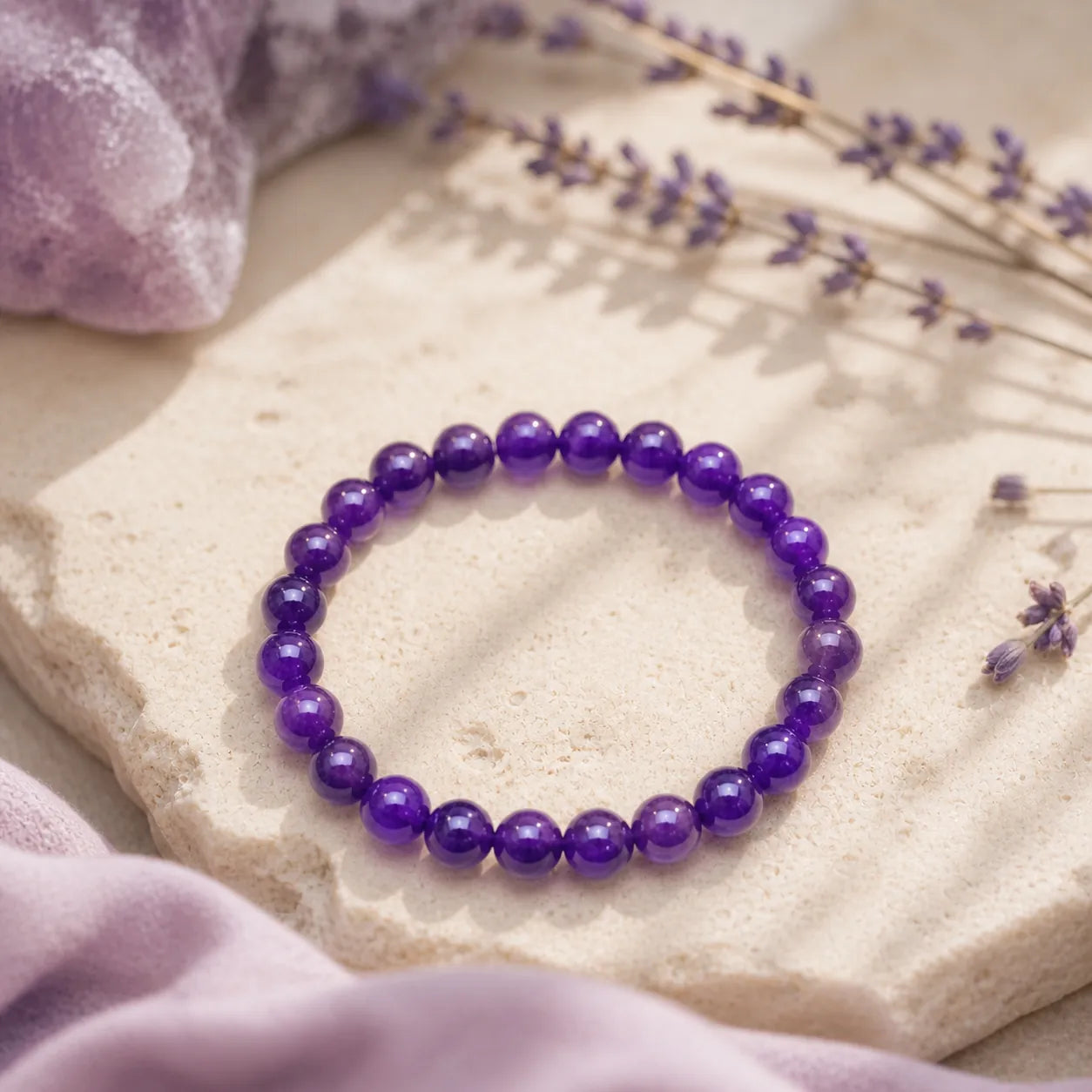
A related intention option
Amethyst Calm Bracelet
This is a related calm, meditation option, not a Selenite product. We only identify jewelry as Selenite when that exact material is verified.
Explore this related optionDusting, Stains, and Humidity Protection
If a stain appears, try a dry cotton swab first. For fingerprints, a barely damp cloth wiped immediately and dried with a second cloth may sometimes work on polished pieces, but this is a judgment call rather than a guaranteed safe step — and repeated damp wiping will eventually dull the surface. Store selenite in a dry cabinet or shelf away from bathrooms, kitchens, and windows that collect condensation. A small silica packet in the display case can help in humid climates.
How to Charge Selenite — Moonlight, Selenite Bowls, and What to Skip
Charging is a spiritual practice, and selenite is often charged by moonlight on a dry windowsill or by placing it on a larger selenite piece. Keep these boundaries in mind:
- Skip: full-moon water bowls, saltwater soaks, and leaving selenite outdoors during rain or heavy dew.
- Careful with: direct sun for long periods — fading is not well documented for gypsum, but heat and rapid temperature shifts are best avoided for soft minerals.
- Good practice: charge overnight, bring the piece back indoors before morning condensation forms, and wipe it dry if you notice any dampness.
Selenite in Water Around the Home — Sprays, Baths, and Selenite Water Safety
Selenite waters and sprays are a common DIY trend, but they need a clear safety distinction. Selenite is gypsum, while the "selenite" in toxicity databases often refers to sodium selenite, a different selenium compound with real toxicological concerns — so do not treat mineral and chemical data as interchangeable. Separately, sodium selenite has been used in environmental applications to reduce mercury in lake water, which is a laboratory and environmental use, not a recommendation for home water treatment.
For practical household use: do not drink selenite water, do not add selenite to bathwater, and do not spray selenite-infused liquid on skin or around pets and children. Mindat's mineral record notes that specimens should be treated with care, and no health-benefit claim for selenite water is supported by verified sources. If you want the visual calm of selenite in a bathroom, display it dry on a shelf away from the shower rather than placing it near the tub.
Frequently Asked Questions
Can selenite go in water?
No. Selenite is gypsum, which is slightly soluble in water, so even short soaks can dull or damage the surface. Clean it dry with a soft cloth instead.
What happens if you put selenite in water — does it really dissolve?
It does not vanish instantly, but water slowly dissolves the gypsum surface, which may leave cloudy patches, pitting, and cracks after repeated exposure.
How do you cleanse selenite without water?
Use sound, smoke, moonlight, a dry salt bed, or a selenite charging plate. All of these support the traditional cleansing practice without moisture.
Sources
- Mindat — Selenite: Mineral information, data and localities
- USGS — Acute Toxicity Database: Sodium Selenite
- USGS Open-File Report 03–018
This article shares mineral care and cultural crystal practices; it is not medical advice. © 2026 Lumina Quartz.