Crystal Meanings: A Complete Guide to Amethyst, Rose Quartz, Citrine & More for Sleep, Stress, and Grounding
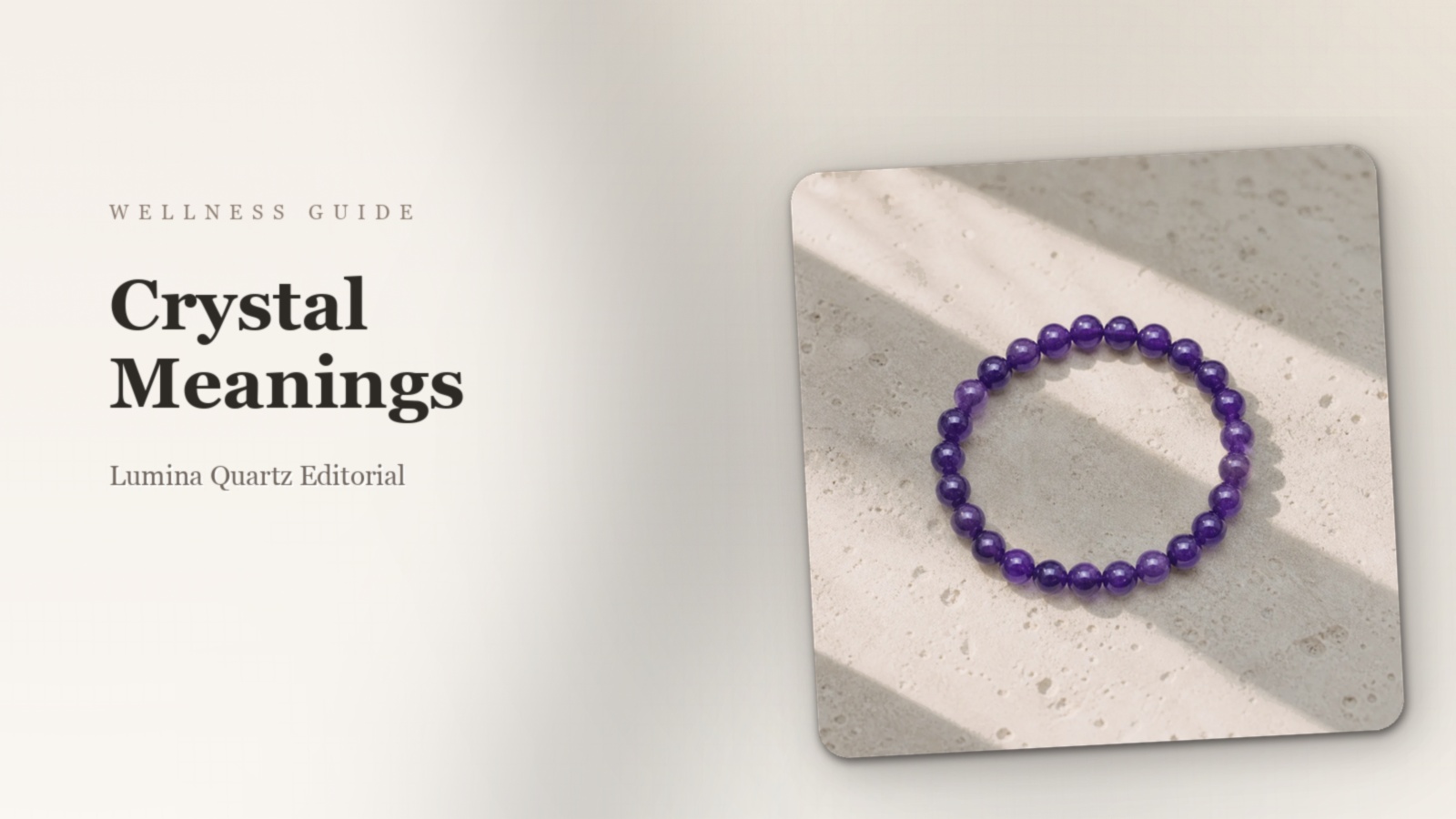
Table of Contents
- Introduction to Crystal Meanings
- What Are Crystal Meanings?
- How to Use This Guide
- Key Takeaways
- Popular Crystals and Their Meanings
- Amethyst
- Rose Quartz
- Clear Quartz
- Citrine
- Black Tourmaline
- Different Crystals and Their Meanings at a Glance
- How to Choose the Right Crystal
- By Intention
- By Chakra
- By Zodiac Sign
- Choosing a Crystal: A Practical Decision Guide
- How to Cleanse and Care for Your Crystals
- Cleansing Methods
- Charging and Programming
- Frequently Asked Questions
- Sources
- Explore Lumina Quartz Collection
Introduction to Crystal Meanings
There is a quiet language spoken in stone — one that has echoed through human hands for thousands of years. Long before the periodic table gave us names for every element, people gathered crystals from riverbeds and mountain crevices, sensing something larger within their quiet weight. Crystal meanings are not rigid rules etched in stone. They are a living, personal conversation between the earth, the stone, and the person who holds it.
People have long turned to crystals for grounding, clarity, and comfort in moments of uncertainty. While stones are not meant to replace medical care or professional guidance, they may support emotional balance, focus, and a deeper connection to the present moment. In this guide, we explore crystal meanings through a gentle lens — honoring both the poetry and the practicality of working with the earth's gifts.
What Are Crystal Meanings?
Crystal meanings refer to the symbolic, energetic, and cultural associations that have grown around specific stones and minerals over centuries. These meanings are not scientifically proven in a strict sense, but they are often associated with particular qualities — such as love, abundance, protection, or clarity — that people find meaningful in their daily lives.
Each crystal's meaning is drawn from a rich tapestry of sources: ancient healing traditions, folklore, color symbolism, and the physical characteristics of the stone itself. A deep purple amethyst, for instance, has long been associated with calm and intuition, perhaps because its color mirrors the twilight sky. A rose-hued quartz, soft as a whisper, has become symbolic of love and compassion. These meanings are far from arbitrary — they are woven from centuries of human experience, observation, and quiet reflection.
There is also a mineralogical story running quietly beneath the symbolic one. Amethyst, citrine, rock crystal, smoky quartz, and rose quartz are all varieties of the same mineral family, quartz — a point noted by the Smithsonian National Museum of Natural History, which also traces our word "crystal" back to the Greek krystallos, meaning "ice." The GIA Gem Encyclopedia catalogues amethyst, citrine, and rose quartz among the recognized gem varieties of quartz. Mineralogists attribute the visual differences among these varieties largely to trace elements, and heating and irradiation experiments have shown how color in amethyst-citrine quartz can be altered. Knowing the science simply gives you a firmer foundation for whatever personal meaning you choose to attach to a stone.
How to Use This Guide
Think of this guide as a quiet conversation, not a manual. There is no single "correct" way to understand crystal meanings, and no stone will resonate the same way for everyone. As you read, notice which stones draw you in. Let your curiosity be your compass, and allow yourself to linger on the ones that speak softly to your heart.
We encourage you to explore the meanings below, reflect on which crystals feel aligned with your intentions, and then allow the stones to simply accompany you in your space. You may find that the true gift of a crystal is not in what it does, but in what it helps you remember about yourself — your resilience, your tenderness, your capacity for stillness.
Key Takeaways
- Crystal meanings are rooted in tradition, intuition, and symbolism — not rigid rules.
- Popular crystals like amethyst, rose quartz, clear quartz, citrine, and black tourmaline each carry distinct associations.
- Other stones such as kyanite, red jasper, sunstone, and fluorite offer gentler, more specific qualities worth exploring.
- Choosing a crystal is a deeply personal process that can be guided by intention, chakra alignment, or zodiac sign.
- Regular cleansing and charging may support a crystal's energetic resonance and your connection to it.
- Crystals may support emotional balance and mindfulness, but they are not substitutes for medical or professional care.
Popular Crystals and Their Meanings
While there are hundreds of stones in the world, a few have become beloved household names in the realm of crystal meanings. Let us walk through the most commonly explored crystals and the qualities they are often associated with.
Amethyst
Amethyst is perhaps the most recognizable of all purple stones. Its color ranges from pale lavender to deep violet, and it has been treasured for centuries as a stone of peace and clarity. Amethyst is often associated with the mind — calming anxious thoughts, encouraging restful sleep, and offering a sense of spiritual protection. Many people choose to keep amethyst on their nightstand or meditate with it in the evening to invite stillness. It may support a clearer, quieter mental space, especially during times of transition or overthinking.
Rose Quartz
If amethyst is the moon, rose quartz is the first blush of dawn. This soft pink stone has become synonymous with love in all its forms — romantic love, self-love, friendship, and compassion. Rose quartz is often associated with the heart, both literally and symbolically. It is a popular stone for those who are healing from heartbreak, deepening relationships, or simply learning to be kinder to themselves. Its gentle energy may support emotional openness and tenderness, reminding us that vulnerability is itself a form of strength. If you would like to keep that reminder close, our Rose Quartz Bracelet – Self-Kindness is designed for everyday wear.
Clear Quartz
Clear quartz is sometimes called the "master healer" in crystal communities — not because it contains any magic, but because it is believed to amplify energy and intention. Its transparent appearance makes it a versatile companion; many people use clear quartz alongside other stones to strengthen the energetic resonance of a space or practice. It is often associated with clarity, focus, and the idea of returning to one's true self. If you are unsure where to begin with crystals, clear quartz is a gentle and accessible choice that can meet you wherever you are.
Citrine
Citrine glows with a warm, sunny gold. It is often associated with abundance, creativity, and personal power. Unlike some stones that are more reflective or calming, citrine carries a bright, activating energy that may support motivation and optimism. Many people place citrine in their workspace or near their front door, welcoming a sense of growth and possibility into their daily lives. It is a stone for dreamers who are also doers — a small reminder that light is allowed to find you, even in the middle of ordinary days.
Black Tourmaline
Black tourmaline is the steady hand on your shoulder. It is one of the most widely used stones for grounding and protection, often described as creating a soft but firm boundary between you and the noise of the world. Many people keep a piece near their front door, on a work desk, or in a bag during busy travel days, simply as a reminder to return to their own center. Rather than dramatic shifts, black tourmaline is associated with quiet steadiness — the kind that helps you stay rooted when plans change or emotions run high.
Different Crystals and Their Meanings at a Glance
Beyond the five best-known stones, there are many different crystals and their meanings that speak to more specific moments in life. These are a few that readers often ask about next.
- Kyanite — often associated with alignment, clear expression, and honest communication. Blue kyanite is a favourite for journaling or difficult conversations, and it is traditionally thought to need less cleansing than most stones.
- Red Jasper — a warm, earthy stone linked to endurance, courage, and steady forward movement. It is often chosen during long projects or seasons that require patience.
- Sunstone — a bright, sparkling stone associated with joy, confidence, and vitality. Where citrine encourages abundance, sunstone tends to be chosen for warmth, self-assurance, and a lighter mood.
- Fluorite — frequently described as a stone of order and clear thinking. Many people keep fluorite on a study desk or near paperwork, using it as a small cue to slow down and focus on one thing at a time.
Notice that these meanings overlap. Fluorite and clear quartz both touch on focus; sunstone and citrine both lean toward brightness and momentum. That is normal. The stones are less like separate departments and more like different voices saying something similar in their own tone — which is exactly why the one you choose matters more than the one that is theoretically "strongest."
How to Choose the Right Crystal
There is no test to pass here. Most people find their stone by noticing which one they keep looking at, or by naming what they need and working backwards from there.
By Intention
Start with the feeling you are reaching for. Rest and quiet evenings often lead people to amethyst. Self-kindness and heart-centred connection tend to lead to rose quartz. Focus and clarity point toward clear quartz or fluorite. Motivation and a brighter outlook draw people to citrine or sunstone, while grounding and steadiness bring them to black tourmaline or red jasper.
By Chakra
In chakra traditions, colours are mapped to energy centres along the body. Purple stones such as amethyst are associated with the crown and third eye, blue stones like kyanite with the throat, green and pink stones including rose quartz with the heart, and black or deep red stones such as black tourmaline and red jasper with the root. If a particular area of your life feels unsettled, you may simply find yourself drawn to its colour.
By Zodiac Sign
Zodiac correspondences are another traditional way to choose. Amethyst is often linked with Pisces and Aquarius, rose quartz with Taurus and Libra, citrine with Leo and Gemini, black tourmaline with Scorpio and Capricorn, and red jasper with Aries. Treat these pairings as gentle suggestions rather than rules — plenty of people work happily with a stone that has nothing to do with their sign.
Choosing a Crystal: A Practical Decision Guide
If you would rather decide by situation than by symbol, this table maps common everyday moments to the stones most often chosen for them, along with a simple way to use each.
| What you are looking for | Crystals often chosen | A gentle way to use it |
|---|---|---|
| Quieter evenings and winding down | Amethyst | Keep on a nightstand or hold during a few slow breaths before bed |
| Being kinder to yourself | Rose quartz | Wear as a bracelet or keep in a pocket as a small daily reminder |
| Focus during study or deep work | Clear quartz, fluorite | Place beside your desk and use it as a cue to return to one task |
| Motivation and a lighter mood | Citrine, sunstone | Keep near a workspace or entryway where you will see it daily |
| Feeling unsteady or scattered | Black tourmaline, red jasper | Carry in a bag or keep by the front door for busy days |
| Saying what you mean clearly | Kyanite | Hold before a conversation or keep near a journal |
A short boundary checklist before you buy
- Crystals are supportive tools for ritual, focus, and reflection — not medical devices.
- No stone can promise a guaranteed outcome, cure, or diagnosis. If a claim sounds absolute, treat it with care.
- For anything involving your physical or mental health, speak with a qualified professional.
- Let your own response be the final test. If a stone feels heavy or distracting rather than settling, it is perfectly fine to pass on it.
How to Cleanse and Care for Your Crystals
Caring for a crystal is less about maintenance and more about ritual — a small, deliberate moment of attention that many people find grounding in itself.
Cleansing Methods
- Moonlight — resting a stone on a windowsill overnight is one of the gentlest methods and safe for nearly every crystal.
- Sound — a singing bowl, chime, or even a few minutes of your favourite calming music.
- Smoke — passing a stone through the smoke of dried herbs or incense, a long-standing tradition.
- Water — good for hard stones like clear quartz, but avoid it for soft or water-soluble minerals such as selenite or malachite.
- Salt — effective but abrasive; dry salt can scratch polished surfaces, so use it sparingly or place the stone in a small dish rather than burying it.
Charging and Programming
Charging simply means giving a stone time in a supportive environment — sunlight, moonlight, or beside a cluster of clear quartz. Programming is the more personal half: holding the stone, naming your intention in a sentence or two, and then letting it go. Keep the intention small and kind. "I would like to be gentler with myself this week" is a more workable intention than an impossible standard, and it keeps the practice honest.
Frequently Asked Questions
What do crystal meanings actually mean?
Crystal meanings are the symbolic and cultural associations that have gathered around particular stones over time, drawn from folklore, colour symbolism, and healing traditions. They are not scientific claims. Many people find them useful as prompts for reflection and ritual — a way of naming what they want to focus on.
Which crystal is best for sleep?
Amethyst is the stone most often kept by the bed, usually on a nightstand rather than under a pillow. Some people also prefer a softer stone such as rose quartz or simply a small, smooth stone they enjoy holding. What matters most is that the stone feels calming to you rather than stimulating.
Can I wear or carry more than one crystal at a time?
Yes, and many people do. Clear quartz is frequently paired with other stones because it is traditionally thought to amplify intention. If you are new to crystals, though, starting with one stone for a few weeks can make it easier to notice how you feel about it.
Do crystals really need to be cleansed?
There is no scientific requirement, but cleansing is a meaningful ritual for many people — a small pause that marks a fresh start. If you enjoy it, cleanse when a stone feels "stale" to you, after a difficult day, or simply on a schedule that suits you, such as each new moon.
How do I know which crystal is right for me?
Start with what you need rather than what is popular. Name the feeling — rest, steadiness, focus, self-kindness — and see which stone you keep returning to. If two options seem equally appealing, choose the one you find more pleasant to look at and hold, since you are the one who will live with it.
Are crystal meanings scientifically proven?
No. The mineralogy of these stones is well documented — quartz varieties and their colouring elements, for example, are studied in detail by gemologists and museums — but the symbolic meanings are a matter of tradition and personal experience rather than established science. Crystals can be a lovely part of a mindful routine, but they are not a substitute for medical or professional care.
Sources
- Mindat — Rose Quartz
- Rose Quartz Care and Cleaning
- Rose Quartz History and Lore
- Artificially Induced Color in Amethyst-Citrine Quartz | Gems & Gemology
The mineralogical details referenced in this guide draw on the following public resources:
- GIA Gem Encyclopedia — Complete List of Gemstones
- Smithsonian National Museum of Natural History — Quartz Gems (var. citrine)
Explore Lumina Quartz Collection
If you would like to keep reading, these companion guides go deeper on individual stones:
- Rose Quartz Crystal: A Gentle Guide to Meaning, Benefits, and Uses
- Black Tourmaline Meaning: Meaning, Properties, and Everyday Uses
- Kyanite Crystal Meaning: A Guide to Benefits, Uses, and Chakra Alignment
- Red Jasper: A Gentle Guide to Meaning, Benefits, and Uses
- Sunstone Meaning: Meaning, Properties, and Everyday Uses
- Fluorite Meaning: Meaning, Properties, and Everyday Uses
Whichever stone you choose, let it be a small, kind companion — something that reminds you to breathe, to slow down, and to return to yourself.