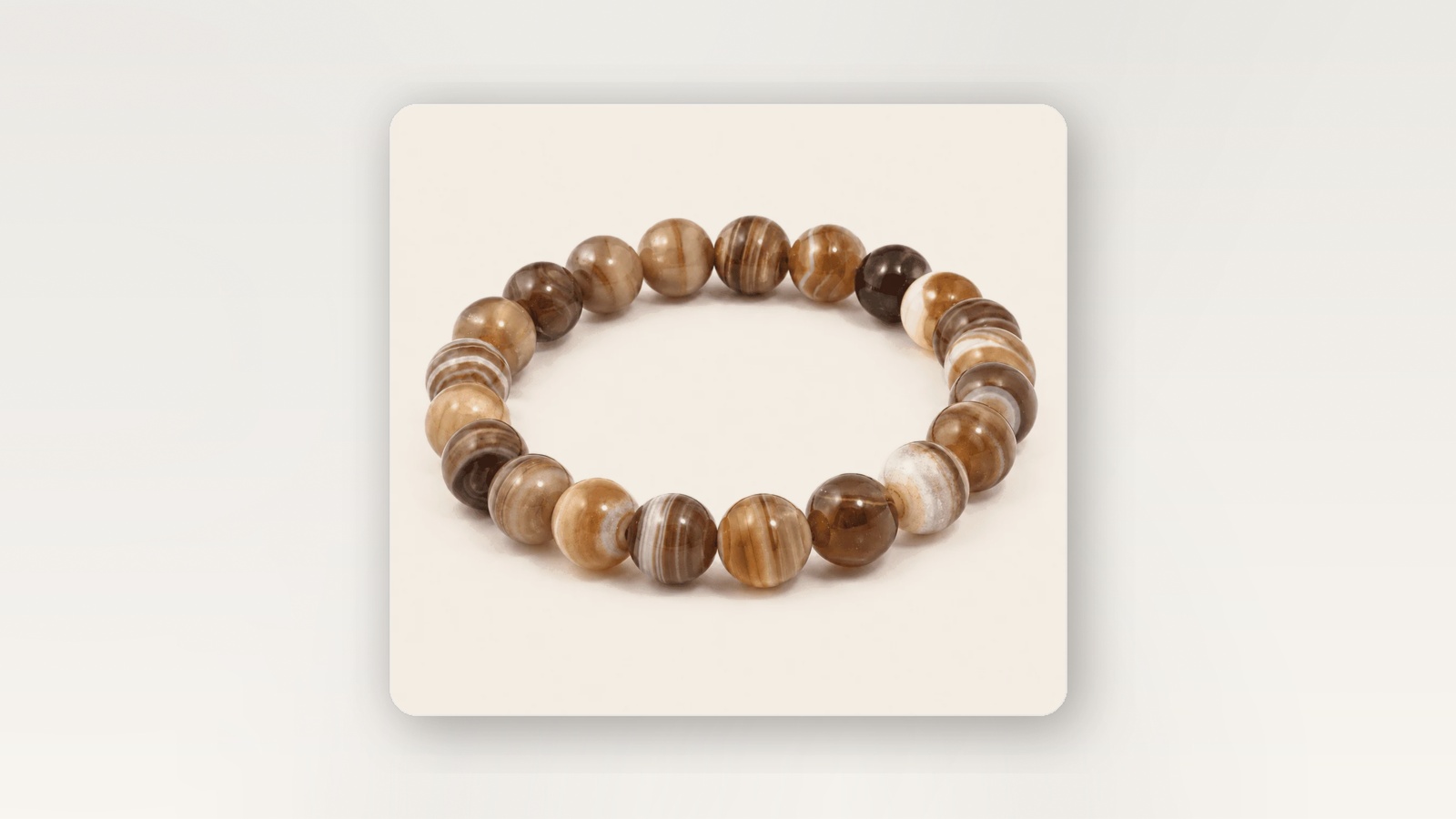
Black agate is a banded chalcedony (microcrystalline quartz, SiO₂) whose deep, opaque-to-translucent black colour comes from dense layering and mineral inclusions rather than from a single pigment. Spiritually it is most often associated with grounding, protection, and calm endurance — a stone of quiet boundaries rather than dramatic change. Geologically it is a variety of agate, and in correct usage "onyx" refers to black-and-white banded agate (hardness 6½–7, specific gravity 2.6–2.65, waxy lustre), which is why black agate and black onyx are so frequently confused. This guide separates verified mineral facts from cultural symbolism, and shows you how to judge, wear, and care for a piece honestly.
10-Second Executive Summary — The Verdict Box
- Direct Verdict: Black agate is a natural banded chalcedony traditionally associated with grounding, protection, and root-chakra symbolism in personal practice. It is not a medical treatment, and "healing" claims are cultural, not clinical.
- Mohs Hardness: 6½–7 (durable enough for daily wear; still scratches softer than quartz at 7).
- Specific Gravity: 2.6–2.65 · Lustre: Waxy · Formula: SiO₂.
- Colour source: Natural banding and inclusions — deep uniform jet-black that is perfectly even is often a sign of dyeing or heat treatment, so verify before buying.
- Best for: Daily grounding wear, meditation anchors, desk or bedside placement.
- Buy standard: Ask for written disclosure of natural rough, no resin-filling, and no irradiation or dyeing — prefer sellers who state these terms explicitly.
What Is Black Agate? Mineral Facts and Formation
Black agate is a variety of chalcedony — the fibrous, microcrystalline form of quartz — formed when silica-rich fluids deposit in layers inside cavities and fissures of volcanic rock. Agate deposits of this type are documented in basalt cavities and interlayer fissures, where siliceous hydrothermal fluid crystallises over long periods (see the GIA Gem News International report on agate formation in basalt). The banding you see is the record of those deposition cycles.
Two physical details matter for buyers. First, agate/onyx sits at Mohs 6½–7 with a waxy lustre and a specific gravity around 2.6–2.65, per the Mindat onyx entry. Second, the terminology is genuinely messy: in correct usage, "onyx" means a black-and-white banded agate, while "black agate" may describe a dark, near-monochrome chalcedony. This overlap is the root of most marketplace confusion, and we return to it in the buyer's guide below.
Black Agate Meaning and Spiritual Symbolism
Grounding, Protection, and the Void
In crystal lore, black agate is often associated with grounding — a symbolic sense of being anchored when everything else feels loud. Its darkness is read as protective: a boundary stone, a "keep your energy yours" talisman. Many traditions link black stones to the void or the womb of the earth — not emptiness as absence, but emptiness as potential, the quiet before something begins.
It is worth being precise here. These are cultural and symbolic meanings, carried through folklore and personal practice. They are not measured properties of the mineral. What some people find practically useful is the ritual itself: holding a specific stone can serve as a reminder, a tactile cue to pause and breathe. That is a personal practice, not a medical effect.
Black Agate and the Root Chakra
Black agate is most commonly connected to the root chakra (Muladhara) — the energy centre traditionally associated with safety, stability, and belonging in chakra-based systems. In that framework, dark stones are placed low on the body or near the feet to encourage a sense of being "held." Whether or not you work within that framework, the root-chakra association explains why black agate is a favourite symbolic companion for people navigating transition, travel, or overstimulation.
Use this as a symbolic map, not a diagnostic one. If you feel persistently ungrounded or anxious, a grounding routine may support calm — but it does not replace rest, support, or professional care.
Healing Properties and Emotional Benefits (With Honest Caveats)
Traditional accounts describe black agate as a stone of steady endurance — often associated with calm in turbulent periods, patience, and the quiet courage to hold a boundary. Practitioners may use it during meditation or journaling as a focal object for reflecting on safety and self-trust.
Honest caveats are essential. There is no reliable research showing that wearing or holding black agate changes mood or relieves any physical or mental health condition. Crystal "healing" is best understood as a contemplative and symbolic practice. If you enjoy it, its value may come from the pause it creates — the moment of attention — rather than from the stone itself. Keep any emotional or physical health concerns with qualified professionals.
How to Use Black Agate Daily: Wear, Meditate, Place
Because black agate is hard enough for daily wear yet soft enough to scratch, a little intention goes a long way. Three simple, repeatable uses:
- Wear: A bracelet, ring, or pendant worn against the skin keeps the stone as a tactile reminder. Choose a setting that protects the surface; avoid stacking it directly against harder stones like diamond or sapphire.
- Meditate: Hold the stone in one hand or rest it on the lower belly. Let its cool, smooth weight be the anchor you return to when the mind drifts — the stone is a cue, the breath is the work.
- Place: Keep a piece on your desk, by the door, or on a bedside tray as a "grounding point." A single stone in a meaningful spot usually works better than a scattered collection, because the association stays clear.
For jewellery, remove it before swimming, showering with harsh soaps, or intense cleaning, and store it separately to limit abrasion.
Is Black Agate Natural or Dyed? A Buyer's Guide
Not every black agate on the market is naturally black. Because chalcedony is porous, dyeing, sugar-and-acid treatment (the traditional method of darkening banded onyx), and heat treatment are all well-documented practices — the Mindat onyx entry describes the historic sugar/sulphuric-acid method used to turn bands black. None of this makes a stone "fake," but it does mean the label should be honest.
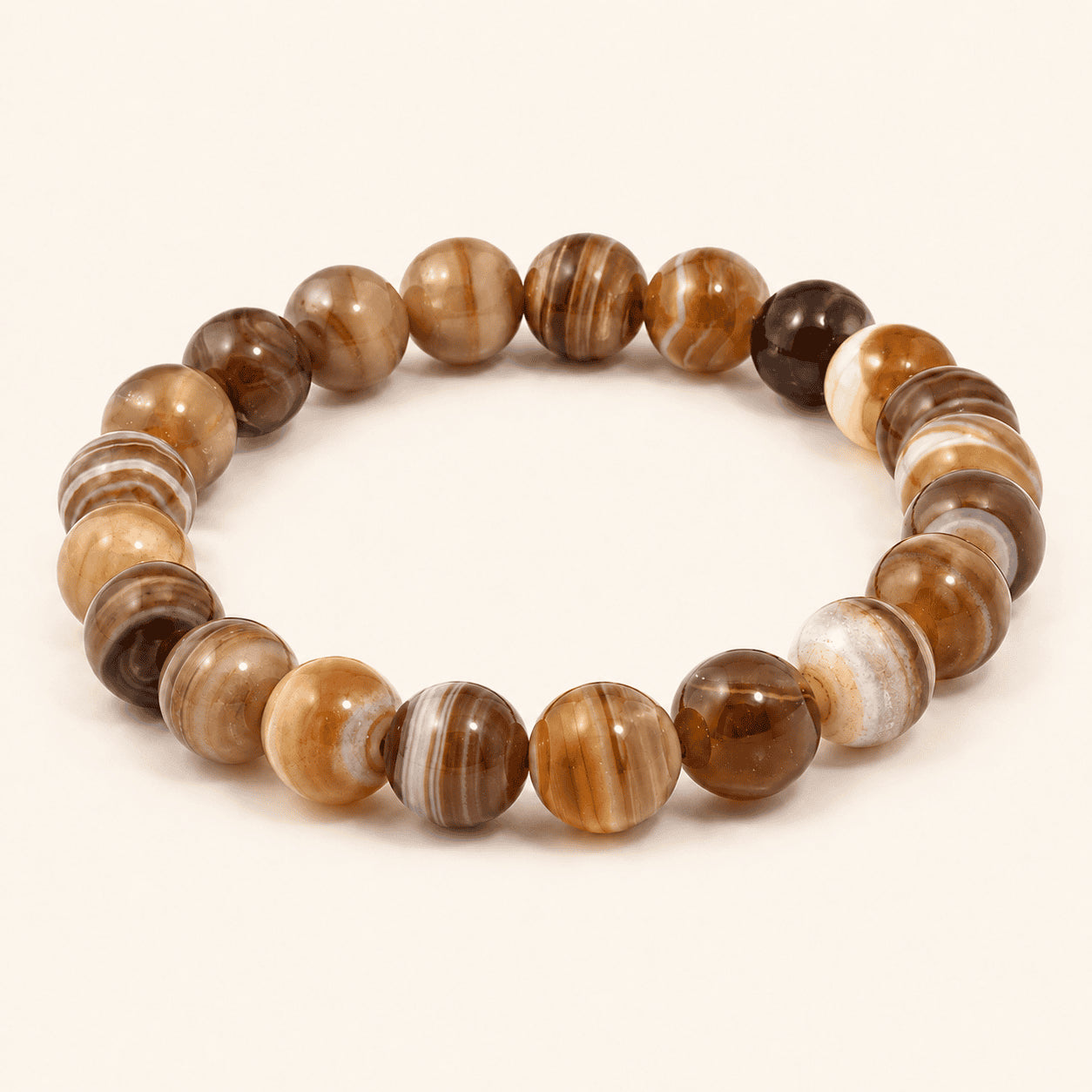
A related stone-family option
Botswana Agate Bracelet – Patient Grounding
This is a related variety in the same stone family, not a Agate product. We only identify jewelry as Agate when that exact material is verified.
Explore this related optionA practical buying approach: ask directly whether the stone is natural, untreated, and unfilled, and expect the answer in writing. Natural pieces typically show uneven depth, faint banding, or subtle tonal shifts rather than a perfectly uniform jet black.
Buyer's Decision Table: Natural Black Agate vs. Treated vs. Look-Alike
| Signal | Natural Black Agate | Treated / Dyed Agate | Banded Calcite "Onyx" |
|---|---|---|---|
| Colour pattern | Uneven depth, faint banding, subtle tonal shifts | Suspiciously uniform jet black, dye pooling in cracks | Bold, high-contrast bands; often carved into objects |
| Hardness | 6½–7 (scratches glass) | 6½–7 (hardness unchanged by dye) | 3 (softer; will not scratch glass) |
| Lustre / weight | Waxy; SG 2.6–2.65 | Waxy; may feel slightly "sealed" | Glassy to dull; noticeably lighter feel |
| Disclosure | Stated as natural, untreated, unfilled | Should state dye/heat; if silent, assume treated | Often mislabelled "onyx"; check origin |
Practical boundary: a hardness test (does it scratch glass?) separates agate from softer calcite imitations, but it cannot detect dyeing. For that, ask for written disclosure — and prefer sellers who state treatment status explicitly.
Black Agate vs. Sulemani Hakik vs. Black Onyx
These three names are frequently used interchangeably, and that is where confusion begins. Black onyx is, in strict usage, black-and-white banded agate; many "black onyx" items are dyed chalcedony. Sulemani Hakik (also spelled Sulaimani Aqeeq) is a South Asian trade name for a dark agate associated with cultural and religious significance — it is a market term, not a distinct mineral species, so its exact identity varies by seller and region. Black agate is the broadest of the three descriptions. Chemically they can all be SiO₂ chalcedony; the difference lies in banding, treatment, and the story attached to the name. Ask for the mineral description, not just the folklore name.
Choosing and Caring for Your Black Agate Piece
Choose for two things: integrity and fit with your life. On integrity, favour pieces sold as natural and untreated with a clear written description, with visible natural variation rather than a flat, synthetic black. On fit, consider how you will use it: a smooth, polished cabochon or bead suits daily wear, while a raw or carved piece may suit a fixed placement on a shelf or altar.
Care is straightforward. Clean with lukewarm water and a soft cloth; avoid ultrasonic cleaners if the stone is dyed, filled, or set with fragile fittings. Keep it away from prolonged heat and direct sunlight, store it in a soft pouch separate from harder gems, and let the stone dry fully before wearing again. A gently cared-for piece will hold its waxy sheen for years.
FAQ: Zodiac Signs, Side Effects, and Common Questions
What does black agate symbolize and what does it mean spiritually?
It is most often associated with grounding, protection, and quiet endurance, and is tied to the root chakra in chakra-based practice. These are cultural and symbolic meanings, not clinically proven effects.
Is black agate natural or dyed, and how can I tell?
Both exist; dyeing and heat treatment are common in the trade. Look for natural tonal variation, ask for written disclosure of treatment status, and treat silence on the label as a sign to ask more questions before buying.
Who should avoid black agate, and is it linked to a zodiac sign?
There is no verified safety reason to avoid it, though some people prefer not to wear stones whose symbolism does not resonate with them. It is popularly linked to Capricorn and Scorpio, but chakra, zodiac, and side-effect claims are tradition, not medicine.
Sources
- GIA — Gem News International (agate formation in basalt, hydrothermal silica deposits)
- Mindat — Onyx (hardness 6½–7, SG 2.6–2.65, formula SiO₂, historic sugar/acid treatment)
© 2026 Lumina Quartz. This article shares mineral facts and cultural symbolism for educational and reflective use. It is not medical advice, and crystal practices should not replace professional care.