Aquamarine Stone Meaning: A Complete Guide to Calm, Communication, and Meditation
Table of Contents
- Introduction: The Meaning of Aquamarine Stone
- What is Aquamarine?
- Key Symbolism of Aquamarine
- Historical and Cultural Significance
- Ancient Beliefs and Sailors' Talisman
- Aquamarine as March Birthstone
- Metaphysical Properties of Aquamarine
- Emotional Healing and Communication
- Aquamarine Stone Spiritual Meaning
- Physical and Spiritual Benefits
- Aquamarine and Chakras
- How to Use Aquamarine Stone
- Wearing Aquamarine Jewelry
- Meditation and Crystal Healing
- Cleansing and Caring for Aquamarine
- Choosing Your Aquamarine: A Practical Guide
- Where to Buy Authentic Aquamarine
- Conclusion: Embrace the Calm of Aquamarine
- Key Takeaways
- FAQ: Aquamarine Stone Meaning
- Sources
There is a quiet wisdom in the color of the sea at dawn — that pale, luminous blue that seems to hold both the sky and the ocean in a single breath. This is the world of aquamarine, a stone that has invited humans for centuries to pause, soften, and listen. In this guide, we wander through its history, its symbols, and its gentle energy, discovering how it may support a life of greater calm, honesty, and inner clarity.
Introduction: The Meaning of Aquamarine Stone
Aquamarine takes its name from the Latin words aqua (water) and mare (sea), and indeed, its color is like a held breath of the ocean — translucent blues and greens that shift quietly with the light. But the aquamarine stone meaning runs deeper than its mineral beauty. For centuries, it has been regarded as a guardian of emotional truth, a companion for honest communication, and a gentle reminder that stillness can be a form of strength.
In a world that often rewards noise and urgency, aquamarine invites us to be like the sea at low tide: grounded, open, and full of depth. It does not ask us to be louder; it asks us to be clearer.
What is Aquamarine?
Aquamarine is a variety of the mineral beryl, the same family that gives us emerald. Its signature color comes from trace amounts of iron, and the finest specimens glow with a crystal-clear blue that has been compared to tropical waters. The Gemological Institute of America describes aquamarine as a light to medium blue variety of beryl, often with subtle green undertones, and rates it at 7.5 to 8 on the Mohs hardness scale — durable enough for regular wear. It is found in several regions around the world, including Brazil, Madagascar, Nigeria, and Afghanistan, and is treasured by gemologists and jewelry lovers alike for its clarity and understated grace.
The name itself has a long history. Mineralogists note that "aquamarine" was used by Italian speakers for blue-green varieties of beryl as early as the mid-seventeenth century, before it became the standard gemological term we recognize today.
Key Symbolism of Aquamarine
The aquamarine stone meaning is multifaceted, but a few central themes recur across cultures and generations. These symbols are not rigid rules; they are threads of intention that weavers have returned to again and again:
- Calm and clarity: Aquamarine is often associated with soothing turbulent emotions and inviting mental stillness.
- Honest communication: It may support open, truthful expression — especially in conversations that require tenderness.
- Courage and protection: Historically, it has served as a talisman for travelers, particularly those who journey across open water.
- Emotional renewal: The stone is linked to releasing old patterns, making space for a quieter and more grounded sense of self.
Historical and Cultural Significance
The story of aquamarine begins long before modern gemology. Ancient Romans believed the stone was the treasure of mermaids, washed ashore from the deep and offered to the human world as a gift of peace. They carved it into amulets to protect sailors on long voyages, trusting in its power to calm the waves and guide ships safely to harbor. Greek sailors, too, carried aquamarine on their journeys, believing that its cool blue essence mirrored the sea's temperament — and that wearing it would keep them harmonized with the ocean's ever-changing moods.
This association with water is not merely poetic. In the symbolic language of many cultures, water is the element of emotion, intuition, and flow. Aquamarine, with its aqueous clarity, naturally became a vessel for those meanings. It was also a stone of marriage and fidelity in some traditions, a quiet reminder that lasting love is often less about grand gestures and more about the steady warmth of presence.
Ancient Beliefs and Sailors' Talisman
For sailors, the aquamarine stone meaning was both practical and sacred. The GIA's educational resource for young gemologists records that in ancient times, sailors wore amulets of aquamarine for protection at sea — a tradition echoed across Mediterranean cultures. A pale blue stone held up to the light was sometimes used to read the sky, with a deepening of color said to suggest approaching weather. Whether that folklore holds water or not, the deeper symbolism remains: aquamarine has always been a stone of trust in the unknown, a small piece of the sea's protection carried close to the skin.
There is something profoundly human about holding a stone that looks like the sea while crossing the actual sea. It is an act of faith, a conversation with the element itself. And that faith — that willingness to move forward without knowing exactly what lies ahead — is one of the most beautiful qualities that aquamarine continues to offer today.
Aquamarine as March Birthstone
Aquamarine is the traditional birthstone for March, as confirmed by the Gemological Institute of America, marking the threshold where winter's quiet gives way to spring's first tender light. For those born in this month, the aquamarine stone meaning often centers on balance — honoring the deep well of feeling within while summoning the courage to move forward with purpose. It is a stone that holds both sensitivity and strength in equal measure.
As a gift, aquamarine has also been offered to celebrate nineteenth wedding anniversaries, its cool blue tones echoing the clarity and trust that deepen over years of shared life. It is a stone of beginnings and continuings, a small beacon of calm in an ever-unfolding story.
Metaphysical Properties of Aquamarine
While the physical properties of aquamarine are well documented by science, its metaphysical associations have been carried forward through meditation traditions, crystal healing practices, and countless quiet moments of personal reflection. As with all such practices, these are symbolic and supportive companions, not a substitute for professional medical or psychological care.
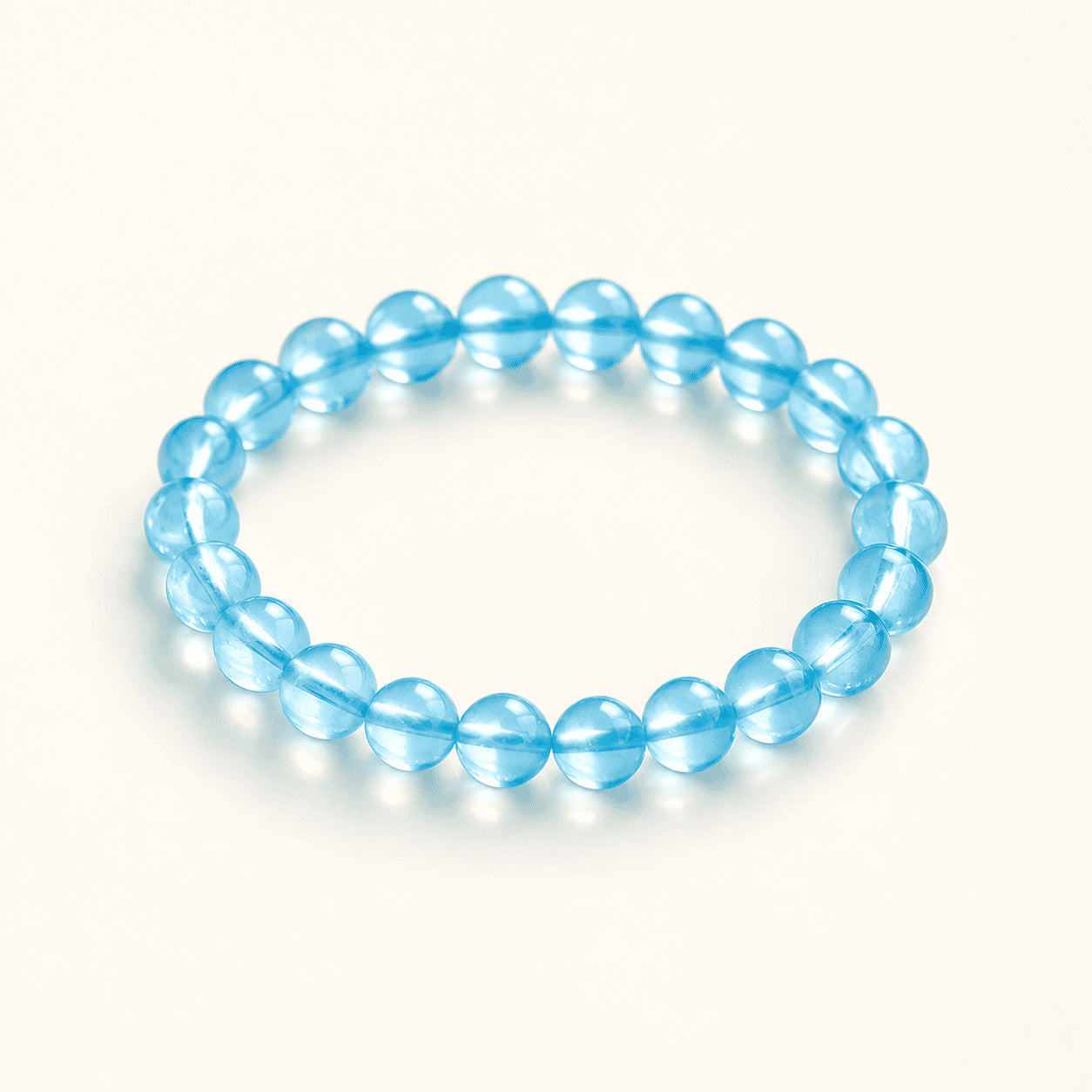
Aquamarine Mindful Bracelet
A quiet bracelet for turning this intention into a small daily ritual.
Shop This Authentic Piece →Emotional Healing and Communication
Aquamarine is perhaps best loved for its resonance with the throat — the place where feelings become words, where truth finds its voice. Those who feel nervous before speaking, who struggle to set boundaries, or who often swallow their words may find aquamarine to be a gentle ally. It may support the courage to speak kindly but clearly, and to listen with equal honesty.
The stone is often associated with the kind of communication that is both tender and true. In relationships, it may encourage partners to navigate difficult conversations without retreating into defensiveness or silence. Its patient energy is said to foster mutual understanding, reminding us that listening is just as sacred as speaking.
Aquamarine Stone Spiritual Meaning
The aquamarine stone spiritual meaning is rooted in water: the element of intuition, flow, and emotional truth. Across meditation traditions, the stone is treated as a doorway to the inner tide — a way of noticing what rises and falls within us without being swept away by it. Where some crystals are associated with fire and momentum, aquamarine carries a cooler, more contemplative current.
In spiritual practice, aquamarine is often connected with three themes:
- Inner truth: It is associated with the willingness to see yourself honestly, without harshness. Many people use it during journaling or quiet reflection, when the aim is clarity rather than judgment.
- Spiritual clarity: Because its blue tones are linked with the upper chakras, it is often used to quiet mental chatter so that intuition can be heard more easily.
- Trust and surrender: Its long history as a traveler's stone gives it a spiritual meaning of trusting the journey — moving forward with faith rather than certainty.
None of this requires belief in anything specific. For many, the aquamarine stone spiritual meaning is simply a reminder to slow down, breathe, and let the deeper self speak. That alone can be a meaningful practice.
Physical and Spiritual Benefits
In crystal lore, aquamarine is described as a cooling, harmonizing presence. Practitioners often associate it with a sense of steadiness during stressful seasons, with clearer thinking when the mind feels crowded, and with the emotional release that comes from finally saying what has been held back. Others simply appreciate it as a calming focal point — something to hold during a difficult conversation or a restless night.
It is worth saying plainly: these are traditional associations and personal experiences, not medical outcomes. Aquamarine is a beautiful companion for reflection, but it does not replace rest, therapy, or professional care when those are needed.
Aquamarine and Chakras
In chakra-based practice, aquamarine is most often linked with the throat chakra, the center of expression, truth, and authentic voice. A balanced throat chakra is described as the ability to speak with kindness and to listen without defensiveness — qualities that mirror aquamarine's gentle reputation.
Some also connect the stone with the third eye, where its clarity is said to support intuition and inner vision, and with the heart, where its watery softness resonates with compassion. If you work with chakras, aquamarine is a natural fit for any practice centered on honest expression or quiet insight.
How to Use Aquamarine Stone
Wearing Aquamarine Jewelry
Because of its hardness, aquamarine is a favorite for everyday jewelry — particularly rings, pendants, and earrings. A pendant resting near the throat is a common choice for those drawn to its communication symbolism, while a ring or bracelet keeps the stone within easy reach throughout the day. Many people find that simply knowing it is there creates a small pause before speaking, a moment that can change the tone of an entire conversation.
Meditation and Crystal Healing
Aquamarine lends itself beautifully to quiet practice. Try holding a tumbled stone in your palm, or resting it nearby, and spending five to ten minutes with slow, even breathing. Some prefer to place it gently near the throat or heart while lying down, though any comfortable position works just as well. If you keep a small crystal selection at home, you can pair it with kyanite for throat-centered work or fluorite when the focus is mental clarity.
There is no single correct way to work with the stone. The intention you bring to the moment matters far more than the technique.
Cleansing and Caring for Aquamarine
Aquamarine is relatively sturdy, but it is still a gemstone and deserves gentle handling. To keep it feeling clear:
- Rinse and rest: A brief rinse in lukewarm water, then a soft cloth dry, is often enough.
- Use sound or moonlight: Many people prefer non-water methods, such as a singing bowl, a bell, or a night under the moon.
- Skip harsh chemicals: Avoid ultrasonic cleaners, steam, and household cleaners, which can dull the surface over time.
- Store separately: Keep it apart from harder stones so it does not get scratched.
Choosing Your Aquamarine: A Practical Guide
Aquamarine appears in many forms, and the right one depends entirely on how you intend to use it. This quick guide can help you decide.
Match the form to your intention
- Raw or specimen piece: Best for a bedside or altar space, where you want a visual anchor for calm and reflection.
- Tumbled stone: Best for holding during meditation, breathing exercises, or a difficult conversation. Comfortable, portable, and easy to care for.
- Palm stone: Best if you like something substantial to rest in your hand during longer quiet sessions.
- Pendant: Best for all-day wear, especially if your focus is honest communication — the stone sits near the throat.
- Ring or bracelet: Best for a subtle, constant reminder that travels with you.
- Earrings: A gentle option for those who prefer their stone not to be touched or handled during the day.
A gentle boundary guide
- Choose aquamarine for reflection, ritual, and emotional companionship — not as a treatment for any health condition.
- Let the stone support a practice you already have: breathing, journaling, meditation, or honest conversation.
- If you are navigating grief, anxiety, or a difficult relationship, pair the stone with real support from people or professionals.
- Trust your own response. If a particular piece feels heavy or simply does not appeal to you, it is fine to choose another.
How do I know if a piece is genuinely aquamarine?
Aquamarine is a blue to blue-green beryl with a glassy luster, and it is typically eye-clean with few inclusions. Very pale stones can resemble blue topaz or even glass, so buy from a seller who lists the stone's origin and treatment, and who is clear about what you are receiving. Hardness of 7.5 to 8 means it should resist scratching in everyday wear.
Where to Buy Authentic Aquamarine
Because its pale tones vary so much, aquamarine rewards a careful eye. Look for sellers who disclose the stone's origin, whether it has been heat-treated (a common and accepted practice), and its clarity. Photographs taken in natural light will give you the truest sense of color. When you are ready, you can browse our aquamarine selection to find a piece that feels like the right companion for where you are now.
Conclusion: Embrace the Calm of Aquamarine
Aquamarine does not shout. It does not demand attention or promise transformation in a single moment. What it offers is quieter and, in many ways, more useful: a reminder that clarity and calm are available to us in any breath, and that speaking honestly is a form of courage worth practicing.
Whether you wear it, hold it during meditation, or simply keep it near, let it serve as a small invitation — to slow down, to listen to yourself, and to let your words come from a place of truth rather than reaction. Like the sea at dawn, the aquamarine stone meaning is ultimately about depth that does not need to announce itself.
Key Takeaways
- Aquamarine is a blue to blue-green variety of beryl, named from the Latin for "water of the sea."
- It is the official birthstone for March and a traditional gift for nineteenth wedding anniversaries.
- Its core symbolism includes calm, honest communication, protection for travelers, and emotional renewal.
- The aquamarine stone spiritual meaning centers on inner truth, intuition, and trust in the unknown.
- It is most often linked with the throat chakra, and also associated with the third eye and heart.
- Because of its 7.5–8 hardness, it works well in everyday jewelry with simple, gentle care.
FAQ: Aquamarine Stone Meaning
What does the aquamarine stone symbolize?
Aquamarine most often symbolizes calm, clarity, and honest communication. Its oceanic color links it with emotional steadiness and flow, while its long history as a sailor's amulet gives it associations with protection and courage during uncertainty. Many people also see it as a symbol of renewal — the feeling of releasing what no longer fits and making room for something quieter.
What is the aquamarine stone meaning in relationships?
In relationships, aquamarine is traditionally associated with truthfulness and patience. It is often described as a stone that supports difficult conversations without defensiveness, and it was historically linked with fidelity and lasting partnership. Rather than heightening passion, its energy is gentler: encouraging partners to listen well and speak kindly.
How to use aquamarine stone for its benefits?
The simplest approach is also the most effective. Wear it as jewelry if you want a constant, subtle reminder near the throat. If you prefer a quiet practice, hold a tumbled stone during a few minutes of slow breathing, or keep one beside your journal. Some people place it near the throat or heart during meditation. Whatever you choose, set a clear intention and return to it regularly — the ritual itself is what tends to matter most.
Do I need to charge aquamarine before using it?
Some people like to "charge" a new stone by leaving it in moonlight overnight or holding it during a few minutes of quiet intention. There is no required method, and nothing will go wrong if you skip this step. Think of it as a way of marking a beginning rather than a rule to follow.
Sources
- GIA — Aquamarine History and Lore
- GIA GemKids — Aquamarine
- Mindat — Aquamarine: Mineral information, data and localities
- GIA 4Cs — The Beauty of Blue Diamonds (aquamarine color and hardness reference)
Continue exploring with our gentle guides to rose quartz, black tourmaline, and sunstone.
A quiet piece for carrying this ritual into the day.
Explore Aquamarine Mindful Bracelet — Lumina Quartz →