Agate Metaphysical: Meaning, Healing Properties, and Daily Benefits

Table of Contents
- 10-Second Executive Summary / The Verdict Box
- What Is Agate? Geology, Formation, and Why Its Bands Matter
- Agate Metaphysical Properties: Stability, Harmony, and Grounding Energy
- Agate and the Chakras: How Color Changes the Energy
- Blue Lace Agate (Throat)
- Moss Agate (Heart)
- Black and Botswana Agate (Root and Calm)
- Agate Selection Checklist: Match the Stone to the Intention
- Emotional and Spiritual Benefits: Inner Peace, Confidence, and Release
- Physical and Everyday Benefits: Focus, Vitality, and Protection
- Types of Agate and Their Unique Meanings
- How to Work With Agate Daily: Wearing, Meditating, and Crystal Grids
- Frequently Asked Questions About Agate
- What are agate's metaphysical properties and what does agate mean spiritually?
- Which chakra is agate associated with, and does it change by color?
- How do you cleanse, charge, and wear agate in daily life?
- Sources
Agate's metaphysical properties are traditionally described as stability, harmony, and gentle grounding — and because agate is a banded form of chalcedony (microcrystalline quartz), its physical hardness of 6.5–7 on the Mohs scale makes it one of the most wearable stones in a daily practice. Its meaning in crystal lore is built directly on that structure: layered bands read as layered balance, and each color variety is often associated with a different kind of calm.
10-Second Executive Summary / The Verdict Box
- Direct Verdict: Agate is a grounding, harmonizing stone often associated with emotional steadiness, patience, and protection. It is a supportive everyday stone rather than a dramatic "high-energy" crystal.
- Mineralogy: Banded chalcedony (microcrystalline quartz); Mohs hardness 6.5–7; relatively tough but still vulnerable to sharp impact and prolonged heat.
- Chakra Logic: Agate's chakra association follows color — blue lace agate with the throat, moss agate with the heart, black and Botswana agate with the root and calm.
- Best Use Cases: Daily wear as a pocket or pendant stone, slow breath-focused meditation, grounding crystal grids, and boundary-setting rituals.
- Quality Marker: Look for natural banding, cool-to-the-touch surface, and no dye pooling in cracks — the core checks of the Lumina Grade AAA Integrity Standard.
What Is Agate? Geology, Formation, and Why Its Bands Matter
Agate is a banded variety of chalcedony, which is itself a form of microcrystalline quartz. It forms when silica-rich water deposits layer after layer inside cavities in host rock, often volcanic, so the stone records its own history in visible bands. Verified agate localities include the Ashburton River area of Canterbury, New Zealand, as catalogued on Mindat, and similar banded agates occur in volcanic regions worldwide.
Those bands matter metaphysically for a simple structural reason: agate is a stone of layers, and crystal traditions read layers as balance. Where a single-point quartz is treated as an amplifier, agate is treated as a stabilizer — it is often described as "quiet" energy, the kind that holds a space rather than fills it. The fine-grained structure also explains its durability: at Mohs 6.5–7, agate resists scratching better than most ornamental stones, which is why it has been carved into beads, seals, and talismans for millennia.
In short, agate's geology and its symbolism reinforce each other. The banding is not decoration added to the meaning; it is the meaning in mineral form.
Agate Metaphysical Properties: Stability, Harmony, and Grounding Energy
In crystal and metaphysical traditions, agate is most often associated with stability, harmony, and grounding. These are commonly framed as:
- Stability: a steadying presence during change or transition, often used as a reminder to move at a sustainable pace.
- Harmony: balancing opposing pulls — work and rest, logic and intuition — which is why banded stones are frequently described as "balancing" stones.
- Grounding: a physical, earthy quality that many people find supportive in meditation or journaling, especially when the mind feels scattered.
- Protection (traditional): agate appears in protective amulet traditions across cultures; this is cultural symbolism, not a physical effect.
It is worth being honest here: these are traditional and symbolic associations, not clinical claims. Agate may support a sense of calm through ritual and intention, but it does not regulate the nervous system or treat any condition. What agate offers is a tangible anchor — something cool, solid, and patterned to return your attention to.
One practical nuance: agate is often described as a "slow" stone compared with high-energy crystals. If your practice favors intensity, agate is best used as the base layer — the stone you keep in your pocket while the louder crystals do their work — rather than the centerpiece of an activation ritual.
Agate and the Chakras: How Color Changes the Energy
Yes, agate's chakra association changes by color, and this is one of the most consistent patterns in crystal literature. The common mapping is color-first: the stone's hue is matched to the chakra associated with that color.
Blue Lace Agate (Throat)
Pale blue with fine white lace banding, blue lace agate is traditionally associated with the throat chakra and with clear, gentle communication. It is often chosen by people who want to speak more calmly rather than more loudly — a "soft voice" stone rather than a confrontation stone.
Moss Agate (Heart)
Moss agate is technically a chalcedony with green inclusions rather than a true banded agate, but it is sold and used alongside agate. Its green, plant-like patterns connect it to the heart chakra and to themes of growth, patience, and connection with nature. It is a favorite for slow, seasonal intentions rather than urgent goals.
Black and Botswana Agate (Root and Calm)
Black agate and Botswana agate — the latter with its tight grey-and-white banding — are most often linked to the root chakra and to calm, steady protection. In practice, this is the pair people reach for when they want a stone that feels like a floor under their feet: less about opening and more about holding.
Agate Selection Checklist: Match the Stone to the Intention
Use this as a step-by-step buying and use checklist rather than a color-preference guide. Each line turns the metaphysical theme into a concrete decision.
- Define the intention first. Communication, growth, or stability? That determines the color family before you look at a single stone.
- Match color to chakra only after the intention fits. Blue lace for throat-focused communication; moss for heart-centered growth; black or Botswana for root-level steadiness.
- Judge natural banding. Genuine agate bands are irregular, follow contours, and differ from layer to layer. Perfectly uniform bands are a reason to slow down and inspect.
- Check for dye pooling in cracks. Color that concentrates along fractures rather than within the banding is a common sign of dyeing — outside the natural-stone baseline of the Lumina Grade AAA Integrity Standard.
- Apply the Lumina Grade AAA Integrity Standard baseline. Choose natural rough-stone character, no chemical resin filling, and no irradiation or dye treatment when selecting for metaphysical use — a treated stone is still beautiful, but it is not the material the traditions describe.
- Handle before you commit. Agate should feel cool and weighty in the hand. Light, plasticky, or overly glassy stones often signal treatment or a different material.
Boundary note: If a seller promises specific emotional or health outcomes, treat that as marketing, not metaphysics. Agate's role is symbolic and ritual; the intention and the routine are the active ingredients.
Emotional and Spiritual Benefits: Inner Peace, Confidence, and Release
In traditional crystal work, agate is often associated with three emotional themes:
- Inner peace: the banded structure is read as a model of balance, supporting quiet reflection and slower breathing during meditation.
- Confidence: agate appears in courage and stability lore across cultures; many people use it as a reminder to proceed steadily rather than prove themselves. It may support a sense of being grounded enough to speak or act.
- Release: working with agate is often paired with journaling or gentle ritual — holding the stone while naming what you are ready to let go of. The stone is a physical cue for the release, not the cause of it.
Spiritually, agate is often described as a stone of continuity — it holds history in its bands, and that makes it useful for reflection practices, seasonal transitions, and moments when you want to feel connected to something older than the current stress. If you keep a single stone over time, agate's durable structure means it will quietly survive daily handling and become a genuine object of memory.
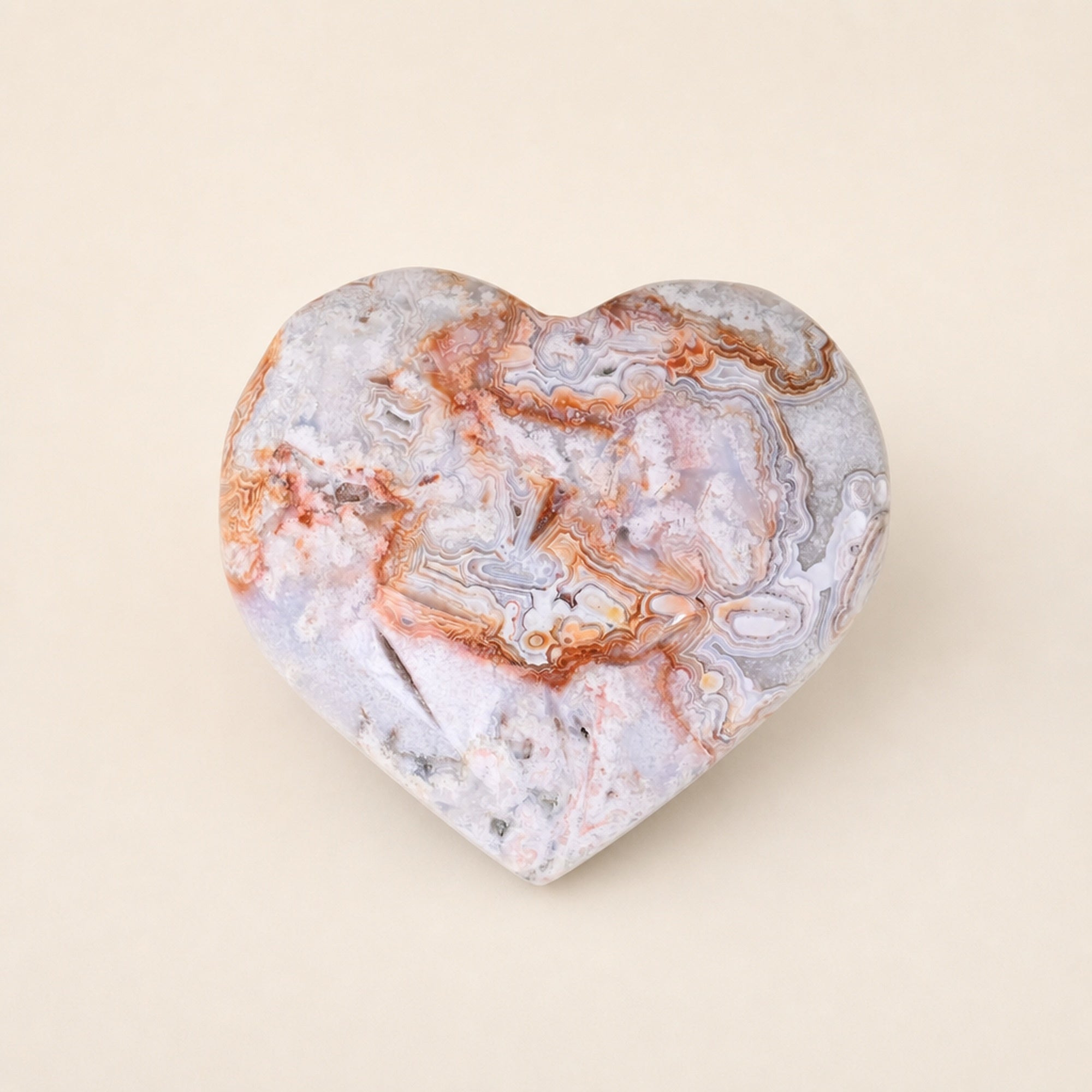
A related stone-family option
Crazy Lace Agate Heart Stone – Joyful Movement
This is a related variety in the same stone family, not a Agate product. We only identify jewelry as Agate when that exact material is verified.
Explore this related optionPhysical and Everyday Benefits: Focus, Vitality, and Protection
On a practical level, agate's everyday benefits are best understood as ritual benefits supported by its physical properties. Its hardness (Mohs 6.5–7) means it tolerates daily wear, which makes it one of the few stones you can genuinely keep in a pocket or wear close to the skin without constant worry. That constancy is the point: a grounding stone only "works" as a reminder if it stays with you.
Common everyday uses include:
- Focus: placing a small agate on a desk as a tactile reset cue between tasks.
- Vitality (traditional): agate is often associated with gentle energy and endurance in crystal lore; treat this as symbolic encouragement, not a health claim.
- Protection (traditional): a pocket stone used as a boundary reminder before difficult conversations. The metaphor is a shield; the actual benefit is the pause it creates.
Care matters too: despite its hardness, agate can chip on sharp impact and may fade under prolonged direct heat or strong sunlight. Store it away from harder stones such as corundum, and clean it with mild soap and water — ultrasonic cleaners are generally not recommended for treated stones.
Types of Agate and Their Unique Meanings
Agate varieties are easiest to remember by color family and pattern, and their meanings follow that structure:
- Blue lace agate: throat chakra; gentle communication and calm self-expression.
- Moss agate: heart chakra; growth, patience, and nature connection (technically a green chalcedony, not a banded agate, but used alongside agate).
- Dendritic agate: named for tree-like fern inclusions; traditionally associated with grounded growth and quiet resilience.
- Fire agate: iridescent peacock tones from thin mineral layers; linked to vitality, motivation, and "warm" energy — the most active member of the family.
- Botswana agate: fine grey banding; calm, root-linked steadiness and patience in slow change.
- Black agate: root chakra; protection and boundary themes.
The practical difference between them is largely one of temperament: fire agate for forward motion, blue lace for expression, moss for growth, and black or Botswana for stability. Buying by pattern preference is fine — color is part of the practice — but buy by intention if you want the stone to do a specific job in your routine.
How to Work With Agate Daily: Wearing, Meditating, and Crystal Grids
Agate is one of the easiest stones to integrate into daily life because it is stable, silent, and durable. Three workable methods:
- Wear it. A pendant, bracelet, or pocket stone keeps agate close to the skin as a continuous reminder. Pair the choice with your intention: blue lace near the throat, moss near the heart, black or Botswana for grounding.
- Meditate with it. Hold a smooth agate in the palm, breathe slowly, and use the banding as a resting point for attention — tracing the layers works well for busy minds. Five minutes is enough; agate rewards consistency more than duration.
- Use it in crystal grids. Because agate is a stabilizing stone, place it at the outer or "anchor" positions of a grid and let more active stones sit in the center. For a simple grounding grid, arrange four small agates in a square around your intention stone.
For cleansing and charging, gentle methods suit agate best: moonlight, sound, or brief contact with selenite or clear quartz. Avoid long sun exposure for dyed or heat-sensitive stones. When in doubt, keep the routine simple — a stone that is cared for is also a stone that stays meaningful.
Frequently Asked Questions About Agate
What are agate's metaphysical properties and what does agate mean spiritually?
Traditionally, agate is associated with stability, harmony, grounding, and gentle protection. Spiritually it is often treated as a stone of continuity and balance — layered like its bands — rather than a high-energy catalyst.
Which chakra is agate associated with, and does it change by color?
Yes. Agate's chakra association follows color: blue lace agate with the throat, moss agate with the heart, and black or Botswana agate with the root. The general rule is to match the stone's hue to the chakra linked with that color.
How do you cleanse, charge, and wear agate in daily life?
Use gentle methods such as moonlight, sound, or contact with clear quartz, and avoid prolonged direct heat. Wear agate as a pendant, bracelet, or pocket stone, and cleanse it when the stone feels "flat" to you or after a period of intense use.
This article presents agate's metaphysical properties as traditional and symbolic associations. It is not medical advice, and crystal use is not a substitute for professional care. © 2026 Lumina Quartz. All rights reserved.